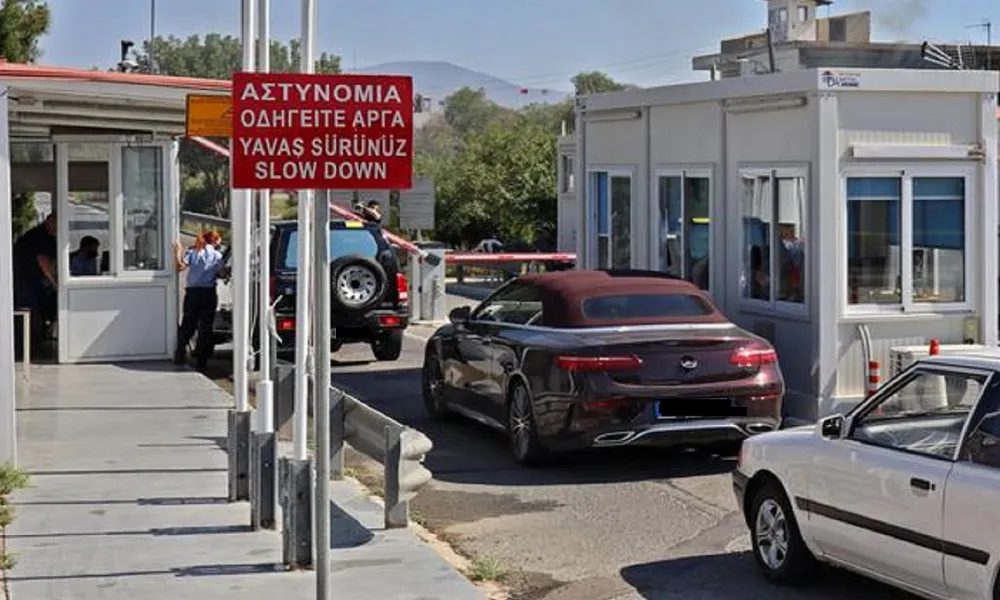

More than 190 million crossings have been recorded at Cyprus checkpoints between April 2003 and March 2026, according to data analysed by Turkish Cypriot journalist Cenk Mutluyakalı, published in the Turkish Cypriot daily Yeni Düzen.
As previously reported, worsening economic conditions in the north – marked by steadily rising inflation and high consumer prices across the board – have pushed Turkish Cypriots to travel to the government-controlled areas not only for shopping, but for other purposes as well. The newly released data reflect this trend.
According to the figures, which Mutluyakalı says were obtained from the “general police directorate” in the north, total recorded movement reached 190,281,960 crossings since the checkpoints opened on April 23, 2003 and until March 2026. Of these, about 95.9 million were entries and 94.3 million were exits.
“For long periods, entry and exit figures have been almost identical, despite population differences. Naturally, roughly three times as many people live in the south of the island. In contrast, we unfortunately do not even know the population figure in the north. Leaving population aside, there is an administration unable to clearly state how many ‘citizens’ it has,” writes Mutluyakalı.
The data covering checkpoint crossings from 2003 to 2026 highlight a reality that is difficult to ignore. Despite the political deadlock over the Cyprus problem, movement between the two sides has not declined. On the contrary, it has increased to the point where it is now considered part of everyday life. From about 4.5 million crossings in 2003, annual figures have surged to nearly 15 million in recent years, pushing overall movement above 190 million.
For a long period, crossings showed a steady, though modest, predominance towards the north. Data from 2003, 2004, 2019, 2024 and 2025 indicate higher movement in that direction during those years.
The most recent figures are of particular interest. In the first quarter of 2026, for the first time, a clear increase was recorded in crossings towards the Republic of Cyprus, with 1,404,608 crossings, compared with 1,400,480 towards the north.
Economic pressures
As highlighted in earlier reports, the deteriorating economic situation in the north – with inflation continuing to rise and consumer prices remaining high – has effectively forced many Turkish Cypriots to cross into the government-controlled areas, especially for shopping. This shift is clearly reflected in the data now published.
At the same time, differences emerge by community. Based on 2025 figures, crossings towards the north fell by about 300,000 per year, while a corresponding increase was recorded in movements towards the government-controlled areas.
It should also be noted that the available data captures only the overall volume of crossings, not their composition. They do not distinguish between Turkish Cypriots, Greek Cypriots, or tourists.
Sustained movement
With more than 190 million crossings recorded over two decades, the figures point to sustained and extensive movement between the two sides, illustrating a reality of growing social interaction that continues regardless of political developments.
As highlighted in the Yeni Düzen article, the rise from roughly 4.5 million entry and exit crossings in 2003 to around 15 million annually today reflects a social dynamic that goes beyond the political stalemate.
“If leaders abandoned their attachment to self-declared ‘sacred’ positions, focused on equality based on citizenship rights in a new and united Cyprus, and if the divisive role of the guarantor powers were removed, these figures could crown a political solution.
“Perhaps then younger generations would breathe in one of the most prosperous environments in the Eastern Mediterranean. Cyprus’ social body has already largely unified, while its political and military mind remains divided,” notes Mutluyakalı.
He concludes: “190 million crossings say one simple thing: ‘We need each other.’ What more is there to add?”