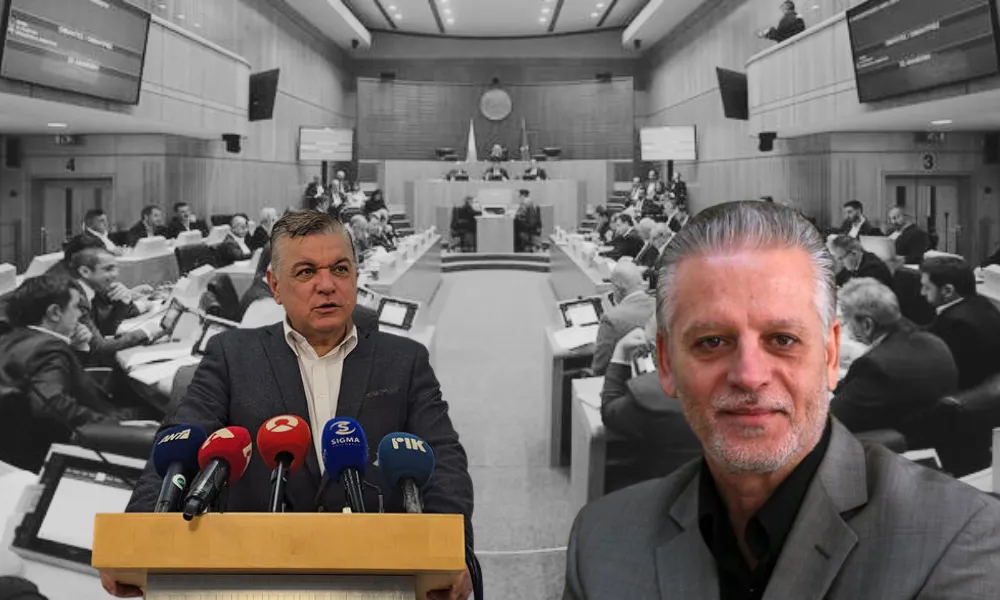
The criminal investigations involving MPs Nikos Sykas and Marinos Sizopoulos once again expose how urgent it is to restrict parliamentary immunity strictly to the exercise of parliamentary duties. The blanket immunity MPs scandalously enjoy today, even for criminally punishable acts, offends public sentiment.
Over the past four months, the issue of lifting the immunity of two MPs has arisen, as they are considered suspects in serious criminal offences. EDEK MP Marinos Sizopoulos is under investigation for corruption, while DISY MP Nikos Sykas is being investigated for domestic violence. To this day, neither MP has given a statement to investigators, as both are shielded by parliamentary immunity.
Although ordinary citizens consider it self-evident that parliamentary immunity cannot protect MPs from criminal conduct, this is precisely what happens. Worse still, MPs themselves have deliberately and systematically avoided, since January 2021, discussing the Ministry of Justice bill that would limit the general immunity they currently enjoy, confining it solely to the exercise of their parliamentary duties.
General immunity
Parliamentary immunity is regulated by Article 83 of the Constitution. It provides, in essence, that MPs are not subject to criminal prosecution and bear no civil liability for opinions expressed or votes cast in the House of Representatives. An MP cannot, without the permission of the Supreme Court, be prosecuted, arrested, or imprisoned while in office, unless caught in flagrante delicto for an offence carrying a prison sentence of five years or more. If permission is denied, the period during which prosecution is barred does not count towards limitation periods, and enforcement of any custodial sentence is suspended until the MP ceases to hold office.
If the Attorney General does not consent…
It is therefore clear that, under Article 83, without the consent of the Attorney General and subsequently the judges of the Supreme Court of Cyprus, an MP cannot be investigated, prosecuted, or imprisoned, unless caught in the act committing a serious offence punishable by five years’ imprisonment or more.
In the past, there was a case in which former Attorney General Kostas Clerides refused to initiate procedures to lift the immunity of then DISY MP and current Commissioner for Agricultural Payments Andreas Kyprianou, despite potential criminal offences.
Kyprianou was accused of acting vindictively and coercively by attempting to photograph the underwear of AKEL MP Irene Charalambidou with his mobile phone, allegedly trying to place it under her skirt, while calling her a derogatory slur, according to her complaint. The incident took place in Parliament after Charalambidou attempted to photograph Kyprianou and other MPs smoking inside a parliamentary chamber, in violation of the law banning smoking in enclosed spaces.
The former Attorney General ruled that the offence of indecent assault was not sufficiently established in law and that the public interest would not be served by submitting a request to lift Kyprianou’s immunity in relation to mutual insults. Instead, he instructed that out-of-court fines be imposed on the MPs who had been smoking inside Parliament.
Efforts stalled since 2016
Limiting MPs’ immunity strictly to the exercise of their duties was an electoral commitment of former President Nicos Anastasiades from his first term. The relevant bill was eventually submitted to Parliament on 2 March 2016, on the eve of parliamentary elections. It was first discussed by the House Legal Affairs Committee in October 2019, more than three years later, raising concerns as to whether immunity should be limited solely to freedom of vote and expression, or also cover statements made by MPs when exercising opposition criticism.
The bill was withdrawn by letter from Justice Minister Emily Yiolitis on 16 November 2020, in order to be re-examined. Following further study and consultations with the Attorney General, a revised bill was prepared and submitted to Parliament on 14 January 2021. This version also covers any statement or act carried out by MPs in the exercise of their parliamentary duties.
The bill, titled The Thirty-Second Amendment to the Constitution Law of 2021, remains pending before the House Legal Affairs Committee. It proposes amending Article 83 so as to restrict the general immunity MPs currently enjoy exclusively to the performance of their duties. The proposed wording states that MPs shall not be subject to criminal prosecution or civil liability for any opinion expressed, vote cast, or any statement or act carried out in the exercise of their parliamentary duties.
MPs who spoke to Politis argue that general parliamentary immunity should be retained, as it protects them from false and vindictive complaints. However, in all four cases where parliamentary immunity was lifted, the allegations were ultimately found to be well-founded.
If MPs genuinely wish to salvage whatever credibility remains for Parliament and themselves, they should promptly pass the bill limiting their immunity strictly to parliamentary duties, without further backtracking or delays.
MPs who were convicted
For tomorrow, Monday, at 11 a.m., a hearing has been scheduled before the Supreme Court on the Attorney General’s application to lift the immunity of Nikos Sykas, who will be represented by a lawyer. According to those close to him, he is not expected to object to the lifting of his immunity. No decision has yet been taken regarding Marinos Sizopoulos, despite the findings of the Independent Authority Against Corruption having been forwarded to the Legal Service for review last September.
To date, following applications by the Attorney General, the Supreme Court has lifted the immunity of four MPs in order for them to be investigated and tried for criminal offences:
-
Andreas Themistocleous: The most recent case. The Supreme Court lifted his immunity on 10 February 2016 for violations of the Road Traffic Code, after repeated arrests for speeding on a motorway. He was convicted by the Nicosia District Court and sentenced to a fine and a six-month driving ban.
-
Faidias Sarikas: In February 2015, the Supreme Court lifted the immunity of the EDEK MP to investigate offences related to bribery, corruption, and abuse of power committed during his term as Mayor of Paphos. He was convicted by the Paphos Assize Court and sentenced to four years’ imprisonment for bribes received from contractors involved in sewage board projects.
-
Giorgos Georgiou: In 1984, the Supreme Court lifted the immunity of the DISY MP and lawyer, who was charged and convicted in a forgery case and sentenced to imprisonment.
-
Lefkios Rodosthenous: In 1961, the Supreme Court lifted the immunity of the MP from the Patriotic Front, who was charged and convicted of extorting a citizen for financial gain and sentenced to imprisonment.