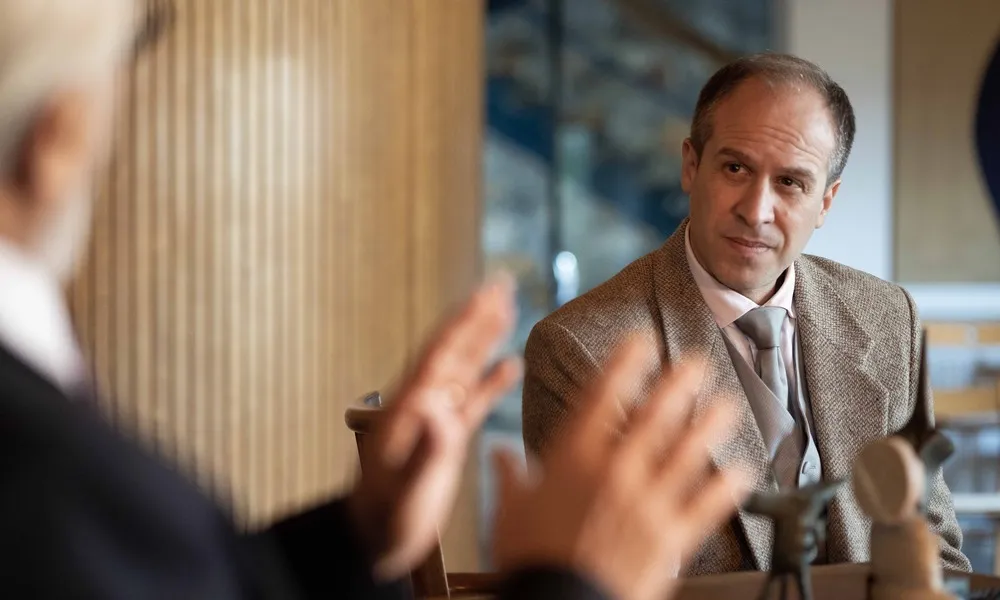
Andreas Araouzos is an actor, director, and the driving force behind Alpha Square. At the moment, he is involved in two stage productions, Η τελευταία συνεδρία του Φρόιντ (Freud’s Last Session) and Μια Ιλιάδα (An Iliad), while in December he will present, for the fourth time, Art by French playwright Yasmina Reza. The play was first staged in English in 2003, restaged in 2008, translated into Greek in 2011, and will now return with Araouzos sharing the stage with actors Varnavas Kyriazis and Fotis Apostolidis.
As for the other two productions, it’s worth noting that Η τελευταία συνεδρία του Φρόιντ emerged out of an inactive period last year following the outcome of the Θυμέλη (Thymeli) funding scheme. The play was first performed in a house designed by Neoptolemos Michaelides, impressively produced without state subsidy, using only natural light and setting, in Ayios Andreas. This year, it travelled to Athens and is now touring across Cyprus, with its final stops in Paralimni (09/11), Nicosia (15 and 16/11), and Alona (22/11).
Μια Ιλιάδα (An Iliad) is a monologue translated and directed by Araouzos, again produced with minimal set and cost. It stars the distinguished actress Despina Bebedeli, in what she has announced as her final stage performance.
As part of the Portraits column of Politis to the Point, we spoke with the artist and asked him a few questions.
Your path began with studies in mathematics and management before leading you to directing. How did this shift from “logic” to creation happen?
I believe logic fits and helps everywhere. But, as with everything in life, it needs metron, that balance the ancient Greeks so wisely advised. The balance between logic and creativity is, at least in my experience, a wonderful challenge and the key ingredient for mental well-being.
You were among the first in Cyprus to do theatre in English. Today, we live in a country with a large number of foreign-language residents. Have you considered returning to English-language theatre?
Although in the past ten years Alpha Square has mainly focused on Greek-language productions, we still occasionally stage English ones. The most recent were David Hare’s monologue Beat the Devil, about the coronavirus, and the staged reading A Portrait for the Mona Lisa by Jules Tasca, a fictional dialogue between Da Vinci and Lady Joconda. English-language theatre definitely interests me and always will.
What do you look for in the plays you choose to direct? How would you describe or characterise them?
A strong script and a captivating, ongoing dialogue are the key for me. I tend to choose plays that revolve around disagreement and argumentation, heated clashes of opinion that engage the audience with questions of identity, morality, belief, and behaviour.
Nearly a year later, Η τελευταία συνεδρία του Φρόιντ (Freud’s Last Session) continues its run. How would you describe the journey and the challenges that came with it?
This play was born out of the failed results of the Θυμέλη funding scheme. It left us unemployed for six months (last year, and again this year), and we had to, and wanted to, respond through our work. The play perfectly fits (perhaps to the extreme) the type of work I described earlier. The financial constraints of a production with zero funding led to creative solutions that ultimately served the performance in a way audiences embraced wholeheartedly.
Working with Varnavas (in our tenth year of collaboration!) on these roles and this relationship was an act of love and respect for our art. No matter what each day brought, the show went on. I’m very happy and proud that we’re now entering a third round of performances, touring across Cyprus in unique and intimate spaces. The consistency of audience reactions has been deeply moving.
In Μια Ιλιάδα (An Iliad), you chose to present a play based on Homer’s epic as translated into English by Robert Fagles. Why this version? What drew you to it?
Once again, it came as a response to the discouraging, almost insulting, results of the Θυμέλη scheme. This monologue with Ms Bebedeli was staged at Satiriko Theatre, translated and directed by me, with minimal set and budget. I’m grateful to the creative team -Lakis Genethlis, Nikos Mylonas, Dimitris Zachariou, Vicentios Christianides, and Christina Psara- for their tireless contribution and talent.
This third collaboration with Despina Bebedeli came at a crucial moment and with what I believe was the most fitting play. She is the artist and the person best suited to tell this story today, with this particular reflection on the curse of war.
You’ve worked repeatedly with both Despina Bebedeli and Varnavas Kyriazis, who stars in the other two ongoing productions. What do you find in their artistic quality?
There’s a long list of what they bring. Beyond the sacredness with which they approach texts, roles, and responsibility, there’s also their profound respect for their director (despite the difference in years of experience). That level of shared presence in rehearsal is exemplary, and rare.
You often manage to capture the spirit of the times and experiment with new ideas, like your upcoming performance of Art with a glass of wine for the audience. Why return to this play for the fourth time? And how did the wine idea come about?
A staged reading of a comedy, just before Christmas, with wine, what could be more delightful? It’s something I’d love to attend myself, so why not create it?
For me, Art is one of the most enjoyable plays because it masterfully combines sharp comedy with deep drama. What could be more relevant to our times, and our lives, than a story that peels back the layers of friendship and examines its quality? And what could be more entertaining (and existential) than the fact that this “examination” begins with a work of art?
How do you view the current state of the theatre scene in Cyprus? Is it growing? Are there opportunities for young people? Or is it harder now to make theatre? What does the Cypriot theatre world need, both now and for the future?
The theatre landscape in Cyprus is indeed growing. There are creators, there’s potential, and there’s even intent from the state and institutions. But there are also far too many mistakes, and many could be avoided. I’ve grown tired of listing them, and sometimes I feel like I’m repeating myself when I speak out publicly.
The most obvious and indisputable issue is the extreme delays in the announcement and evaluation of funding applications. This leads to wasted time and hollow months within each production cycle. For us, that means poor planning and unemployment. As if the uncertainty inherent in our profession weren’t enough, we also face unjustifiable bureaucratic waste.
Funding schemes evaluate our success as cultural organisations, but paradoxically, only if we operate at a loss do we receive the full grant. Meanwhile, our state theatre, ΘΟΚ (Cyprus Theatre Organisation), has been without a director for two years (not for the first time), purely due to bureaucracy. Things must become more functional, but for some reason, that seems to be the hardest thing of all.
The interview is also available in Greek on Parathyro website, parathyro.politis.com.cy.