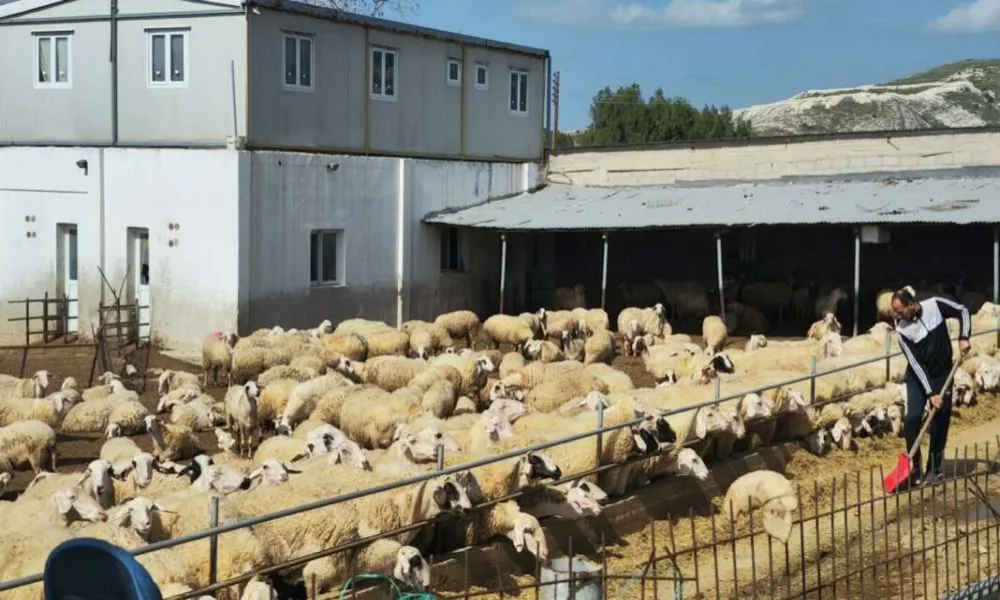
Around 500 additional animals have been added to the list of culls following a new case of foot-and-mouth disease at a livestock unit in Dromolaxia, triggering renewed alert among the Veterinary Services. Authorities describe the spread of the virus as “expected”, with the number of animals marked for culling now reaching approximately 20,500 and the number of infected units rising to 23.
At the same time, Veterinary Services spokesperson Sotiria Georgiadou acknowledged that the ten-kilometre control zone in the Larnaca district is expanding, along with the mandatory vaccinations within it. Official statements now refer to containment within the Larnaca district rather than the previously defined “red triangle” of Oroklini, Livadia and Aradippou.
A full vaccination plan has also been prepared so that vaccinations can be extended across the rest of Cyprus.
New case near control zone boundary
During the latest briefing to journalists, Georgiadou said the new case was detected on the outskirts of the existing ten-kilometre infected zone.
“As we have said several times before, both within three kilometres and within ten kilometres we expect to find cases. This is normal in the progression of the virus. The encouraging element is that the virus remains within the Larnaca district and the objective is to contain it there, with all the restrictions, prohibitions and penalties imposed for illegal movements,” she said.
Vaccination zone expands
Vaccinations of sheep and goats in the areas initially designated within the ten-kilometre radius are expected to be completed by Friday at the latest, according to Georgiadou.
However, the new case in Dromolaxia has led to a limited expansion of the ten-kilometre radius, requiring vaccinations to be carried out around the newly infected livestock unit.
European Commission response
Georgiadou also referred to a teleconference held yesterday between the Director of the Veterinary Services and the European Commission’s Directorate-General for Health.
During the meeting, Cyprus presented laboratory results, sampling data, epidemiological investigations, the number of cases and the progress of vaccinations.
Cyprus asked whether it would be possible, as an exception to existing legislation and the relevant code of the World Organisation for Animal Health, to cull only animals that test positive for the virus within an infected herd.
“Their response was categorical, stressing that the provisions of EU legislation for foot-and-mouth disease are specific, that no deviation is foreseen and that there is no alternative solution other than the complete culling of the herd,” Georgiadou said.
She added that the Veterinary Services will return to the issue and ask again whether an alternative solution could be considered.
Farmers’ organisations and producer groups have reacted to the mass culling. According to a report published yesterday by Politis, they had planned to send a joint letter of protest to President Nikos Christodoulides requesting alternative solutions.
Allegations regarding burial procedures
An announcement issued yesterday by the Ecologists Movement, accompanied by photographs, stated that livestock farmers had reported alleged breaches of safety protocols during the burial of dead animals.
According to the statement, “photographs from the burial trench show carcasses ‘floating’ in water. There are serious questions regarding the sealing of the trench to prevent contamination of groundwater and soil.”
The statement also claimed that infected carcasses were being transported to the burial trench in open trucks, creating a risk of spreading the disease. It added that the burial site was neither covered nor enclosed and that strong odours were spreading across the area, reaching several kilometres away.
Veterinary Services response
Commenting on the circulation of the photographs, Georgiadou said their publication was regrettable.
“These distressing matters should not be in the public domain. We must respect the people who are losing their animals and their livelihoods rather than publicising such images,” she said.
Responding to allegations that burial procedures had not followed the correct protocols, she said the burial site was a mass grave that complies with all sanitary provisions, coordinated among five government departments.
Special sealing materials such as lime and clay are used, together with disinfectants, to reduce the transmission of the virus, she said, adding that the procedures follow specific health provisions.
The Veterinary Services later issued a detailed announcement stating that the liquid visible in the burial trench is disinfectant used as part of biosecurity measures to reduce the viral load.