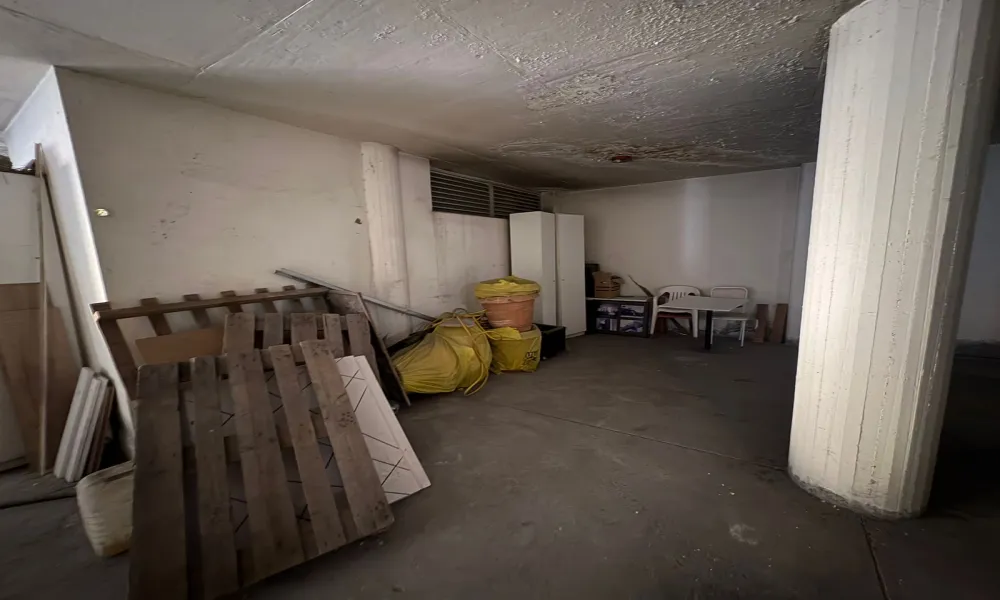
Serious questions have emerged over the management of civil defence shelters in Cyprus after documents obtained by Politis revealed that authorities had repeatedly assured the government and parliament that inspections were being carried out regularly.
Civil Defence commander Maria Papa had reportedly provided written assurances over the past two years to both Interior Ministry permanent secretary Ellikos Elias and Interior Minister Constantinos Ioannou that shelters were being systematically inspected and maintained where necessary.
However, a recent nationwide inspection ordered by the interior minister has revealed that hundreds of shelters are either unsuitable or no longer available.
Hundreds of shelters unavailable
According to the findings of the inspection carried out last week, around 200 shelters were found to be unsuitable for use. A further 230 shelters were discovered to no longer exist in practice.
In many cases, property owners had changed the use of the basements that were originally designated as shelters, converting them into storage areas, parking spaces or even residential apartments. In other cases, building modifications reduced the available space to the point where the shelters could no longer serve their intended purpose.
The findings mean that 430 shelters previously listed in official records are currently unavailable.
Authorities are expected to remove these locations from the “SafeCY” mobile application, which allows residents to locate nearby civil defence shelters in case of emergency.
Questions over information given to parliament
The revelations have also raised concerns within the Interior Ministry itself. According to information obtained by Politis, ministry officials are frustrated because earlier assurances from Civil Defence formed the basis of the government’s response to parliament.
On 8 May 2025, the ministry informed MPs that more than 2,200 shelters with capacity for around 250,000 people were registered across Cyprus and that regular inspections were being conducted to ensure their availability.
The statement suggested that shelters were operational and maintained when necessary. However, the results of the latest inspection appear to contradict those assurances, giving parliament an inaccurate picture of the system’s readiness.
Warnings raised in parliament
Concerns about the condition and accessibility of shelters had already been raised in parliament.
On 30 October 2024, independent MP Alexandra Attalides submitted a parliamentary question to Interior Minister Constantinos Ioannou highlighting problems she had observed regarding civil defence shelters.
In her letter she warned that access to many designated shelters could not be guaranteed and that several had already been repurposed by their owners.
She also noted that information about shelter locations was not easily accessible online and that citizens often had to contact Civil Defence offices during working hours to obtain details.
Attalides warned that the lack of accessible information could leave residents unprepared in the event of an emergency and could also disadvantage non-Greek-speaking residents who rely on online information.
How the shelter system was created
The civil defence shelter programme began following a Council of Ministers decision in April 2000 assigning responsibility for the development of shelters to the Civil Defence Force.
Under the programme, agreements were signed with owners of buildings with suitable basements. In exchange for allowing their basements to be designated as shelters, owners received financial support and equipment installed at state expense.
These installations included reinforced metal doors, windows, ventilation openings, water tanks and toilet facilities. In return, owners agreed that in the event of an emergency the spaces would be cleared and made available for public protection within 24 hours.
Between 2000 and 2013 around 2,300 shelters were created across Cyprus with a capacity of approximately 250,000 people, at a total cost of about €4.15 million to the state.
Programme suspended during economic crisis
In July 2013 the Council of Ministers approved the suspension of the shelter creation programme as part of broader austerity measures during the financial crisis.
Civil Defence engineers and technicians involved in the programme were reassigned to district administrations. However, maintenance of the existing shelters was expected to continue under the responsibility of Civil Defence.
Shelter policy revised
In January 2015 the government approved a revised framework allowing the creation and maintenance of shelters without direct state expenditure.
Under this model, property owners retain full ownership of the basements and are responsible for maintaining them. Unlike earlier arrangements, the state no longer installs reinforced doors, windows or other equipment.
The recent inspection findings have now reignited debate over the effectiveness of the current system and whether sufficient oversight has been carried out to ensure that the shelters listed in official records are actually available in case of emergency.