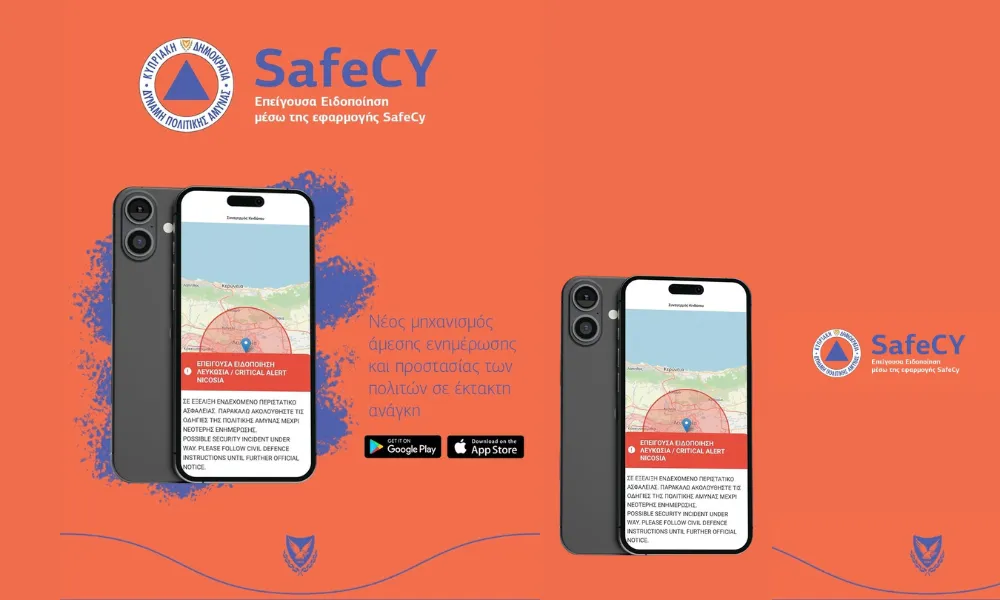

The SafeCY mobile application will be upgraded to send targeted emergency alerts to citizens’ phones in the event of a security incident, Interior Minister Konstantinos Ioannou announced on Wednesday following a meeting of the Council of Ministers.
The announcement was made alongside updates on inspections of civil defence shelters and new government measures aimed at strengthening emergency preparedness and public protection.
Civil defence shelter inspections
Presenting the results of recent inspections of the 2,480 civil defence shelters listed across Cyprus, Ioannou said that 194 locations were found to be unsuitable or no longer exist because the buildings have been demolished. These sites have therefore been removed from the official list of shelters.
In addition, the status of 288 shelters has changed to private use and they will remain available only to their owners or tenants.
The process of removing unsuitable and privately used shelters from the SafeCY application has already begun and is expected to be completed in the coming days.
Inspections also showed that several shelters require cleaning or the removal of stored items to be ready for public use if necessary. The Ministry of Interior is currently in contact with property owners to facilitate clearing and preparing these spaces.
Ioannou noted that the inspections revealed weaknesses in the policy introduced in 1999 to create shelters within existing private spaces.
Shift towards larger public spaces
The minister said the government has adopted a new approach aimed at increasing population coverage by prioritising larger public locations.
These include municipal underground parking areas, church basements, parking facilities in supermarkets, hotels and office buildings.
Although the total number of shelters may be lower under the new approach, larger spaces will allow more people to be accommodated.
Ioannou said population coverage has already increased from about 30% to approximately 45%.
Provincial administrations have also worked with municipalities and communities to identify additional public spaces suitable for temporarily hosting large numbers of people. These locations are gradually being added to the SafeCY application.
The government is continuing efforts to identify further spaces that could be used as shelters, including through discussions with business associations, hotel groups, supermarkets and the Church regarding the availability of large underground facilities.
Planning incentive to increase shelters
The Council of Ministers also approved a planning incentive aimed at increasing the number of shelters.
Under the new measure, developers submitting applications for projects that include underground levels will be able to benefit from a 5% increase in the building coefficient if part of the basement is allocated for use as a civil defence shelter.
The measure mainly targets underground parking areas, which cannot later be converted into other uses that would make them unsuitable as shelters. Buildings participating in the scheme will be required to include provisions for drinking water and sanitary facilities.
The incentive will apply to new development applications as well as already approved residential, commercial, office and mixed-use developments.
According to Ioannou, the measure is expected to be utilised by the construction sector and contribute to expanding the number of shelters and improving population protection in the event of hostilities.
New civil protection framework
The Council of Ministers also approved draft legislation titled the Civil Protection and Related Matters Law of 2026.
The proposed legislation establishes the institutional framework for creating a National Civil Protection Mechanism and introduces the position of National Civil Protection Coordinator.
The mechanism will introduce a new framework for coordination among all relevant authorities, with the national coordinator responsible for overseeing the response to natural and human-made crises.
The coordinator will have responsibility for coordinating all involved services and agencies during emergencies, including issues related to deployment, movements and operational planning.
The bill will be submitted to the House of Representatives for discussion with the aim of being adopted as law as soon as possible.
Until the legislation is adopted and the national mechanism established, the Council of Ministers has appointed Fire Service Chief Fire Officer Nikos Longinos as temporary coordinator for wildfire management, replacing the Director General of the Ministry of Agriculture in that role.
Emergency alerts through SafeCY
The SafeCY application will also be used to send alerts to citizens in the event of security incidents, providing guidance on self-protection measures.
Ioannou explained that notifications will be sent to mobile phones that have the application installed within a predetermined radius around an incident.
The measure aims to address limitations of SMS alerts, which are sent based on the address registered with a mobile phone provider rather than the user’s actual location.
The minister acknowledged that the system will not cover citizens who do not have the SafeCY application installed or who do not use smartphones. However, he stressed that it represents an additional tool for informing a large number of citizens until the full Early Warning System is implemented.
Ioannou concluded by emphasising the government’s commitment to addressing weaknesses identified in both the shelter network and the early warning system as part of a broader strategy to transform Civil Defence into a modern and comprehensive civil protection system focused on safeguarding citizens and improving national resilience in emergency situations.