
One year ago, in March 2025, the Ministry of Interior submitted a bill to parliament aimed at providing additional legislative tools to the District Local Government Organisations (EOA) to address effectively the serious and long-standing problem of dangerous buildings affecting municipalities, communities and thousands of residents living nearby.
In drafting the bill, proposals already submitted to parliament by DIKO MP and current Minister of Labour Marinos Mousiouttas were taken into account.
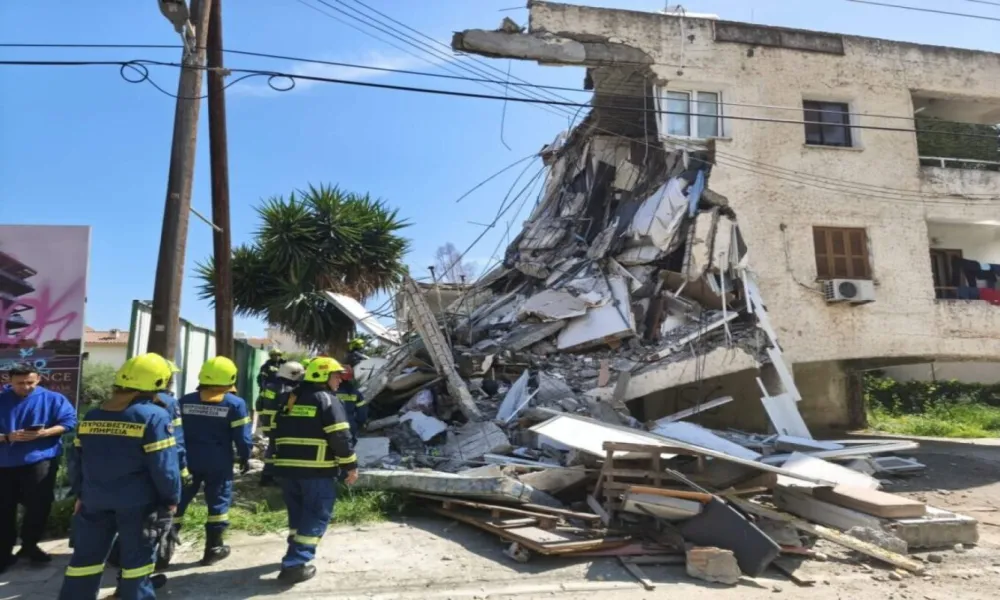
The bill is still pending examination by parliament. Had it been passed into law, it is possible that the two African migrants who lost their lives in the building collapse in Germasogeia on Holy Saturday might still be alive today, as the legal and operational framework available to the Limassol EOA would have been significantly more effective and functional.
Specifically, the Limassol EOA would have been able to proceed unilaterally with securing a court order for the demolition of the building. If the occupants failed to comply within a reasonable period of time, the Limassol EOA would also have had the authority to cut off electricity and water supply, forcing residents to vacate the dangerous building for their own safety.
In the case of the building in Germasogeia, residents had been given a three-month deadline to leave the premises, until 26 June 2026. However, only three weeks later, the building collapsed.
Main provisions
The bill currently before parliament concerning the management of dangerous buildings provides for the following:
Simplification of the procedure for serving notices by removing from existing legislation the requirement to send a double registered letter to the owner of a dangerous building. Alternative notification methods are introduced, such as publication on the relevant EOA website and notification of the local authority.
Provision for the demolition of dangerous buildings as a measure to eliminate risk.
Issuance of a unilateral court order (ex parte) for measures to be taken in relation to a dangerous residence, including the removal of persons living in it. Such an order would save valuable time, which in cases of this nature is crucial for the protection of human life.
Prohibition of the use and/or rental of a building that has been designated as dangerous.
Disconnection of water and electricity supply as a means of pressure to ensure the evacuation and abandonment of the building.
Sealing of dangerous buildings as an immediate measure to prevent people from entering them.
Registration of a charge on the affected property to cover expenses incurred by the EOA in addressing the hazard, with the owner’s debt regulated through monthly instalments.
In cases where the owner fails to comply with a notice concerning a dangerous building, the administrative fine would increase to up to €40,000 from the current €20,000. If the violation continues, the EOA may impose a fine of up to €200 for each day the violation persists.
In cases of non-compliance with such notices, courts would also be able to impose fines of up to €20,000 instead of the current €10,000 for a first conviction, and up to €40,000 instead of €20,000 for a second or subsequent conviction.