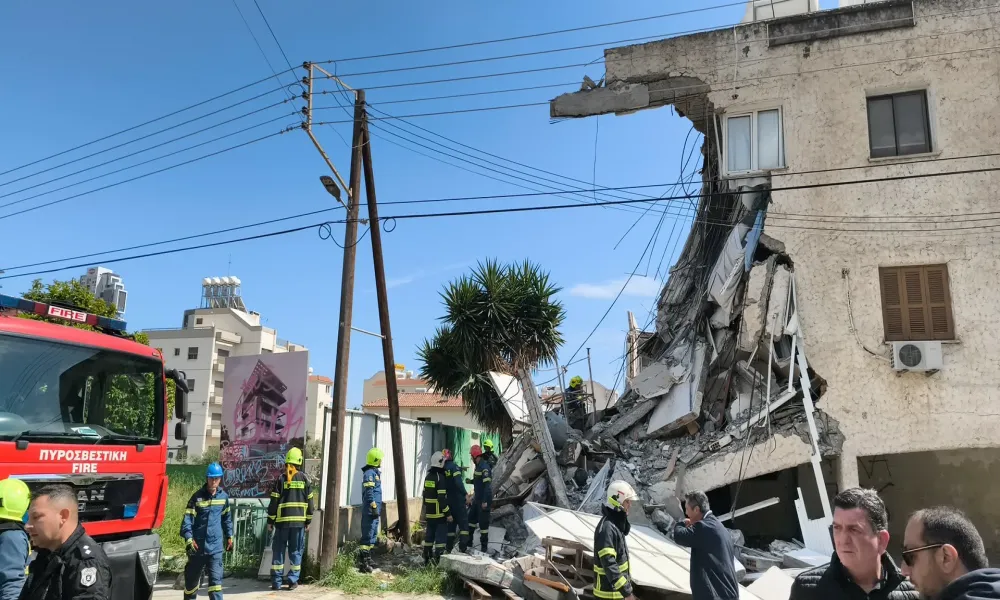

Four days after the collapse of the two-storey apartment building in Germasogeia and the tragic loss of two lives, the questions are not diminishing but increasing. Police have already set up an investigative team that is taking statements from all those involved and will proceed with prosecutions if responsibilities are established.
At the same time, both the Limassol District Local Government Organization (DLGO) and the Municipality of Amathounta (formerly Germasogeia) refer mainly to the problematic legal framework that limits their actions. The DLGO holds the letter it sent to the owners on 26 March 2026, although it remains unclear whether it reached them through the registered postal procedure.
Meanwhile, residents of the apartment building have revealed dramatic accounts of the moments of the collapse and said they were paying rents of up to €1,300 per month for unsuitable apartments, without any knowledge of the building’s danger.
Photographed and then demolished
The police investigative team that has taken over the case has been taking statements since Saturday regarding anything that might shed light on the circumstances of the collapse.
The DLGO and the municipality have already submitted relevant documents, while the owners of the building are also being sought for statements in addition to the tenants. Police are investigating the case as the unnatural deaths of two people. Statements and evidence will determine whether all procedures required under existing legislation for dangerous buildings were followed.
Investigations at the scene effectively stopped on Sunday afternoon when, by decision of the DLGO and after the Fire Service handed over the site, the building was demolished due to its dangerous condition. The structure was officially declared hazardous and an immediate provision of the legislation allowing demolition to remove the risk was applied.
Before the final demolition, the building was photographed externally by police. Due to its condition, no one could safely enter the building for on-site investigations.
Two significant elements
Beyond witness statements, investigators are examining the recent renovation carried out in several apartments. Possible alterations to the building may have contributed to the collapse either by increasing its weight or by interfering with structural supports in a way that worsened the building’s condition.
Certain parts of the building have already been photographed as part of the case file, and initial indications suggest that unauthorised alterations may have taken place, such as converting a balcony into a bedroom.
A particularly important testimony is expected from a specific owner who appears to be a key figure, as he had repeatedly attempted to coordinate with other owners to carry out repairs without success. The same owner reportedly contacted the DLGO earlier this year to inspect the building again, which led to the letter sent on 26 March.
Letters from the municipality and the Limassol DLGO
From the first moments after the collapse it became known that both the then Municipality of Germasogeia and the Limassol DLGO had sent letters to the owners concerning the condition of the building.
The municipality’s letters date back to 2017 but produced no result. From April 2025, following the reform of local government, responsibility for dangerous buildings passed to the DLGO.
On 19 February the DLGO carried out an on-site inspection of the building, confirmed its problems and decided it should be declared dangerous. However, another month passed before letters were prepared and sent to the owners. The letters were issued by the DLGO on 26 March 2026 and gave a 90-day deadline for the hazard to be addressed.
The letter was sent using a registered postal procedure, and it remains unknown whether it reached the owners before the collapse. The issue is expected to be clarified once the postal service resumes operations and informs the DLGO whether the letters were collected.
Under this procedure, a postal notice is delivered to the recipient’s address instructing them to collect the registered letter from the local post office, where they sign for receipt.
It should be noted that in this process the DLGO notifies the owners and not the tenants of the building. The legislation does not require the tenants to be informed, even through a simple notice posted at the building’s entrance.
Mobilisation after the tragedy
As often happens in similar cases, the tragedy and the loss of two lives have triggered widespread mobilisation regarding dangerous buildings across Cyprus.
In Limassol alone, around 500 such buildings are estimated to exist, requiring immediate action. However, the DLGO is unable to implement such measures under the current legal framework.
The Limassol DLGO has received numerous reports from residents identifying other dangerous buildings. At the same time, many owners are rushing to prevent similar incidents, while tenants are expressing concern for their safety.
According to information obtained by Politis, only one case from the Limassol DLGO has reached the court for the issuance of an order for the immediate removal of tenants. The order was issued unilaterally by the DLGO but has not been enforced because police did not respond to carry out the removal. Instead, police referred the DLGO to a new legal procedure for failure to comply with a court order.
Yesterday, amid the developments and public reactions, police contacted the DLGO to receive an update. A joint operation to remove tenants and seal a dangerous building on Hipparchou Street in central Limassol may take place in the coming days.
Housing concerns
Foreign tenants who lived in the apartment building that collapsed in Germasogeia have been experiencing desperate circumstances since Saturday, having lost all their belongings, money and personal documents. They say they had received no warning about the danger of the building.
Holding written appeals for help, they staged a protest yesterday and called on the state to support them as they are now left without housing. Among their statements, survivors referred to the rents they had been paying, reportedly €1,300 for a three-bedroom apartment and €950 for a studio.
At the same time, disagreement has emerged between the Municipality of Amathounta and Civil Defence regarding their accommodation. The municipality says it took responsibility for their temporary housing and has called on the state to assume its responsibilities. Civil Defence states that it arranged from the outset the transport and accommodation of 18 people in a hotel and also covered their basic needs.
For the moment, nine people remain in the hotel with expenses covered by the state, while efforts continue to find a permanent housing solution for them.