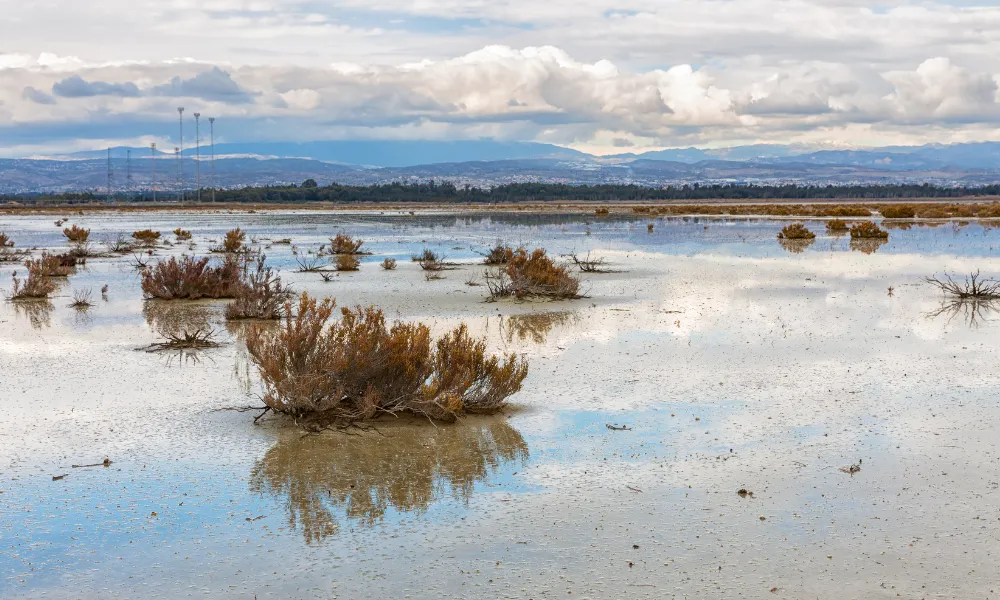

Akrotiri Salt Lake, the largest natural lake in Cyprus and one of the most important wetlands in the Eastern Mediterranean, is deteriorating at an alarming rate. Over the past five years, uncontrolled development, weak planning and prolonged state inaction have disrupted the lake’s water balance and its biodiversity to a degree that environmental groups now describe as critical.
One of the clearest indicators is the collapse of the flamingo population. In 2020 around 13,000 flamingos were recorded at the lake. In 2021 the number fell to 6,000. For 2025 only about 200 have been documented so far. In January 2025 BirdLife recorded roughly 30 flamingos, the lowest number since systematic monitoring began in 1992. By contrast, flamingo populations in the Larnaca and Paralimni salt lakes are rising.
Years of warnings, no study, no action
The problem was identified as early as 2020. By September 2022 the disruption to the lake’s environmental balance was so visible that a high level meeting was held in Limassol involving state departments, the British Bases and environmental organisations. The main issue was that the lake was no longer drying out in the summer, a sign that water was reaching the wetland in unnatural volumes and rhythms.
Instead of acting, authorities sought a legal opinion to determine which department was responsible for commissioning a hydrological study. No study was ever conducted. Three years later the situation has deteriorated further. Analyses now show that contaminated water containing bacteria such as E. coli is reaching both Akrotiri Salt Lake and the nearby Zakaki (Makria) Lake.
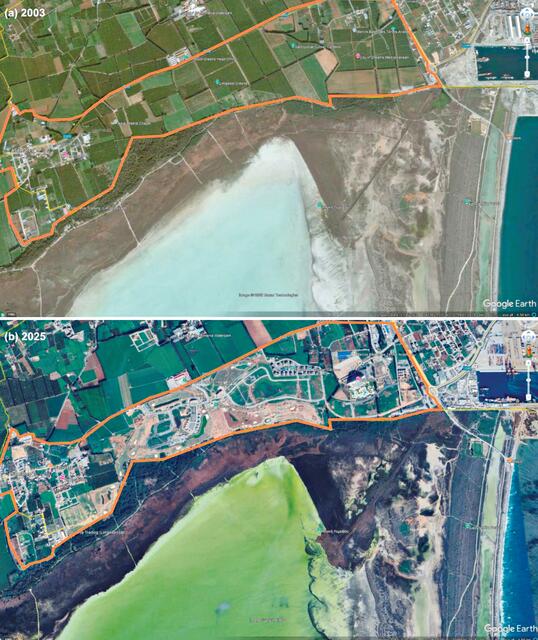
BirdLife recently published satellite images that illustrate the scale of the landscape transformation. In 2003 the area north of the lake was mostly agricultural land with citrus groves and long rows of trees. In 2025 it has become one of the fastest growing districts of Limassol, shaped by the mall, the casino resort, the golf course and extensive residential development.
How the water balance was broken
The degradation of the wetland results from several converging factors. Drainage works for construction have redirected water flows. Surface runoff has increased because farmland that once absorbed water has been replaced by concrete. Thousands of trees that acted as natural filtration zones have been removed. Golf course turf absorbs limited water and the chemicals used on it eventually move into groundwater. For years the wider area lacked a sewage system, which allowed unsuitable water to reach the wetland.
Large developments irrigate their parks with tertiary treated water which, according to repeated complaints, is not always retained within their premises. Evidence suggests that significant volumes of this water enter stormwater channels operated by EOAL, which ultimately empty into the lakes.
The result is that water now arrives at the wetland quickly and without natural filtration. This has altered the ecological balance that supported the system for centuries.
Pollution confirmed through official tests
In November 2024 the Department of Environment carried out chemical analyses for the first time. The results confirmed contamination. Elevated concentrations of ammonia and E. coli pointed to contact with untreated sewage. The presence of faecal bacteria signalled recent pollution of human or animal origin. The department also detected nitrate levels consistent with disturbance from building foundations and drainage works.
In January 2025 the Department imposed a fine of twenty thousand euro on a major developer preparing seventy eight plots. Inspectors found that environmental terms for water management during excavation and drainage works had not been followed. A second violation was documented in November 2025 and was expected to lead to another fine.
A 36-month plan finally begins
Under pressure from environmental organisations and local communities, authorities have begun taking action. On 26 February 2025 a field meeting of the parliamentary committee took place. Shortly after, the Kourion Municipality and the British Bases, who have jurisdiction over the lake itself, initiated the creation of a technical committee to investigate the problem and coordinate solutions.
The committee includes Kourion Municipality, Limassol Municipality, EOAL Limassol, the Department of Environment of the Republic and of the British Bases, the Geological Survey Department, the Water Development Department, the Department of Forests and the General Directorate for Environment.
The committee has drafted a thirty six month action plan to map every natural and technical water flow into the wetland and to identify long term solutions. Each participating authority is responsible for specific tasks and must report progress. At the end of the timeline, the committee will propose the major works required to restore the wetland.
First measures now underway
Two immediate measures have already been agreed. The Water Development Department and the Geological Survey Department will prepare maps that define three zoning categories which determine how deep new construction can go. One zone will prohibit basements, one will allow a single basement and one will allow two. These zones are expected to be incorporated into the Limassol local plan and the British Bases policy framework.
The second measure concerns technical construction rules for future developments. In coordination with Kourion Municipality and EOAL Limassol, new specifications will be introduced for building materials and the obligation to include water retention ponds.
Environmental groups excluded from the committee
Environmental NGOs have been left out of the technical committee even though they uncovered the problem, documented it and sustained the pressure that led to official action. Authorities argue the committee is strictly technical and composed of public bodies. They say NGOs will be consulted once studies are completed and concrete recommendations exist.
The main organisations actively documenting the issue and raising public awareness are:
• BirdLife Cyprus
• Terra Cypria
• Friends of the Earth Cyprus
• The Cyprus Environment Foundation
These organisations continue to monitor the wetland independently and publicly report pollution incidents.
Signs of ongoing contamination
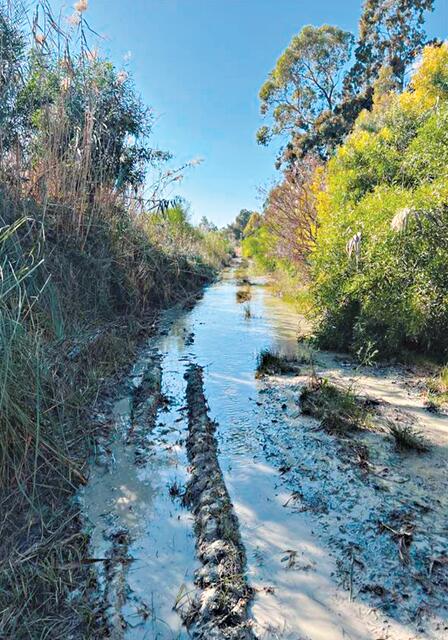
Despite mitigation efforts, signs of active pollution persist. During field visits in November 2025, BirdLife observed stormwater channels full of water despite weeks without rainfall. Stagnant and foul smelling water was visible in several areas. Runoff from construction sites appeared to enter the wetland directly. According to the organisation, these inflows alter the hydrological regime and disrupt the natural processes of the ecosystem.
A unique wetland at a turning point
Akrotiri Salt Lake is not only a national ecological treasure but also a vital habitat for migratory species across the Mediterranean. Years of unchecked development, fragmented oversight and delayed political action have pushed the ecosystem to the brink. The coming years will decide whether the lake can recover or whether Cyprus will lose one of its most valuable natural landscapes.