Voice Across
Over time, the rotating presidency in the Cyprus negotiations has gradually shifted from being discussed as a tool of political equality to being treated almost as an end in itself, particularly in recent years. This observation is valid. The conclusion to be drawn, however, is not that the rotating presidency is unnecessary, but that its growing centrality needs to be properly understood.
In the Cyprus context, the rotating presidency is not an abstract claim to equality. It is the product of a search for safeguards that render political equality visible, verifiable, and irreversible.
Mechanisms before office
Political equality is clearly defined within United Nations parameters that extend beyond Security Council resolutions alone and include the understandings and convergences reached by the parties over the years. This definition cannot be reduced to who occupies a single office or in what order. The essence of political equality lies in effective participation in governance.
Meaningful and effective participation by both communities in federal decision-making processes, the requirement of at least one positive vote from each community on vital issues, arrangements that ensure proportional representation, such as a 2:1 ratio, while preventing unilateral domination within federal bodies, and the principle of collective executive responsibility together constitute the core elements of this framework.
In other words, political equality is not merely about taking turns in the presidential seat. The real challenge is to establish a decision-making architecture in which one community cannot systematically exclude the other and in which the “majority rules” reflex is institutionally blocked. The requirement of at least one positive vote from each community on vital decisions is therefore not a technical detail, but the substance of equality itself.
It is within this framework that the rotating presidency acquires meaning. It is not political equality per se, but a complementary insurance mechanism that ensures effective participation in governance even at the highest executive level. It rejects permanent unilateral control at the apex of the executive and helps ensure that equality does not remain merely on paper.
The 1960 experience and the need for visible equality
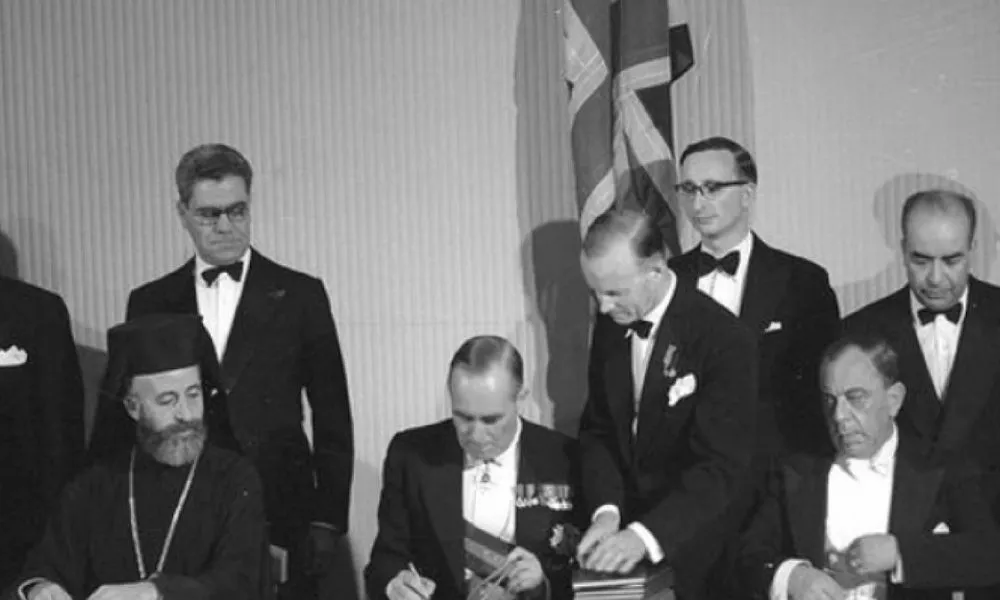
The 1960 partnership arrangement offered, at least on paper, an effective model of federation. It included veto mechanisms and constitutional checks and balances. Yet the system rested on a fundamental assumption: that the side holding power in practice would internalise the need to limit that power. This assumption collapsed within a few years.
The attacks that began on 21 December 1963 were not simply a security crisis. They marked the beginning of the systematic exclusion of Turkish Cypriots from the partnership state. The partnership effectively collapsed, the constitution was suspended, and political equality was unilaterally dismantled. This experience permanently demonstrated to Turkish Cypriots that political equality cannot rest on abstract principles alone, but must be anchored in functioning and visible mechanisms.
For this reason, the rotating presidency is meaningful only when considered alongside effective participation in governance and the principle of a positive vote. Otherwise, equality remains a declaration of goodwill rather than a lived reality.
The risk of fetishisation and institutional alternatives
At the same time, presenting the rotating presidency as the sole key to a settlement carries serious risks. The assertion that “there can be no political equality otherwise” may hinder discussion of more creative and more institutionalised models of equality. Experience from multi-communal states shows that political equality is sustained through strong collective executives, bicameral legislatures, robust checks and balances, and the distribution of authority.
At this juncture, it is possible to consider an institutional alternative that would not weaken the rotating presidency but could, in fact, place it on a firmer footing.
A Presidential Council model, inspired by the Swiss Federal Council and the rotating presidency of the Council of the European Union, offers a serious option for Cyprus. Under such a model, executive authority would not be vested in a single individual but in a collective body. The number of council members could be determined on a 2:1 basis in a manner reflecting political equality. While balancing the relative weight of the two communities within the executive, decision-making would be subject to the requirement of at least one positive vote from each community on vital matters.
The chair of the Presidential Council, selected from among its members, could serve on a rotating basis for six-month terms, similar to the EU Council presidency. This structure would remove the presidency as a permanent centre of power and clarify the distinction between symbolic representation and executive authority. Power would not be concentrated in one hand, and the principle of collective responsibility would be strengthened.
Such a model directly addresses the core concern underlying the demand for a rotating presidency: preventing permanent unilateral dominance even at the highest level of the executive. At the same time, it safeguards political equality not merely through the sharing of offices, but through the architecture of decision-making itself.
Security and guarantees: a separate ground
It is essential, however, to clarify concepts. Political equality and security and guarantees should not be addressed within the same framework. Security is not a subcategory of participation in governance; it rests on a separate historical and strategic foundation.
The purpose here is not to assign blame or engage in a “blame game”. The issue must be presented realistically and together with its roots. The psychological impact of 1974 and Türkiye’s intervention on the Greek Cypriot community is frequently and rightly discussed. Yet with equal seriousness, the experiences and traumas endured by the Turkish Cypriot community before 1974 must also be acknowledged. Ignoring this history is not peace-mindedness, but an incomplete reading of collective memory.
For Turkish Cypriots, Türkiye’s effective guarantee does not arise from abstract fears about the future, but from concrete experiences of exclusion and insecurity in the past. The 1960 partnership collapsed the moment military and political balance was disrupted, painfully demonstrating that constitutional guarantees alone were insufficient to protect any community. For this reason, security and guarantees are not negotiable technical items for Turkish Cypriots. They constitute a precondition for the survival of political equality, though they do not replace it.
The trauma of 1974 and the sovereignty sensitivities of the Greek Cypriot side are, of course, understandable. But empathy does not require abandoning realism. Today, the island hosts not only a Turkish military presence. The United Kingdom maintains a permanent presence through its sovereign base areas. The United States, France, and Israel also use the island as an active military and strategic platform in the Eastern Mediterranean. Cyprus has become part of an intense field of geopolitical competition.
Against this backdrop, asking Turkish Cypriots to relinquish their indispensable security guarantees is neither realistic nor acceptable. Demanding Türkiye’s complete withdrawal from Cyprus, disregarding its historical, geographical, and strategic interests, is likewise an expectation without a counterpart at the negotiating table. Moreover, any settlement will ultimately be put to a referendum. A solution that excludes Türkiye’s effective and de facto guarantee, and therefore its presence on the island, would not receive the support of the Turkish Cypriot people.
Putting concepts in their proper place
A sustainable solution in Cyprus requires placing concepts where they belong.
Political equality is built through effective participation in governance, the requirement of at least one positive vote from each community on vital issues, and collective decision-making mechanisms. The rotating presidency is a tool that helps make this equality visible and irreversible by giving it functional meaning. A Presidential Council and rotational arrangements can render this tool more institutionalised, coherent, and resilient.
Security and guarantees, meanwhile, must be addressed on a separate plane, but as an indispensable reality.
Any solution discourse constructed without these distinctions risks reproducing the mistakes of the past under new labels. What Cyprus needs is not fixation on symbols, but a political architecture that limits power, makes equality visible, and does not exclude security.
Yusuf Kanli, Executive Board member and Vice Chair of the Association of Journalists, Editorial Advisor of Anka News Agency, Journalist/Columnist.