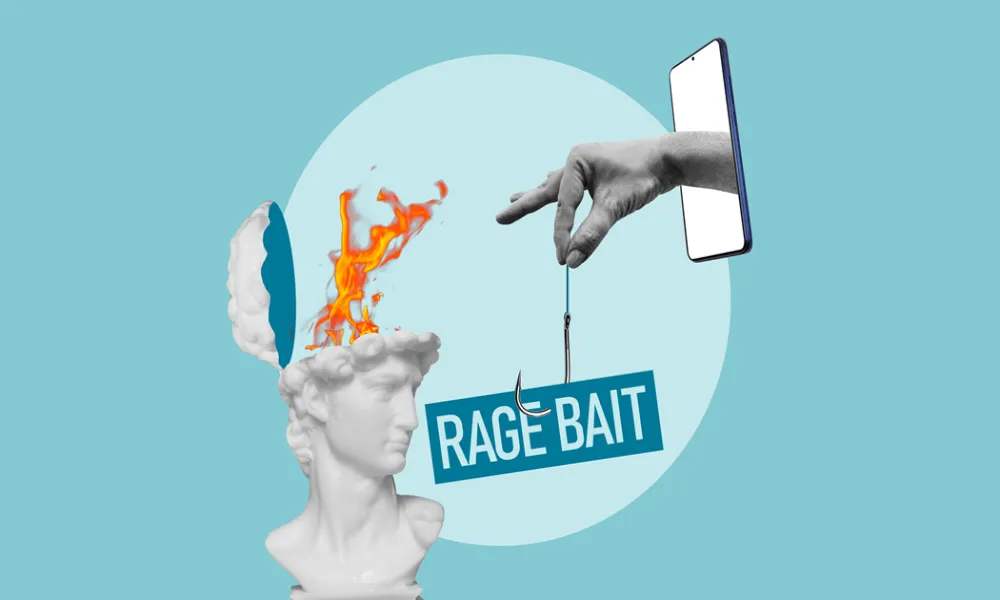

You know that familiar jolt of irritation when you stumble across a post that feels calculated to wind you up? You may have just been hit with “rage bait”, the term for online content crafted to provoke anger and increase engagement. According to Oxford University Press, that term has been selected as Oxford’s Word of the Year for 2025.
The publisher says usage of the phrase has tripled in the past year, a surge it attributes to growing public awareness of how digital platforms exploit emotion to keep users hooked. The definition offered by Oxford describes rage bait as “online content deliberately designed to elicit anger or outrage by being frustrating, provocative or offensive, typically posted in order to increase traffic or engagement.”
The Guardian reported that the choice reflects a broader recognition of “manipulation tactics” shaping online behaviour.
Casper Grathwohl, president of Oxford Languages, said the term’s prominence shows people are becoming increasingly conscious of how platforms “hijack and influence our emotions” in service of algorithmic amplification.
International media outlets have also highlighted the trend as part of a wider cultural shift in the way digital discourse functions. Analysts quoted by outlets such as the BBC and CNN in their commentary on polarising online communication have pointed out that engineered outrage has become a defining feature of social-media dynamics, a cycle where provocation sparks clicks, clicks reinforce algorithms, and algorithms push users towards ever-more-incendiary content.
Grathwohl told The Guardian that last year’s word, “brain rot”, captured the mental drain of endless scrolling, while “rage bait” illuminates the next stage of online exhaustion, content intentionally tailored to spark hostility. “Together,” he said, “they form a powerful cycle where outrage sparks engagement, algorithms amplify it, and constant exposure leaves us mentally exhausted.”
Despite its 2025 prominence, Oxford University Press traced the term’s earliest known usage to a 2002 Usenet post, where it referred to drivers deliberately provoking anger on the road, a precursor to its eventual evolution into internet slang. Over time, the phrase became attached to viral posts, tweets and entire online ecosystems designed to provoke argument for profit.
As social platforms continue to reward conflict, Oxford’s selection suggests that, at the very least, users are beginning to name, and perhaps challenge, the forces shaping their digital emotional lives.