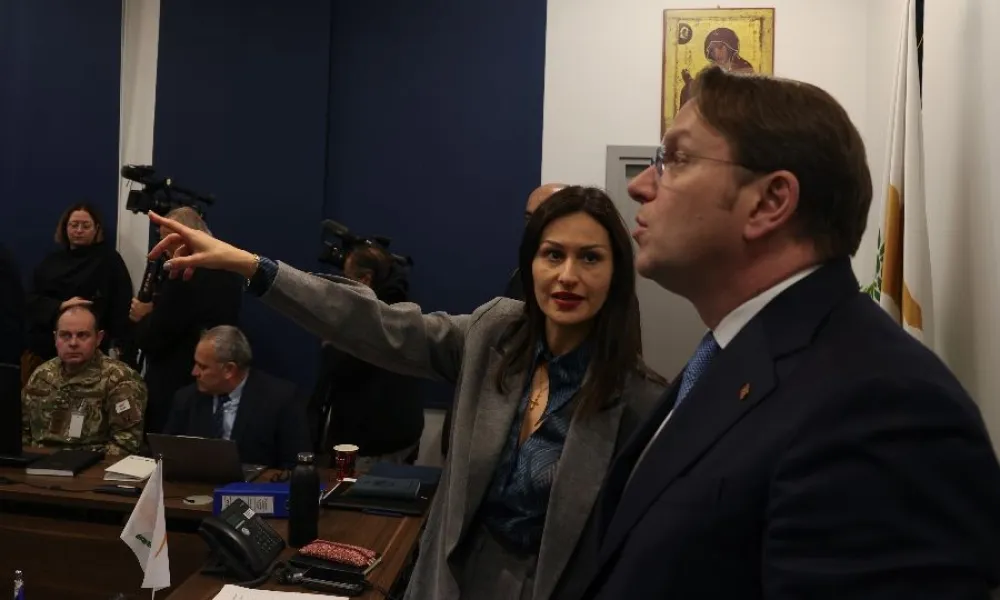
Cyprus is expected to receive European Commissioner for Health and Animal Welfare Oliver Várhelyi on Friday for an emergency visit linked to the ongoing foot-and-mouth disease outbreak. The visit, his second to the island since late February, comes as authorities face growing pressure to decide whether mass culling of animals in infected units should continue.
The government has indicated that the commissioner’s presence may help clarify the direction of the response to the outbreak, which has already affected dozens of livestock units.
Government seeks to calm tensions among farmers
The Presidency, through government spokesperson Konstantinos Letymbiotis, who announced the commissioner’s visit, is also attempting to ease tensions among livestock farmers. Groups of farmers have begun organising coordination meetings and protests against the culling of asymptomatic animals.
Some livestock farmers have also expressed opposition to the culling of goats and sheep that test positive for the virus, arguing that, unlike cattle, these animals are less severely affected and rarely die from the disease.
“Responsibility and composure are needed, away from populism, in order to support the primary sector and those who have been affected,” Letymbiotis said.
Meeting with stakeholders
Speaking after the Council of Ministers meeting, the government spokesperson said arrangements had been made for Commissioner Várhelyi to travel to Cyprus on Friday and meet with affected stakeholders.
He noted that the decision followed communication between the President of the Republic and the President of the European Commission, Ursula von der Leyen.
Letymbiotis also said that on Friday the President will hold a meeting with all relevant stakeholders involved in the management of the outbreak.
Previous visit and earlier assessment
During his previous visit to Cyprus on 26 February, Várhelyi said that the island was not facing the crisis alone and that the European Commission would support livestock farmers, animals and the country.
He made the remarks at the “Zenon” Coordination Centre in Larnaca following a meeting with the competent authorities responsible for handling the outbreak, in the presence of Agriculture, Rural Development and Environment Minister Maria Panayiotou.
At the time, the commissioner expressed cautious optimism that the situation could begin to stabilise within two weeks if containment measures were followed.
However, the number of infected livestock units has since risen to 38, indicating that the situation has not evolved as positively as initially expected.
Importance of culling and restrictions
During the February visit, Várhelyi stressed that strict measures were essential to control the spread of the disease.
“The culling of animals, all movement restrictions and surveillance measures are the most important,” he said.
He also emphasised that foot-and-mouth disease is “the most contagious disease that exists,” noting that it can spread through the air and even be carried on the soles of shoes.
EU support for farmers
Várhelyi said the European Commission would support farmers affected by the outbreak.
“We want to help farmers and they must be devastated to see this disease appear. It is very difficult for them and we will help them with vaccines, we will offer financial compensation and ensure that they can maintain their livelihoods,” he said.
He added that support would continue throughout the process until the crisis is brought under control.
Biosecurity rules and consumer safety
The commissioner also stressed that European biosecurity rules are among the safest in the world and that following them can protect both consumers and livestock farmers.
He said there should be no doubt that meat and halloumi sold in shops remain completely safe for consumption.
He also noted that regionalisation measures would allow halloumi exports to continue outside Cyprus while maintaining the island’s protected status.
“The first two weeks are always critical. We will be with you throughout the entire process,” he said at the time, expressing hope that the situation would begin to ease after that initial period.