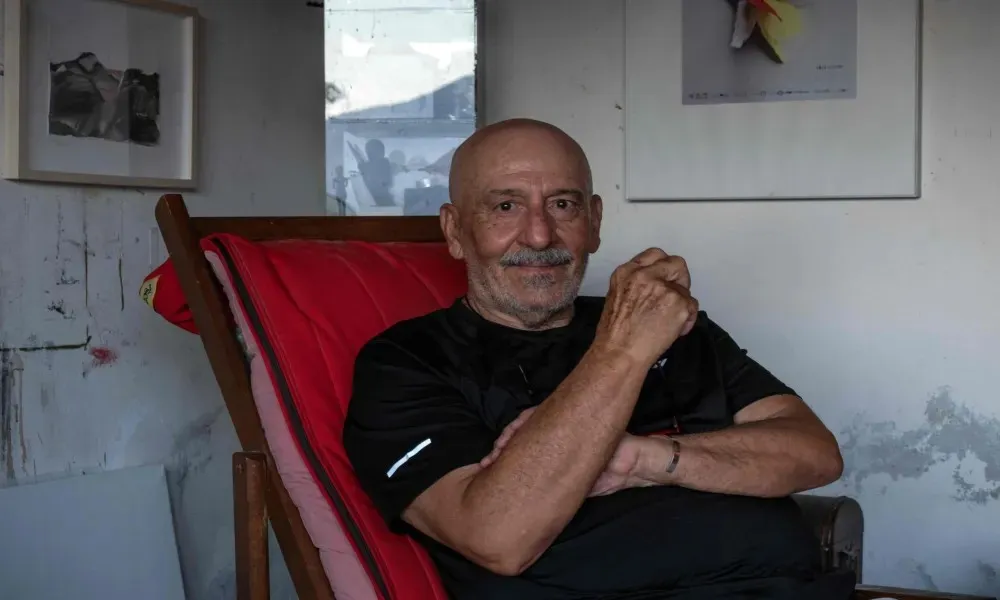
Over the past three days, the name of Turkish Cypriot visual artist Emin Çizenel has dominated both Greek Cypriot and Turkish Cypriot media, following reactions to the inclusion of his work in the exhibition A Slight Indisposition, opening on Friday, June 26, 2026, at NiMAC.
Criticism has focused on the fact that Çizenel designed the flag of the self-declared “TRNC” in 1983. However, beyond this, he is one of the most recognisable figures in the Turkish Cypriot art scene, with work closely tied, as he himself states, to personal experiences of war, displacement and memory.
In public interventions, he has repeatedly addressed Turkish Cypriot identity and the Cyprus issue.
Who is Emin Çizenel
Emin Çizenel was born in 1949 in Malia, Limassol district, and studied at the Istanbul Academy of Fine Arts.
For more than five decades, he has been active in the visual arts and is considered one of the most prominent figures in Turkish Cypriot art. He has held dozens of solo and group exhibitions in Cyprus, Turkey, Sweden, the United Kingdom, Austria and the United States.
His work has been shown at venues such as:
- Galeri Nev in Istanbul
- Atatürk Cultural Center
- Museum of Modern Art in Dallas
- Asia-Europe Biennale
His work has also been exhibited in the government-controlled areas of Cyprus. From the 1990s onwards, he held solo exhibitions in Nicosia, including at Fluxus, HP, Gloria and Argo galleries, while his work has been reviewed in the Greek Cypriot press.
His most recent appearance in the government-controlled areas was in the 2024 exhibition Casts of an Island, organised by collector Nikos Chr. Pattichis as the opening exhibition of PSI Foundation in Limassol, marking 50 years since the Turkish invasion.
The featured artwork
The work “A Lost Moment”, included in the A Slight Indisposition exhibition, is part of the State Collection of the Republic of Cyprus and was acquired around 2006.
It has been shown in several exhibitions “without reactions,” as NiMAC noted in its statement.
Çizenel has said that much of his artistic work is directly linked to his family’s experiences during the 1963–64 intercommunal violence and the 1974 Turkish invasion.
In a 2025 interview with ArtDog İstanbul titled “I Painted What I Lived”, he stated that his painting reflects his own lived experiences and those of his family.
Turkish Cypriot identity
A significant part of his public discourse concerns Turkish Cypriot identity.
Çizenel argues that Turkish Cypriots developed a distinct cultural identity, shaped by:
- island life
- the British colonial period
- coexistence between different cultures
“The Turks living here and the people of Turkey are like two different colours,” he has said, suggesting that Turkish Cypriots have their own language, culture and historical experience.
He has also criticised Turkey for, in his view, failing to fully recognise this distinct identity and for how Turkish Cypriots are often treated.
“I painted what I lived”
Çizenel describes himself as someone who experienced displacement twice, in 1964 and 1974, which shaped both his life and artistic path.
“Everything I experienced, my painting reflected,” he says, summarising his philosophy with the phrase: “I painted what I lived.”
Themes of memory, loss, displacement and the consequences of war frequently recur in his work, elements he sees as inseparable from his personal history.
In another interview, he described Cyprus as his main source of inspiration:
“I am nourished by the geography in which I live,” noting that his artistic language is shaped by the island’s history, place and experiences.
Bicommunal initiatives and cultural heritage
Çizenel has also spoken about his participation in bicommunal initiatives.
He was a member of the Bicommunal Technical Committee on Culture, which helped facilitate the return of around 200 artworks from the occupied areas.
He has also referred to his involvement in the restoration of a Byzantine church in the Kyrenia area, arguing that monuments are part of a shared cultural heritage that must be protected regardless of community.
The Annan Plan artwork
In 2003, ahead of the referendum on the Annan Plan, Çizenel took part in a bicommunal artistic initiative organised during the visit of then UN Secretary-General Kofi Annan to Cyprus.
For that exhibition, he created the work “The Chosen Tree, a Candle for Peace,” proposing a symbolic artistic intervention for the day of a reunification agreement.
According to his concept:
- a cypress tree at Bellapais Monastery would be covered with fabric
- a strong red light would be placed underneath
- the tree would be transformed into a “candle for peace”
- a new anthem for Cyprus and the EU anthem would be played
The Annan Plan was never adopted and the project was never realised.
The work remains as a conceptual proposal, accompanied by a letter from his friend Anber Onar, and is now part of the Costas and Rita Severis Foundation collection, having been presented in August 2024 as part of the Sneak Peek series.