
The Cyprus Employers and Industrialists Federation (OEB) has called for faster reforms to strengthen the competitiveness of the economy, while expressing strong dissatisfaction over its exclusion from international government business missions.
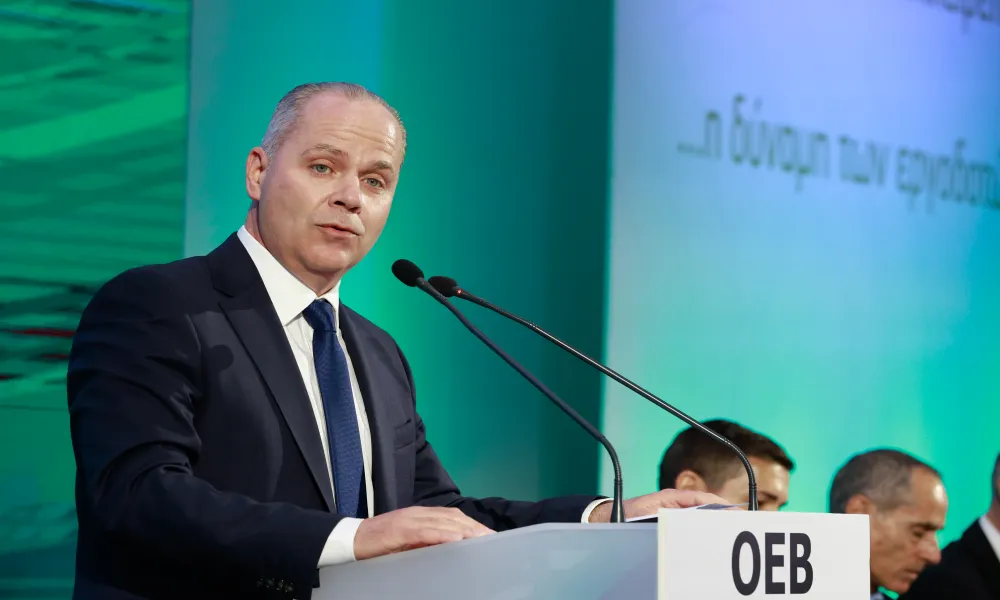
Speaking at OEB’s 65th annual general assembly in Nicosia, the federation’s president, George Pantelides, highlighted long-standing structural weaknesses that continue to weigh on the business environment. He noted that despite positive macroeconomic indicators, including strong growth, low unemployment and declining public debt, significant challenges remain, particularly amid global uncertainty.
Concerns over exclusion
Pantelides criticised what he described as the exclusion of OEB from efforts to promote Cyprus abroad and attract investment.
“It is impossible for us to understand how, in this national effort to attract investment, OEB can be excluded,” he said, pointing to the organisation’s size and influence, representing over 70 percent of GDP through its member associations and businesses.
He also stressed OEB’s role at European level, noting its vice-presidency within BusinessEurope and its participation in EU trade agreements with third countries.
Pantelides placed responsibility on state services but avoided direct criticism of the Cyprus Chamber of Commerce and Industry (CCCI), instead emphasising unity within the business community.
“OEB and CCCI are economic partners that move forward together on key issues, supporting all businesses and the economy,” he said, adding that promoting outward-looking growth is a shared priority that should not exclude any major stakeholder.
Call for reforms
Pantelides underlined the need for the state to act as a genuine partner to the business community rather than an obstacle, urging reforms in the public sector to proceed at a pace comparable to the private sector.
He also sent a message to the political leadership ahead of upcoming parliamentary elections, stressing the importance of a stable majority that can ensure continuity and predictability in economic policy.
In the energy sector, OEB warned of serious risks related to supply adequacy and high costs, calling for progress on natural gas, electricity interconnection with Europe and further development of renewable energy sources.
On tourism, Pantelides referred to growing uncertainty and called for targeted support measures across the sector. He also criticised increasing regulatory burdens in construction, arguing they are hindering rather than supporting the industry.
In healthcare, he raised concerns about shortages of nursing staff, warning that this could lead to reduced services, while reiterating the need for reforms to the national health system.
Finally, he described the cost-of-living allowance mechanism as outdated, calling for a modernised framework for wage and pension setting. He also highlighted labour shortages, particularly in technical professions, healthcare and transport, urging stronger links between education and the labour market.