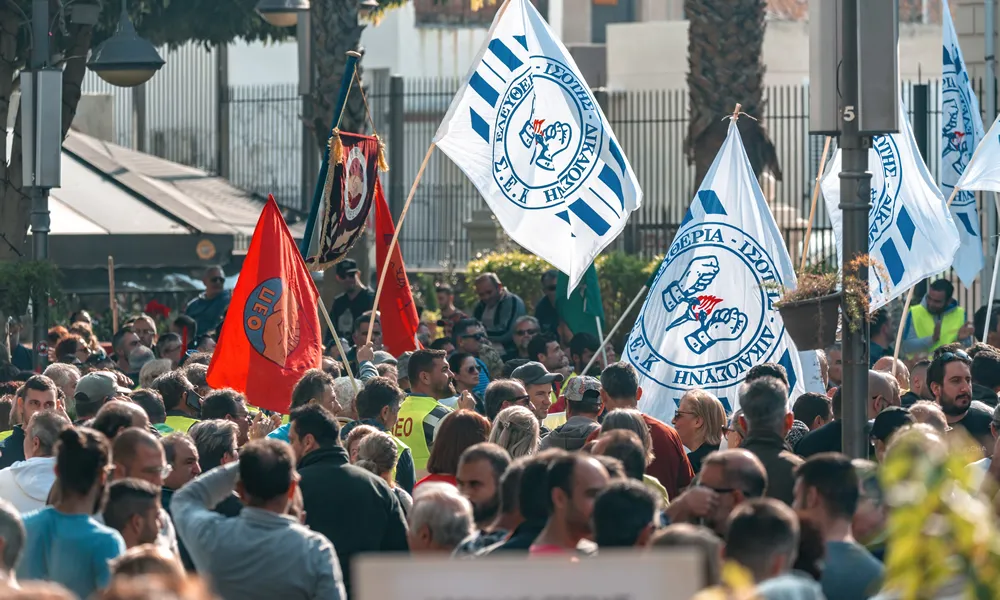



Cyprus’ main trade unions say they are waiting for concrete action from the Government following Wednesday’s meeting at the Presidential Palace with President Nikos Christodoulides, warning that further delay on key labour issues is no longer acceptable.
Representatives of SEK, PEO and DEOK met the President to review outstanding matters including the minimum wage, collective agreements, employment of third-country nationals and pension reform.
Also present were Labour Minister Marinos Mousiouttas, Deputy Minister to the President Eirini Piki, Government Spokesperson Konstantinos Letymbiotis and Presidential Press Director Viktoras Papadopoulos.
Minimum wage and collective agreements
Among the issues raised was the hourly calculation of the national minimum wage, which unions argue creates distortions and, in some cases, effectively reduces hourly pay.
PEO Secretary General Sotiroula Charalambous said the common denominator across all proposals was the need for economic growth to translate into improved living standards for workers.
“Now is the time for decisions,” she said, adding that dialogue has already taken place and that prolonged discussions without outcomes would not satisfy the labour movement.
She referred to the forthcoming bill transposing the EU directive on adequate minimum wages, arguing that it offers the Government an opportunity to reinforce sectoral collective agreements by ensuring that agreed minimum wages are respected where they exist.
SEK Secretary General Andreas Matsas described the meeting as useful and substantive, expressing hope that it would prove constructive in practice. He stressed the need for better regulation of the labour market and improved employment conditions, including adjustments to both the level and hourly structure of the minimum wage.
DEOK President Stelios Christodoulou said that while economic indicators show resilience, the same cannot be said for households. “In a fair society, the way wealth is distributed must also be fair,” he noted.
Third-country workers and labour regulation
The unions also raised concerns over the employment strategy for third-country nationals. They clarified that they do not oppose the recruitment of foreign workers where necessary, but warned that current criteria and procedures risk undermining collective agreements and creating unfair competition among workers and businesses.
The implementation of the digital labour monitoring system “Ergani 2” was also discussed. Union representatives said the system could strengthen enforcement, combat undeclared income and support the Social Insurance Fund, particularly in view of the broader pension reform debate.
Pension reform and the second pillar
Pension reform emerged as one of the most sensitive topics. The unions reiterated that reform must be comprehensive and not fragmented.
Labour Minister Mousiouttas acknowledged differing views but expressed optimism that consensus could eventually be achieved. He clarified that scenarios involving a 2 to 5 percent reduction in higher pensions for a limited percentage of pensioners were actuarial options rather than Government policy, adding that the administration does not favour any reduction of acquired rights.
The unions insisted that the second pillar of pension provision, namely provident funds, cannot be separated from the overall reform framework. They said they are prepared to accept a phased implementation, provided a clear roadmap with timelines is agreed in advance.
Charalambous stressed that no pensioner should fall below the poverty threshold and argued that improving lower pensions should not depend on redistribution among retirees but could be supported by additional state resources.
Matsas underlined that no negative impact on benefits under the Social Insurance Fund would be acceptable. Christodoulou added that pension reform, which typically takes place once every several decades, requires sufficient time and careful planning to secure sustainable outcomes for future generations.
Waiting for decisions
All three union leaders made clear that their next steps will depend on the Government’s response in the coming weeks.
“We will wait to see how the Government proceeds in practice,” Matsas said.
Charalambous echoed that position, stating that the unions’ future actions will be determined by the decisions taken.
The message from organised labour was consistent: dialogue has taken place, the issues are well known, and the expectation now is for concrete measures rather than further consultations.
Source: CNA