


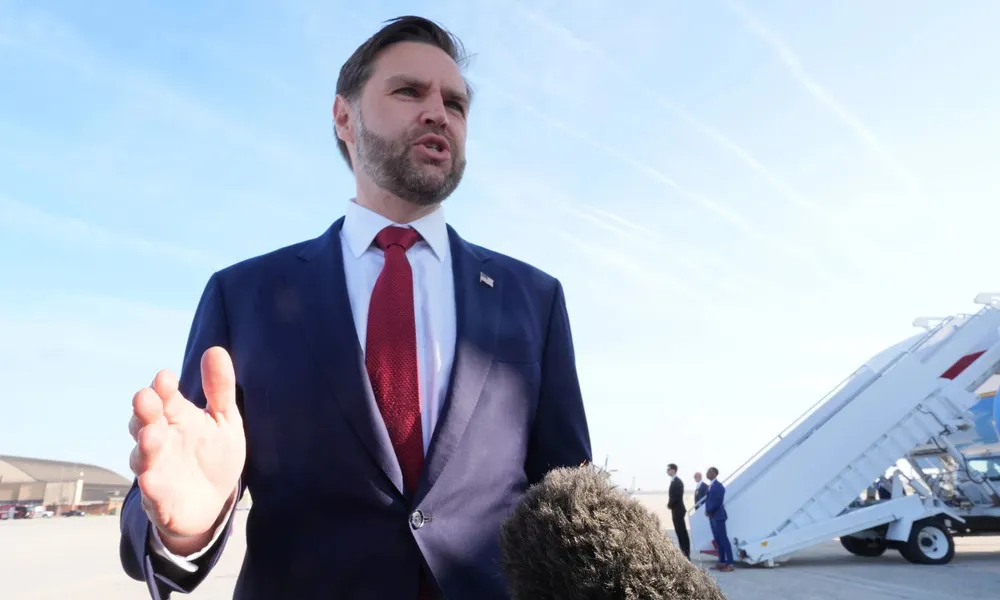

US Vice President JD Vance arrived in Islamabad on Saturday to lead the American delegation in make-or-break negotiations with Iran, as a fragile two-week ceasefire holds and the fate of a broader peace agreement remains far from certain. The talks, brokered by Pakistan and held under extraordinary security conditions, bring together the two sides for the first time in a formal setting since coordinated US and Israeli strikes on Iran began in late February.
The format of Saturday's negotiations reflects the depth of the mistrust between the two sides: US and Iranian teams are expected to sit in separate rooms, with Pakistani officials carrying messages between them, a structure closer to proximity talks than direct diplomacy. US officials told CNN the talks are expected to be both indirect and direct, depending on how the day unfolds.
The delegations
Vance is joined by Trump's special envoy Steve Witkoff and son-in-law Jared Kushner. The Iranian delegation, led by parliament speaker Mohammad Bagher Ghalibaf and including Foreign Minister Abbas Araghchi, Supreme National Security Council Secretary Ali Akbar Ahmadian and Central Bank Governor Abdolnaser Hemmati, landed in Islamabad earlier on Saturday, according to Iran's semi-official Fars News Agency.
Iranian officials have expressed scepticism about Witkoff and Kushner, pointing to earlier rounds of talks in Muscat and Geneva in February, during which the US launched strikes on Iran. They view Vance as more open to ending the conflict, and his inclusion in the delegation is seen as a significant development.
Tehran's conditions
Iran has said the talks will only proceed if Washington accepts its preconditions: a ceasefire in Lebanon and the unfreezing of Iranian assets abroad. Tehran's public posture has been defiant. Ghalibaf said upon his arrival in Pakistan that his country had "good intentions but no trust," adding that Iran's experience of negotiating with the United States had consistently ended in broken promises.
Iran's public messaging has diverged sharply from Washington's, with state media outlets claiming the country won a decisive victory by surviving the US and Israeli strikes and bringing Washington to the negotiating table.
The American position
Trump told NBC he was "very optimistic" about the prospects for a deal, saying Iranian leaders seemed "more reasonable" in private than in public. "They're agreeing to all the things that they have to agree to," he said. The president has also made clear that the talks are not open-ended. Trump warned that the US is readying warships to strike Iran if the negotiations fail, while Vance told reporters before departure that he was looking forward to the talks but warned Iran not to play games with Washington.
At the centre of the US agenda is the Strait of Hormuz. Trump said the truce was contingent on Iran agreeing to the "complete, immediate and safe opening" of the strait, through which a fifth of the global oil supply passes. Iran's partial blockade, imposed after the February strikes, has disrupted global trade and driven up energy prices.
The Lebanon complication
The conflict in Lebanon threatens to derail the talks before they gain traction. Iran has repeatedly said the ceasefire covers Hezbollah, its Lebanon-based ally, echoing Pakistan's position. The US and Israel, however, say the ceasefire does not extend to Lebanon. Just hours after the ceasefire came into effect on Wednesday, Israel launched its largest wave of strikes in Lebanon since the war began, killing at least 303 people and wounding more than 1,000, according to Lebanon's health ministry. Israel has said it will not discuss a ceasefire with Hezbollah, which it describes as a terrorist organisation and the main obstacle to peace, and is instead expected to hold separate talks with Lebanon's government in Washington next week.
Pakistan's role and the security backdrop
Pakistan has emerged as an unlikely but effective mediator. It shares no US military bases, was not targeted by Iranian strikes, and even allowed Pakistani vessels to bypass Iran's Hormuz blockade, leaving it with credibility in Tehran that few other countries could claim. The government has reserved the Serena Hotel in Islamabad's high-security Red Zone as the venue for the talks, with current guests asked to vacate. Up to 10,000 security personnel, including army, police and intelligence officers, have been deployed across the capital.
Pakistan's expectations for an immediate breakthrough are deliberately modest. Officials describe the goal not as a comprehensive agreement but as finding enough common ground to keep talks alive. "What they need to agree is that they will find a solution, and that in itself would be a step in the right direction," former Pakistani envoy Munir Akram told Al Jazeera.
Since the war began in late February, more than 5,600 people have been killed across the Middle East, with more than 300 deaths in Lebanon in the past three days alone, according to the United Nations.
Sources: Al Jazeera, CNN, CBS News, Bloomberg, NBC


