


A third consecutive Politis opinion poll ahead of May's parliamentary elections confirms what previous surveys have suggested: the Cypriot electorate is in flux, and the large pool of undecided voters remains the single most decisive factor in the contest. The political landscape is fragmented but relatively stable, with the two major parties holding their ground while newer formations continue to gain traction and the traditional centre loses further support.
Turnout intention
The survey opens on a note of apparent civic engagement. Some 76% of respondents said they would "definitely vote," with a further 18% saying they probably would, bringing the total expressing a positive disposition toward participation to 94%. Only 6% said they were unlikely or definitely not planning to vote. The poll's authors caution, however, that stated turnout intention does not necessarily translate into a firm voting choice, as the data on undecided voters makes clear.
Voting intentions: overall
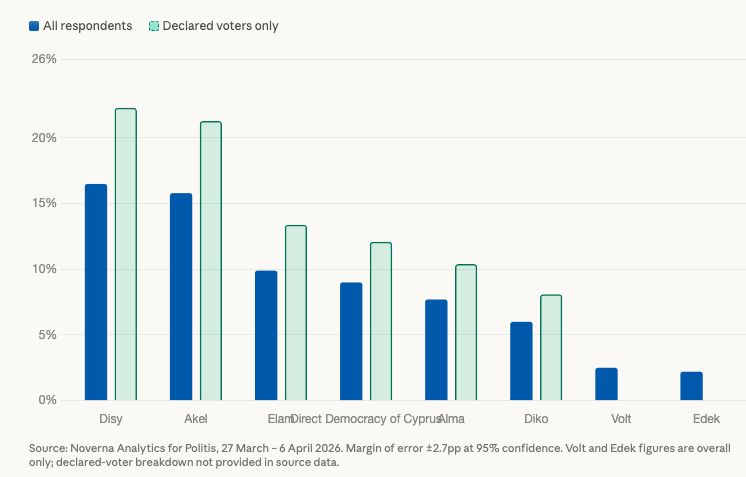
Among all respondents, Disy leads with 16.5%, narrowly ahead of Akel at 15.8%. The gap between the two falls within the survey's margin of statistical error of plus or minus 2.7 percentage points, confirming the continued balance of power between the island's two dominant parties. Elam comes third with 9.9%, consolidating its position as a near double-digit force. Direct Democracy of Cyprus follows closely at 9.0%, placing it within striking distance of Elam for third place and establishing it as one of the main vehicles for anti-establishment sentiment. Alma records 7.7%, also showing notable momentum, while Diko stands at around 6.0%, reflecting continued decline from previous elections. Further back, Volt registers 2.5% and Edek 2.2%, both within range of the 3.6% parliamentary threshold. Smaller formations remain at marginal levels.
Trend over three months
Comparing the February, March and April 2026 polls shows broad stability with some notable shifts. Disy has moved from 17.5% in February to 16.1% in March and back up slightly to 16.5% in April. Akel has remained largely flat, recording 16.1%, 15.9% and 15.8% over the same three months. Elam has hovered around the 10% mark throughout. The most striking movement is that of Direct Democracy of Cyprus, which has risen from 7.0% in March to 9.0% in April. Diko has stagnated, while Volt has edged gradually upward.
Among declared voters only
When the figures are recalculated to include only those who named a party, the picture sharpens. Disy rises to 22.3% and Akel to 21.3%, maintaining their relative distance. Elam strengthens to 13.4% and Direct Democracy of Cyprus reaches 12.1%. Alma records 10.4% and Diko 8.1%. This adjusted picture strips out the distorting effect of the undecided cohort and gives a cleaner view of the balance of forces among committed voters. The trend over three months on this same basis shows Disy dipping slightly from 23.5% to 22.3%, Akel edging up and then falling back, and Direct Democracy of Cyprus recording a clear gain in April.
Party consolidation
The data on voter consolidation reveals important differences in the internal cohesion of each party. Akel shows the highest consolidation rate at 69%, indicating a firm and loyal core vote. Elam follows at 66%, while Disy sits at 57%. At the other end of the scale, Diko records a consolidation rate of just 41%, which partly explains its polling decline, and Edek stands at only 25%, a figure that points to serious voter leakage. The trend over time shows Akel's consolidation edging up, Elam's rising notably in April, and Disy recovering after a slight earlier dip, while Diko has seen a meaningful fall.
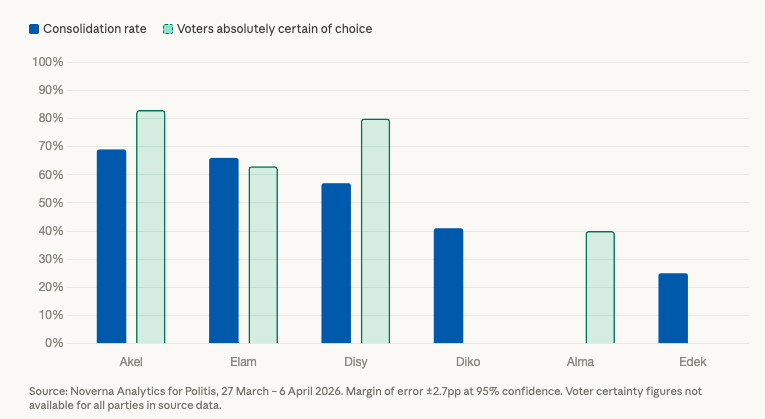
On the question of certainty of vote, Akel's supporters are the most committed, with 83% saying they are absolutely sure of their choice. Disy follows at 80% and Elam at 63%. Alma's voters are the most volatile: only 40% say they are absolutely certain, with 51% saying they could change their mind. This points to a more fluid electorate among newer or less established formations.
The undecided: the decisive factor
The most consequential finding in the survey is the 21.8% of respondents who are undecided or say they will not vote, alongside a further 3.1% who declined to answer. Combined, this pool of roughly 25% of the electorate exceeds the individual share of any single party, and its eventual movement, in any direction, could fundamentally alter the parliamentary arithmetic.
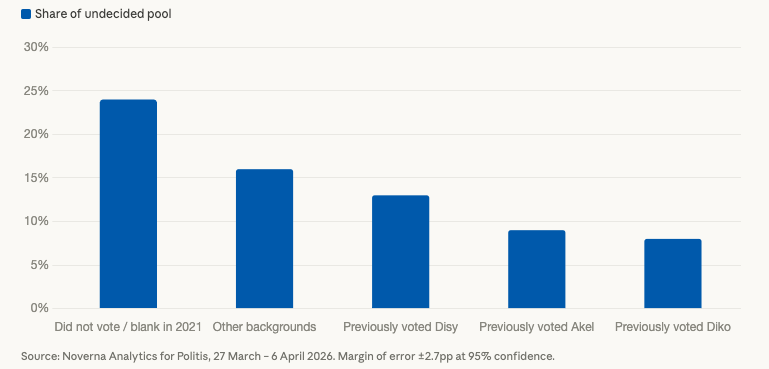
The profile of undecided voters cuts across the political spectrum. Some 24% did not vote or cast a blank ballot in 2021, while 16% come from other political backgrounds. Among those with a prior party affiliation, 13% previously voted Disy, 9% Akel and 8% Diko. The cross-partisan composition of this group means no single party can claim it as a natural reservoir of support.
The overall picture the poll presents is of a fragmented but stable political landscape, in which the major parties are holding their bases without expanding them significantly, mid-tier formations are gaining ground by capturing diffuse social discontent, and the outcome of May's vote will ultimately be determined by a quarter of the electorate that has yet to make up its mind.
The poll was conducted by Noverna Analytics and Research, a member of Sédeak and Esomar, on behalf of Politis. It surveyed 1,005 respondents from the population of the government-controlled areas eligible to vote in the upcoming parliamentary elections, using stratified random sampling and structured telephone interviews via computer-assisted telephone interviewing (CATI). The sample was weighted to reflect the demographic profile of the electorate. The maximum margin of statistical error is plus or minus 2.7 percentage points at a 95% confidence level. Fieldwork was conducted between 27 March and 6 April 2026.
A second part of the survey, to be published on Tuesday, will examine how voters link the parliamentary vote to the 2028 presidential election, which candidates they consider suitable for the presidency and their current assessment of President Nikos Christodoulides.