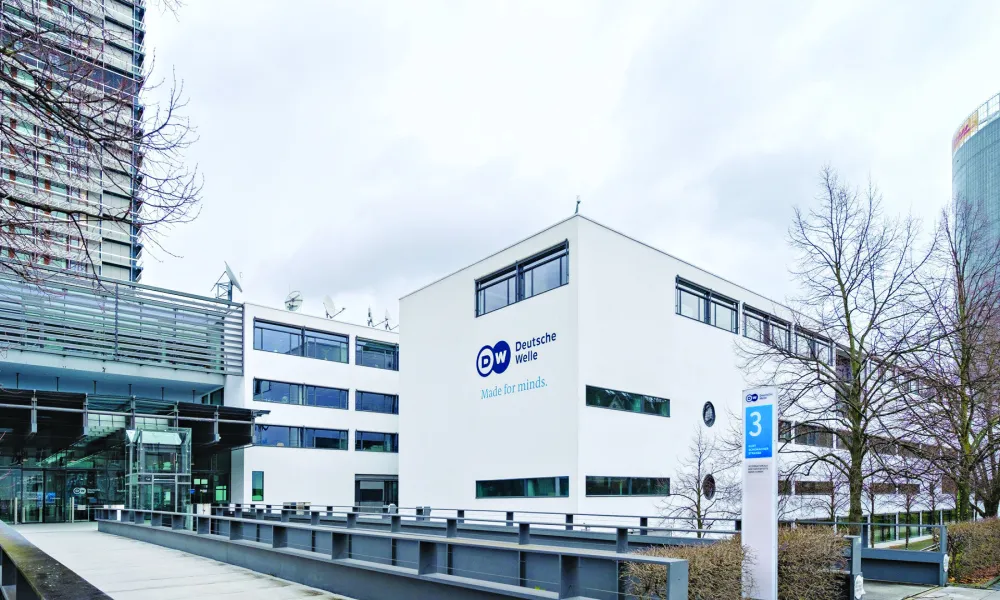



The decision by Deutsche Welle to close its Greek-language service after 62 consecutive years of uninterrupted broadcasting has caused widespread reaction. The closure was announced in February and is scheduled to take effect on 1 January 2027, with the German public broadcaster citing economic reasons following a reduction in its federal subsidy for 2026. Required savings of €21 million have resulted in the merger of departments and the elimination of positions expected to affect around 160 people, although the broadcaster stated that "there will be no dismissals." The German government had decided to cut the network's public subsidy by €10 million, reducing the total budget to €415 million. While this decision affects multiple services, the Greek-language unit is the only one being shut down entirely. Deutsche Welle currently provides services in 32 languages.
The decision was not unanimous
Sources explained to Politis that the overall budget reduction was supported in parliament by the governing Christian Democratic party, but the decisive choice to close the Greek-language programme was made by the Broadcasting Council and the group's board of directors. According to the same sources, the decision was not unanimous. The Greek-language service is considered one of the most successful in Europe, particularly in its digital transition, attracting between four and six million users per month. Its work is not limited to Greece: the network of contributors and correspondents feeds European and German news into Greek, while also providing coverage of Greek and Cypriot affairs in English and German.
No meaningful assessment was made
The blow to Cyprus appears to be considerably deeper than to Greece, sources told Politis, as the closure effectively pulls the plug on coverage of "a very critical region for Europe" at a moment of significant geopolitical developments and important domestic news. What is particularly striking, the sources noted, is that no substantive internal assessment was carried out by Deutsche Welle before the decision was taken. The group was not even aware that the programme was broadcasting to Cyprus. This is evident from the rationale document issued by the group to explain the closure, in which Cyprus is entirely absent. This is all the more paradoxical given that the Greek-language service of Deutsche Welle maintains significant and established partnerships with various local media in Cyprus, including Politis. Reaching the Cypriot audience was a conscious choice by Deutsche Welle and a longstanding goal of the programme, one that was achieved relatively recently and has continued to develop through new partnerships.
The decision was described as "sudden" and practically affects around 200 people. The assurances that there will be no dismissals do not hold in full: since the Greek-language programme relies on a number of external contributors and fixed-term contract employees whose contracts are renewed on a rolling basis, those arrangements will simply not be renewed.
The fight is not over
The battle is not yet concluded. The parliamentary budget is not finalised until December 2026, and the picture is expected to become clearer by summer. The decision has generated enormous pushback at both political and public level, with various Greek-German organisations and official bodies in Germany, Greece and Cyprus expressing their displeasure and solidarity. Journalistic organisations including the Athens Daily Newspapers Journalists' Union (ESIEA), the Cyprus Journalists' Union (ESK) and other Greek and German media have voiced concern over the impact on public information. The President of the House of Representatives, Annita Demetriou, issued a statement expressing concern and calling for the decision to be reconsidered, stating that such a choice "constitutes a downgrading of the official language of two EU member states, undermining the linguistic and cultural diversity of the European project." Such pressure is being directed at both the government and the group, in the hope of reopening the discussion, either at parliamentary level through a revision of the budget cut, or internally through a different allocation of funds. As sources explained to Politis, the total budget of the Greek-language programme represents just 0.2% of the group's overall budget.
The reasoning behind the decision, according to Deutsche Welle's official statement, is that Greece has been an EU member for many years and has "a stable democracy with a pluralistic media landscape," making the service's necessity secondary. By contrast, the statement argues, countries such as Russia and Iran currently "have a far greater need for free information," and the network's resources will be redirected accordingly.