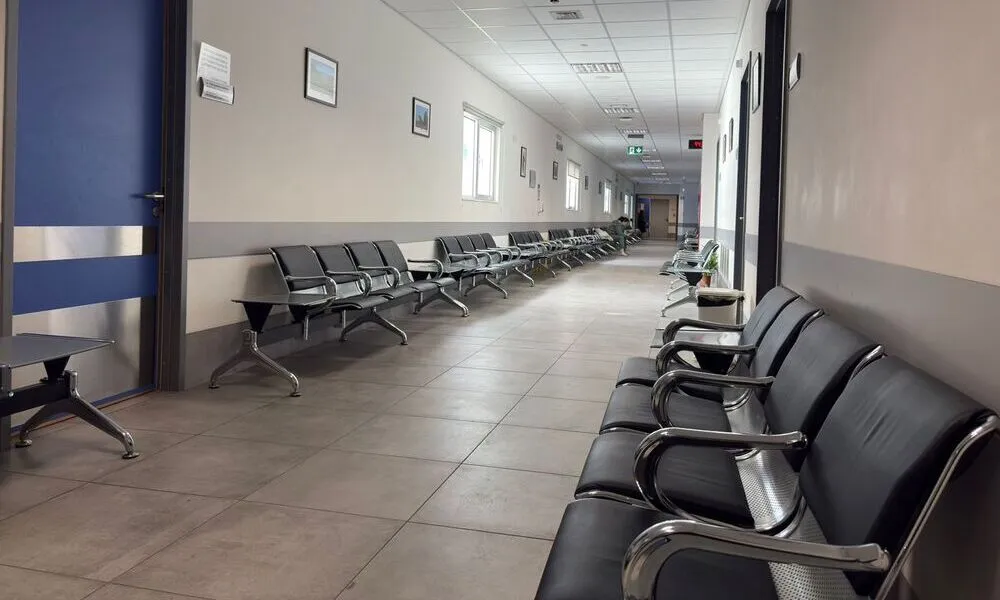

There is significant progress but challenges remain, Health Minister Neofytos Charalambidis acknowledged in the second part of his interview with Politis, reflecting on what he has seen during visits to public hospitals. The scientific competence and dedication of staff are not in question, he said, but the picture that greets a patient on arrival, alongside issues of infrastructure, organisation and staffing, continue to present unresolved problems. Against this backdrop, the autonomisation of public hospitals by the end of 2026 remains a firm target.
First impressions matter
The minister was clear that the core difficulty does not lie in the quality of care itself, nor is there a question of public distrust in hospitals as institutions. "In serious cases, citizens turn to public hospitals, recognising the scientific competence of the medical, nursing and support staff," he said. The problem, he explained, is the image that greets a patient the moment they enter. That first impression, he noted, inevitably shapes the overall perception of public hospitals, which is why upgrading infrastructure has been set as a clear priority.
Charalambidis pointed to interventions already carried out at Limassol General Hospital, which he said were completed within a short timeframe and served as targeted improvements to the day-to-day environment. The ministry intends to extend this approach gradually to other public hospitals. He noted that works currently under way across all public hospitals exceed €145 million in total value. He connected these interventions not only to the need for modernisation but also to improving the daily experience of both patients and staff. At the same time, he acknowledged that beyond physical and technical improvements, issues of organisation, staffing in specific specialties and further modernisation of processes and equipment remain open and require sustained effort.
Autonomy equals flexibility
The question of autonomisation remains, according to the minister, at the core of the reform agenda for public hospitals. He described it as a process aimed at strengthening flexibility, efficiency and the quality of health services, with a target completion date of end of 2026. Asked whether autonomisation should proceed as planned or be reconsidered, Charalambidis was unequivocal: the target must be achieved. In his view, public hospitals have already taken steps forward but must continue along a path of adaptation that encompasses both infrastructure improvements and changes to the way they operate.
Prevention moves to the fore
With the autonomisation of public hospitals already under way as envisioned since the introduction of the General Healthcare System in 2019, the Ministry of Health has shifted from the role of direct service provider to a more strategic and supervisory one. Within this new reality, health policy-making and prevention carry greater weight than before, as the primary areas in which the ministry is called to invest going forward.
The minister places disease prevention among his core priorities, stating that the ambition is to move the health system away from a purely treatment-based model towards a more holistic one that places greater emphasis on early diagnosis and prevention. Population-level screening programmes are already being implemented, he said, including mammography screening for breast cancer and a colorectal cancer programme, while new initiatives targeting cervical and prostate cancer are being advanced. Through these interventions, he said, the aim is to strengthen the population's preventive defences.
Among the ministry's broader strategic priorities, Charalambidis also cited the National Strategy for Mental Health, with the goal not only of improving quality of life but of reducing long-term pressure on the health system. "Prevention cannot be treated as an isolated action but as a continuous investment and a consistent policy choice, with the goal of a health system that operates preventively, intervenes early and actively protects the health of citizens," the minister said.