
EU and Mercosur officials signed a major trade agreement in Paraguay’s capital Asuncion, concluding negotiations that began 26 years ago.
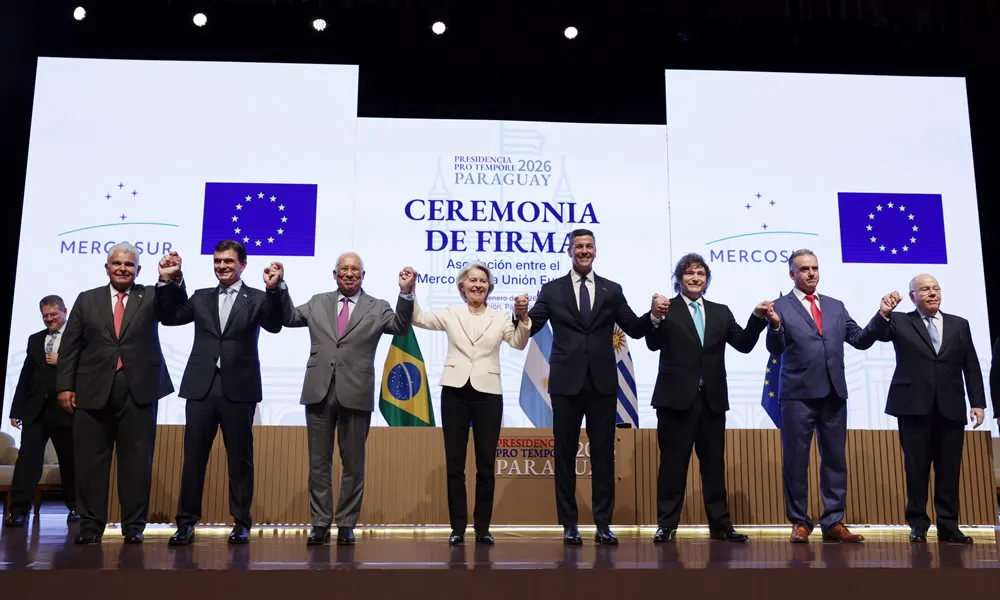
The European Union and the Mercosur bloc formally signed a long-awaited free trade agreement on Saturday in Asuncion, Paraguay, after almost three decades of deliberations.
European Council President Antonio Costa and European Commission President Ursula von der Leyen attended the ceremony alongside leaders from several Latin American countries, as officials posed for a family photo and representatives signed the deal on stage.
Von der Leyen said the agreement aimed to deliver “real and tangible benefits” for people and businesses.
There has been strong reaction to the deal, particularly in countries that voted against it, such as major agricultural producer France, with the Macron government barely surviving a no confidence vote earlier this week.
French farmers have vowed to continue voicing their opposition to Mercosur on the roads, as more protests are planned.
Cypriot producers are also against it, arguing that it lowers standards and poses risks for food safety and the sector's fragile viability.
Fewer duties, more exports
As the European Commission argues on its official website, the Agreement will create a wide range of economic opportunities in the EU by:
- Removing tariffs on EU exports, including agri-food and key industrial products such as cars, machinery, and pharmaceuticals, saving EU businesses €4 billion worth of duties per year;
- Making it easier, quicker and safer to invest in key supply chains, including critical raw materials and related goods;
- Strengthening economic security and supporting the digital and green transitions on both sides;
- Helping the EU and Mercosur to shape global trade rules in line with the highest EU standards.
A balanced deal for EU agriculture
The Agreement, as the Commission notes, will also open unprecedented access to the Mercosur region for European farmers and food producers. The deal is expected to increase EU agri-food exports to Mercosur by up to 50% by:
- Reducing tariffs on key EU agri-food products, such as wine, spirits, dairy, and olive oil;
- Protecting 344 EU Geographical Indications, high-value traditional food and drink products, from unfair competition and imitation.
At the same time, as stated by the Commission, the EU has taken great care to ensure that sensitive agri-food sectors benefit from every necessary protection, thanks to the following measures:
- Carefully calibrated tariff rate quotas that limit market access of sensitive products imported from Mercosur;
- A legally binding safeguard mechanism that protects sensitive European products in case of a surge in imports from Mercosur countries;
- Enhanced controls preventing non-compliant products from entering the EU market, including more audits and checks in third countries, and strengthened controls at EU borders;
- Taking actions by the Commission to operationalise the commitment in the EU's Vision for Agriculture and Food, for a stronger alignment of production standards, such as pesticides and animal welfare, applied to imported products; and
- A €6.3 billion fund, the Unity Safety net as from 2028, as an additional layer of protection for our farmers in case of market disturbances.
Next steps
Following the signature of the EMPA, the EU and Mercosur will now follow their respective procedures to work towards the ratification of the Agreement.
On the EU side, the EMPA will be subject to ratification by all Member States, following their national procedures. At the same time, the ITA will follow EU-only ratification process as it falls under EU exclusive competences. This will require the consent of the European Parliament and the adoption of a decision on the conclusion by the Council, after which it will enter into force.
The iTA will expire once the EMPA enters into force.
Sources: Euronews, European Commission