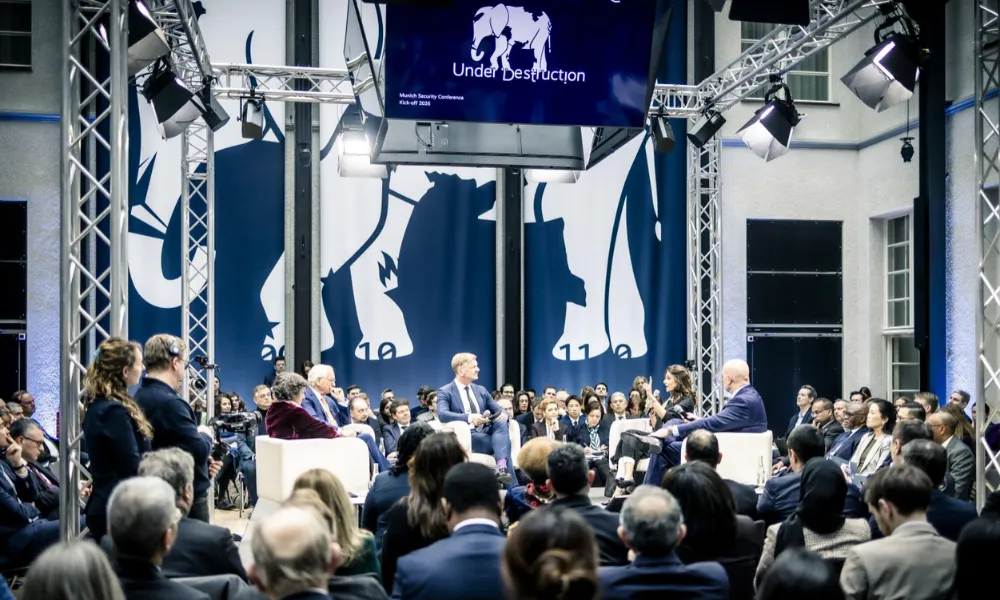
The Munich Security Conference opens today against a backdrop of heightened geopolitical tensions and growing uncertainty in transatlantic relations. One year after the controversial intervention by US Vice President J.D. Vance, European leaders arrive seeking to preserve cooperation with the United States while shaping a more autonomous strategic direction. Greece will be represented by Minister of Environment and Energy Stavros Papastavrou.
Opening of the conference and geopolitical context
This year’s Munich Security Conference begins amid multiple ongoing international crises. The war in Ukraine continues, tensions with Iran remain unresolved, and several global conflicts remain active.
Wolfgang Ischinger, President of the forum, acknowledged the exceptional climate surrounding the event, stating that he could not recall another period with so many simultaneous conflicts and crises of such scale.
The annual gathering, founded during the Cold War as a Western forum for defence and security dialogue, brings together senior officials and policymakers to discuss pressing global security challenges.
From the Vance intervention to Rubio’s diplomatic approach
Last year’s speech by US Vice President J.D. Vance marked a turning point in relations between the United States and Europe. In a sharply worded intervention, he criticised European governments over freedom of speech and migration policies, arguing that these issues threatened Western civilisation. The remarks were interpreted by many participants as a signal that the new US administration no longer viewed Europe as an automatic or equal partner.
This year, the US delegation is led by Secretary of State Marco Rubio, who is expected to adopt a more moderate tone. Before departing, Rubio stated that the United States remains closely connected to Europe, while adding that the world has entered a new geopolitical era requiring a reassessment of relationships and priorities.
Trust and tensions within the transatlantic alliance
Despite efforts to reassure European partners, scepticism remains. Statements by Donald Trump regarding the annexation of Greenland, a territory of Denmark and a NATO member, along with tariffs imposed on both allies and rivals, have contributed to what many European officials describe as a decline in trust. For some European leaders, Washington is increasingly viewed as an unpredictable actor rather than an unquestioned pillar of stability.
Europe’s strategic autonomy and defence priorities
German Chancellor Friedrich Merz is set to open the conference, seeking to balance the preservation of transatlantic ties with the strengthening of Europe’s strategic autonomy. He has previously argued that Europe must learn the “language of power politics”, calling for increased investment in defence, technological independence and economic competitiveness.
The debate is intensified by Europe’s continued reliance on US military capabilities, even as discussions resume over potential security guarantees for Kyiv in the context of the ongoing conflict with Russia.
International participation and global significance
Around 70 heads of state and government and more than 140 ministers are expected to participate in the conference. Attendees include Ukrainian President Volodymyr Zelensky, French President Emmanuel Macron, UK Prime Minister Keir Starmer and Chinese Foreign Minister Wang Yi.
Their presence underscores the broader international character of the forum, which extends beyond transatlantic relations to wider questions about global power realignment.
Diplomatic divisions and shifting alliances
French President Emmanuel Macron has adopted a sharper position in recent months, referring to what he described as an openly anti-American approach by the Trump administration and warning of further escalation following the Greenland dispute.
At the same time, Canadian Prime Minister Mark Carney is reportedly seeking new trade partnerships, including with China, as a response to perceived instability in US policy.
Russia will not be represented at this year’s conference, while invitations to Iranian officials were withdrawn following the violent suppression of protests. These developments reflect broader strains on the post-war international order.
Confidence and credibility in transatlantic relations
According to Wolfgang Ischinger, transatlantic relations are undergoing a serious crisis of confidence and credibility. The conference is not expected to produce immediate solutions but is widely seen as a measure of whether the United States and Europe can redefine their cooperation amid shifting global power dynamics.
For three days, Munich will be at the centre of diplomatic engagement, public demonstrations and political messaging, as international leaders assess whether Western unity can endure under changing global conditions.
Approximately 65 heads of state and government, alongside representatives from international organisations, defence and security experts, academics and industry leaders from more than 115 countries, are expected to attend.
Source: huffingtonpost.gr