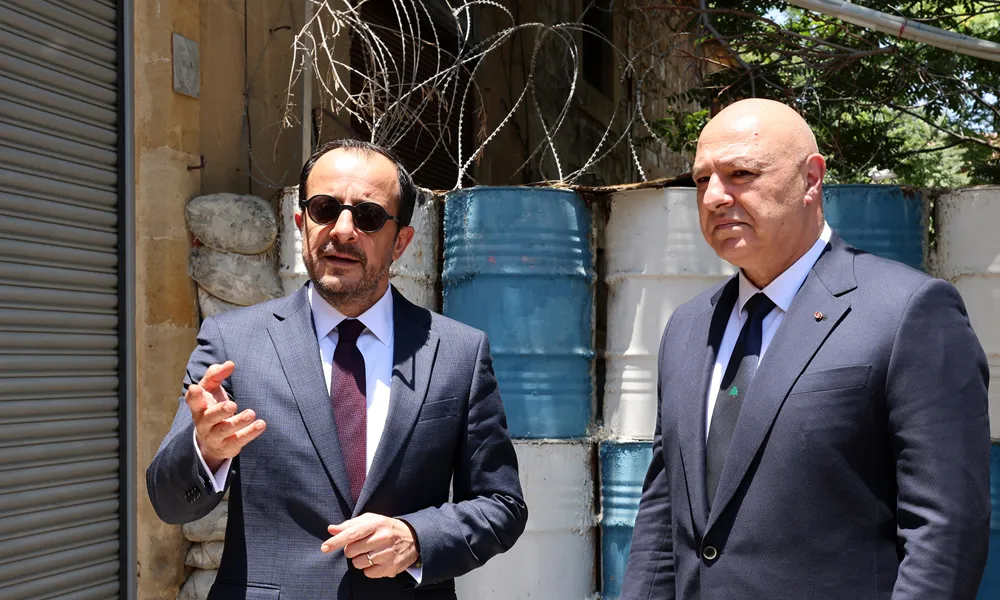

President Nicos Christodoulides arrives in Beirut on Wednesday to sign a revised Exclusive Economic Zone agreement with Lebanon, marking a new page in regional energy collaboration between the two countries.
While the government remained tight-lipped about the reasons behind the president’s visit, Politis to the point understands the maritime delimitation agreement will be one of two announcements made during his meeting with Lebanese President Joseph Aoun.
Revised EEZ agreement after 18 years
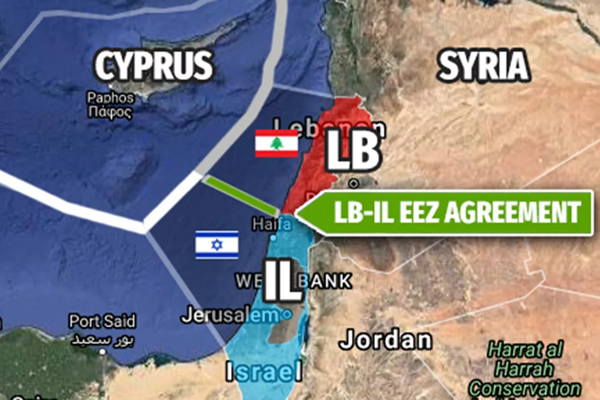
The agreement, adopted by the Lebanese cabinet last month, is a revised version of the initial EEZ delimitation signed in 2007 between the two countries. The initial agreement fell victim to sectarian differences, with the Lebanese parliament unable to ratify it, mainly due to pushback from one denomination, believed to have been influenced to some degree by Ankara’s opposition to the deal.
However, Lebanon reached an informal agreement with Israel on their maritime boundary in 2022, brokered by the US. Rather than ask the Lebanese parliament to ratify an agreement with a country it does not recognise, then President Michel Aoun approved the agreement on Lebanon’s behalf. With this precedent in mind, the revised Lebanon-Cyprus EEZ agreement will likely be signed by the two presidents, after which it will only require internal ratification through a decree by the Lebanese President or one of his ministers, and ratification by Cyprus’ parliament, to come into effect.
Keen to attract international majors
The mood in Lebanon has changed considerably in recent years as the country suffered a series of setbacks that have shaken its financial system and economy. It is now keen to create a stable and predictable environment to attract major energy companies for exploration and exploitation in its maritime waters. As signatories to the UN Convention on the Law of the Sea, the two countries agreed to adopt the median line delineation of their maritime boundary, that is, the middle point between the opposite coastlines. The same method was applied for Cyprus’ EEZ agreements with Israel and Egypt.
Syria next?
The latest version of the maritime boundary with Lebanon incorporates the changes made based on the southern Lebanon-Israel boundary, while setting the northern Lebanon-Syria boundary using the median point again. It also includes a standard clause that allows the tripoint nexus where Cypriot, Lebanese and Syrian waters meet to be permanently finalised at a future point when all relevant parties are involved.
With Lebanon and Cyprus having finalised their respective economic waters, the path is cleared for Syria to engage with Lebanon, Turkey and even Cyprus to settle its respective maritime boundaries. However, it remains to be seen whether current Syrian President Ahmed al-Sharaa is in a position to engage in sensitive negotiations on issues of national interest at present.
Regional energy cooperation
Speaking before the visit, President Christodoulides said announcements would be made on “two important issues” in Beirut, which he did not wish to elaborate on for political reasons.
Government Spokesperson Konstantinos Letymbiotis said on Tuesday, the announcements will concern “issues of energy cooperation and broader regional aspects”, confirming Cyprus’ steadfast orientation towards “enhancing security and stability in the region”.
The two presidents will discuss regional developments, security and stability, and cooperation in areas of mutual interest. He noted Cyprus attaches great weight to strengthening Lebanon’s resilience and stability. Ahead of Cyprus’ EU Presidency, and “as the EU member state closest to Lebanon, Cyprus remains firmly committed to reinforcing the EU–Lebanon partnership,” he added.
Christodoulides will be accompanied by Letymbiotis, Deputy Minister for European Affairs Marilena Raouna, and National Security Adviser Tasos Tzionis.
Based on the intensified contacts between the two countries, and the exchange of visits at a senior level, the second announcement planned could relate to one of the following issues:
· Potential regional collaboration with neighbouring countries;
· Launch of a World Bank-funded study on a Lebanon-Cyprus electricity interconnection;
· Exchange of technical know-how on electricity autonomy;
· Launch of discussions on a comprehensive EU-Lebanon strategic agreement;
· Further collaboration on migration issues.
Commercial interests
Regarding energy companies involved in the region, the major player in Lebanese waters at the moment is French giant Total. The day the Lebanese cabinet approved the EEZ agreement with Cyprus, it also approved the award of offshore Block 8 to a consortium consisting of European majors TotalEnergies and Eni with Gulf NOC QatarEnergy. The area lies at a nexus between Cyprus’ EEZ and Israel’s offshore waters. Across the maritime boundary with Israel sits Chevron which operates the Leviathan and Tamar gas fields, along with smaller reservoirs operated by Energean. In Cypriot waters, the major players looking to move gas to market the fastest are Total and Eni, while ExxonMobil and Chevron also have sizeable confirmed recoverable gas reserves.