
It no longer suffices to say that it is new, European or different. After the electoral failure in the parliamentary elections of last May, Volt is attempting an internal restart. The 11,487 votes it counted after the opening of the ballot boxes may not have given it a seat, but they are considered a good "dowry" for the continuation of the party.
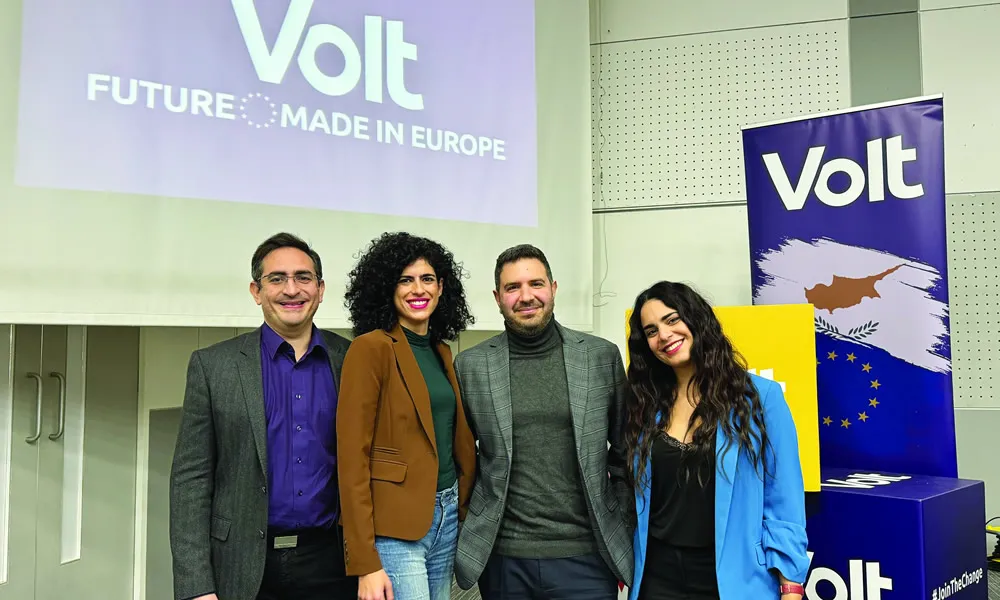
In a difficult but necessary political exercise Volt places itself, and in this context it held on Thursday evening a meeting of members, friends and supporters in Dali, under the title "We are open, come along". After the electoral defeat in the parliamentary elections, the party is called upon to see what went wrong at the ballot box, to keep close to it the people who voted for it and, above all, to answer a basic question: "And now what?" The slogan of the event says a great deal. "We are open." So nothing has closed. Neither the party nor the discussion. With the meeting in Dali, Volt appeared to turn its gaze once again to its own people. The venue of the event was divided into four thematic tables, at which there was a review of what had preceded but also a discussion of proposals concerning communication, organisation, penetration into society, as well as the political identity and positions of the party. The wager of the meeting was to keep the party's voters close and to show that it can stand on its feet again. The interest, however, is already shifting to the electoral congress of October, at which the election of the members of the political council and the emergence of a new leadership are expected.
The need for a role
In the parliamentary elections, Volt won the vote of 11,487 citizens. Although it did not secure any seat, it is trying to keep its presence felt, with its voters able to prove useful in the next big political battle. The wager is whether these votes will constitute political capital, whether they will evaporate or whether they will be won by other parties.
Here the difficult equation begins. Without a parliamentary presence, Volt needs a role, a clear identity and a reason to exist. It no longer suffices to say that it is new, European or different. It must show where it stands and with whom it can march together.
And in the background... AKEL
The recent joint event of AKEL and Volt outside the Legal Service, on the occasion of the "Mafia State" case, did not go unnoticed. It may be explained politically in terms of institutions, transparency and the rule of law. But in politics such images always give birth to scenarios.
AKEL is already looking towards the presidential elections of 2028 and knows that, in order to have a prospect of victory, its traditional base alone does not suffice. It needs openings to more middle-class, liberal, European and anti-systemic audiences. That is, to spaces where Volt, even without a seat, managed to make contact.
For Volt, however, a rapprochement with AKEL has two readings: on the one hand, it can give it a sense of political role and greater influence, especially if there are also political trade-offs, whether at the level of support or at the level of participation in a broader design of power; on the other hand, however, it also opens another important discussion, namely whether Volt, having started as an independent political force, risks over time losing its autonomy and being absorbed into a larger party.
When the numbers speak
Looking back to 2023, during the second round of the presidential elections, the difference between Christodoulides and Mavroyiannis was 15,532 votes. Consequently, Volt's 11,487 votes have great significance in the presidential elections of 2028. The comparison with the first round of 2023 is also of interest, since the difference between Christodoulides and Mavroyiannis was smaller than Volt's electoral size. This certainly does not mean, however, that Volt's voters are a package that is transferred wherever the leadership decides. It does mean, though, that they are not a negligible reservoir.