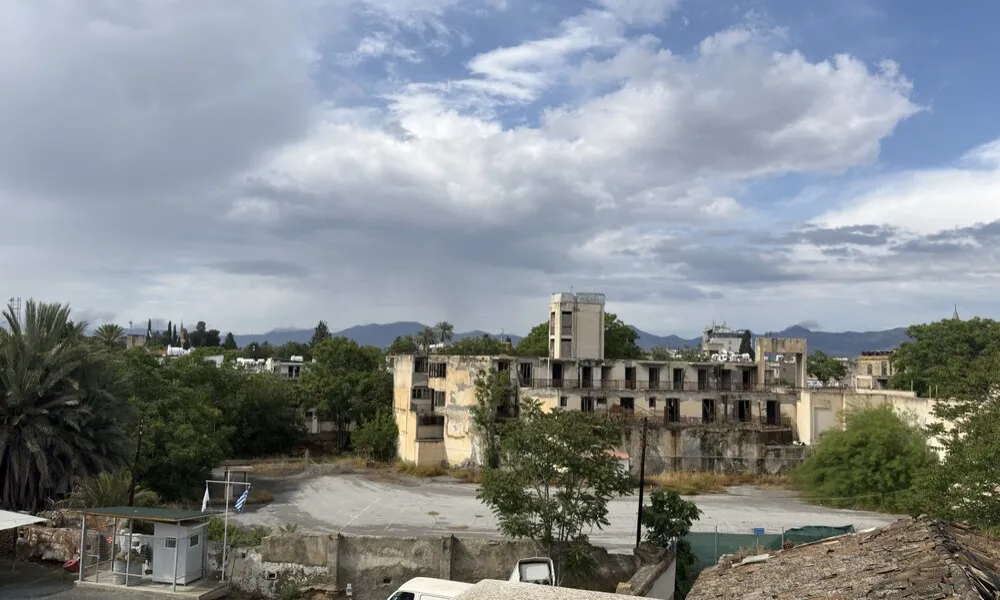

Cyprus has been an EU member for 22 years, but its leadership has still not settled whether it is in its interest for the Turkish Cypriot community to move closer to the Union. What exactly is it seeking? To create fissures in the occupation line and bring the Turkish Cypriots closer? Or does it perhaps prefer that they remain at the mercy of dependence on Turkey?
These strategic questions have never been answered honestly.
Green Line
The European Commission released (30/6) its report on the Green Line Regulation (GLR/2004). The Commission records 7.5 million crossings by citizens (2025). Queues of hardship at the crossing points. The additional points "would improve the daily life of Cypriots", writes (6/7) the Secretary-General, António Guterres, to the Security Council, and adds: (if they opened) "they would demonstrate in a concrete way that the sides have the political will to make progress." Yet Christodoulides does not agree with Erhürman on even one new crossing point. At the most crucial period for a restart of talks, the political will is missing, despite declarations to the contrary.
Obstacles to trade
The European Commission finds that through the GLR "there are possibilities for the development of Turkish Cypriot trade", but this too meets "obstacles". In its report it records a series of obstacles: delays in product checks, restrictions on categories of products and prohibitions on the movement of lorries, all practices of the government at the crossing points. Nicosia stays silent, but these do not go unnoticed. Guterres demands the removal of these obstacles that hold back trade, Greek Cypriot–Turkish Cypriot cooperation and their economic interdependence.
The Commission describes further obstacles: the ban on processed foods (of non-animal origin) produced by the Turkish Cypriots. The government refuses to give its consent. Moreover, Turkish Cypriot businesspeople systematically encounter difficulties in opening accounts at Cypriot banks. The Central Bank of Cyprus issued a relevant circular, but the commercial banks as a rule do not apply it.
Since 2004, the GLR has not included animal products. But halloumi (in Turkish "hellim") became possible to add, it is certified PDO, and Jean-Claude Juncker requested it in 2015. To this day, the Turkish Cypriots have not managed to sell even a single kilo, despite having 25 certified producers.
The Christodoulides government is the only one not to have opened any crossing. The forces that support it, DIKO, EDEK and ELAM, demand that the crossing points be closed. From time to time they demonise the crossings and bicommunal trade, poisoning the climate. The Greek Cypriot supermarkets refuse to put Turkish Cypriot products on their shelves. Regardless of the fact that thousands of Turkish Cypriots cross to the south to buy meat and many products that are cheaper.
Contradictions
On the basis of EU statistical data, Turkish Cypriot businesspeople send to the Greek Cypriots products worth just 14.5 million euros (2025). The Greek Cypriot businesspeople, however, make ten times as many imports directly from Turkey (160 million euros, Statistical Service, 2024). It is an oxymoron, but this is what happens: Nicosia blocks Turkish Cypriot products, while at the same time permitting products from Turkey that come from the occupying power?
The Turkish Cypriots carry out limited trade, mainly through Turkey, which barely reaches 170 million euros annually (2023). The Greek Cypriots import products worth over 12 billion euros annually. They could easily absorb Turkish Cypriot trade. If they were more open and a little generous, they would see that economic interdependence is in their interest. With increased trade, Turkish Cypriot traders would have notable profit and Greek Cypriot clientele. Now they send their products to Turkey and are plagued by the inflation of the Turkish lira.
For years the World Bank has warned: without a Turkish Cypriot business base, the economic gap between north and south widens and reunification efforts become harder. With the chronic inertia, the only ones who ultimately prosper in the occupied areas are big Turkish capital, which builds hotels, casinos and buildings and economically displaces the Turkish Cypriots.
Pretexts
For 22 years the government has applied the GLR selectively and as a pretext. If it wanted, it would promote the necessary changes to the Regulation, as the UN and the EU request: the opening of crossing points, the addition of new products, arrangements for products and lorries. If it wanted, it would also operate the joint technical committee for the harmonisation of the Turkish Cypriot community with the European acquis.
The obstacles it puts in place contribute to the alienation of the Turkish Cypriots, their economic weakening and their deeper dependence on Turkey. With its incomprehensible policy, the only thing it ultimately achieves is to shoot itself in the foot.
The Republic of Cyprus is the opening of the Turkish Cypriots towards the EU. With a coherent European strategy, the Greek Cypriot leadership could overturn the conditions of division, in order to support, at the appropriate moment, the paramount negotiation on the substance of the Cyprus problem under the UN. But the political leadership of the Greek Cypriots keeps the possibilities offered by the EU unexploited. With the dogmatism and the "diplomatic sclerosis" that grips it, it never dared to look beyond the keyhole.