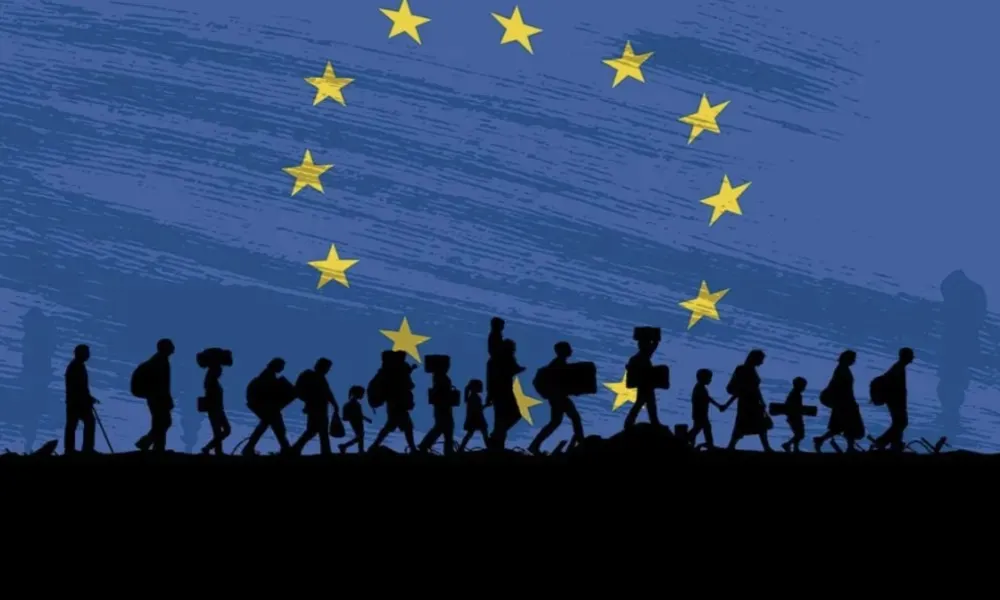

After four years of consultations and two years of preparation, the Pact on Migration and Asylum in the EU came into force on 12 June 2026. It consists of 10 new legislative texts that reshape the European framework for the management of migration and asylum. A week later, the legislative package supplementing the new framework was approved by majority in the European Parliament, including, among other things, the new returns regulation, contested by some member states, which opens the way for the possibility of creating return centres in third countries.
The pact is considered a pivotal point for EU migration policy. It constitutes the first substantive revision of the European system since 2008 and creates a common European system establishing new procedures for the management of migration in normal periods, while also covering crisis situations and phenomena of instrumentalisation, such as the activity of illegal traffickers.
Returns regulation
Alongside the implementation of the new pact, the legislative framework supplementing its application was approved, with the new regulation on the returns of migrants without a right of legal residence in the European Union as its central element. The new regulation introduces common rules for all member states, creating a European system with common procedures for returns. It also provides for stricter rules on forced returns, measures against absconding and special provisions for individuals considered a security risk.
At the same time, timeframes are tightened and case examination procedures are simplified, something that had been identified in the past as one of the basic problems of the previous framework. Migration Commissioner Magnus Brunnerstated that we now "have more control over who can come, who can stay and who must leave" the EU.
A 92% drop in new arrivals in Cyprus
In the case of Cyprus, the new European framework is being applied at a time when the data record a significant reduction both in new asylum applications and in irregular arrivals. Figures provided to "P" by the Deputy Ministry of Migrationdemonstrate a steady decline in new asylum applications in recent years. Specifically:
- New applications, which numbered 11,617 in 2023, fell to 6,769 in 2024 and were further reduced to 2,835 in 2025. For 2026, up to the end of May, new applications stand at 754.
- This reduction, according to the same figures, corresponds to a fall of 46% in 2023 compared with 2022, 42% in 2024 compared with 2023 and 58% in 2025 compared with 2024. Compared with 2022, the overall reduction in new asylum applications in the first five months of 2026 reached 92%.
- A corresponding picture emerges in irregular arrivals. From 10,991 in 2023, they fell to 6,103 in 2024 and to 2,444 in 2025, while for the period January-May 2026, 623 arrivals were recorded.
- In parallel, by the beginning of June 2026, 3,747 voluntary and forced returns had been recorded, a fact which, according to the deputy ministry, reflects the strengthening of the operational and administrative management of migration.
Illegal entry via the occupied areas
As regards the routes of entry, the Asylum Service's figures show that the majority of new asylum seekers enter the Republic of Cyprus illegally. In 2025, 2,531 cases of illegal entry were recorded against 304 of legal entry, while for 2026 up to May, 631 cases of illegal entry were recorded against 123 of legal entry.
The deputy ministry also states that during 2026 sea flows towards the areas controlled by the Republic have been reduced to zero, and that the now limited arrivals take place via the buffer zone.
Regarding the countries of origin of new asylum seekers, for the first five months of 2026 the leading country is Somaliawith 145 people, followed by Syria with 115, Sudan with 83, Iran with 69 and Palestine with 44. However, in pending applications for international protection the picture differs, with Syria remaining the largest category, with 9,700 pending cases in mid-June 2026.
Return centres in third countries
One of the most significant provisions of the new regulation is the possibility of creating return centres in third countries, following agreements between a member state and a third country. The aim is the return of individuals without a legal right of residence in the EU. The centres can operate either as a final destination or as an intermediate station before repatriation.
According to the EU institutions, the relevant agreements must be concluded on the basis of international law and the principles of human rights protection. Austria, Germany, Greece, Denmark and the Netherlands are already in negotiation processes with third countries. Cyprus's Deputy Minister of Migration, Dr Nicholas Ioannides, expressed the Republic's interest in participating in corresponding negotiations. The EU is not involved in these negotiations but will oversee the agreement.
Dr Ioannides had stated on "Politis 107.6 & 97.6" radio, the day after the decision, that this particular regulation "was the missing piece of the pact", describing it at the same time as a "great success" for the Cypriot presidency and the EU.
MEP Loucas Fourlas told "P" that the success of the pact constitutes a "national need", as the procedures until recently were slow and the front-line states "shouldered a disproportionate burden". One of the basic problems of the previous system, he noted, was that four in five applicants whose applications were rejected remained illegally on European soil, owing to gaps and ambiguities that the new pact attempts to address. He also underlined that "whoever is entitled to protection must receive it quickly and with respect for human rights", while at the same time the trafficking networks "that exploit human lives" must be confronted.
Italy - Albania
The debate on the creation of return centres in third countries has already opened at European level, with Italy's modelconstituting the most characteristic example.
In November 2023, Italy and Albania announced an agreement for the creation of two centres in Albania, to which people rescued at sea by Italian vessels would be transferred, including people seeking international protection. They would remain in these centres until the examination of their applications through faster asylum procedures or until their return was arranged. The Italy-Albania agreement constituted one of the first examples of the externalisation of the management of migration flows, with the European debate now turning to the possibility of utilising corresponding models within the framework of the new regulation.
Reactions
This option, however, has provoked strong reactions. Amnesty International, in its analysis of the Italy-Albania agreement, assessed that this particular model is highly unlikely to achieve its declared goal as regards the management of migration, while also expressing concerns about possible effects on fundamental rights, among them the right to life and physical integrity of people rescued at sea, as well as the rights to liberty, to asylum and to effective legal protection of those transferred to third countries.
The Italian model continues to provoke political reactions on the old continent. French President Emmanuel Macron and Spanish Prime Minister Pedro Sánchez have publicly expressed their opposition to the creation of return centres in third countries, while European parliamentary groups and human rights organisations have also voiced concerns about the practical application of the new framework.
From protection to deterrence
Despite the argument that the new pact gives the EU the tools it lacked for the more effective management of migration, there are also strong criticisms of its philosophy and practical application. Dr Nicos Trimikliniotis, professor of Sociology, Social Sciences and Law and director of the Centre for Fundamental Rights at the University of Nicosia, speaking to "P", argued that the new framework shifts the centre of gravity of European policy "from protection to deterrence".
As he explained, the pact introduces, among other things, screening procedures, increased security checks, faster procedures at the borders, greater use of biometric data and easier utilisation of the concept of the "safe third country". According to him, the screening check is not simply an identification procedure but can determine a person's course from the very first stage: whether they will follow the regular asylum procedure, whether they will be placed in a border procedure, whether they will be detained or whether they will be led into a return procedure.
He expressed particular concern about the asylum procedure at the borders, which, as he noted, provides for faster examination of cases within short deadlines and under conditions that may hinder access to legal aid, interpretation and support. He dwelt in particular on the possibility of creating return centres in third countries, describing it as an "externalisation of responsibility". As he stated, the EU is attempting to transfer part of the management of refugee and migration flows to countries outside the EU or at its edges, something that raises significant questions about the protection of rights.
Indirect refoulement
The issue, according to him, acquires particular significance for Cyprus, which is situated in a region that includes countries such as Syria, Lebanon, Palestine, Israel, Egypt and Turkey, while at the same time being an EU member state and a divided state. Dr Trimikliniotis also expressed reservations about the application of the concept of the "safe third country", noting that a country cannot be considered safe merely by political decision; rather, genuine protection, access to asylum procedures, dignified conditions and protection from refoulement must be ensured. As he underlined, the principle of non-refoulement constitutes a core element of international refugee law and cannot be circumvented through agreements with third countries.
Two approaches
The debate around the new pact therefore moves between two different approaches. On the one hand, supporters of the new framework consider that the EU is at last acquiring common tools to confront a problem that disproportionately burdened the front-line states. On the other, critics warn that the more effective management of flows must not come at the expense of the rights of those seeking protection.