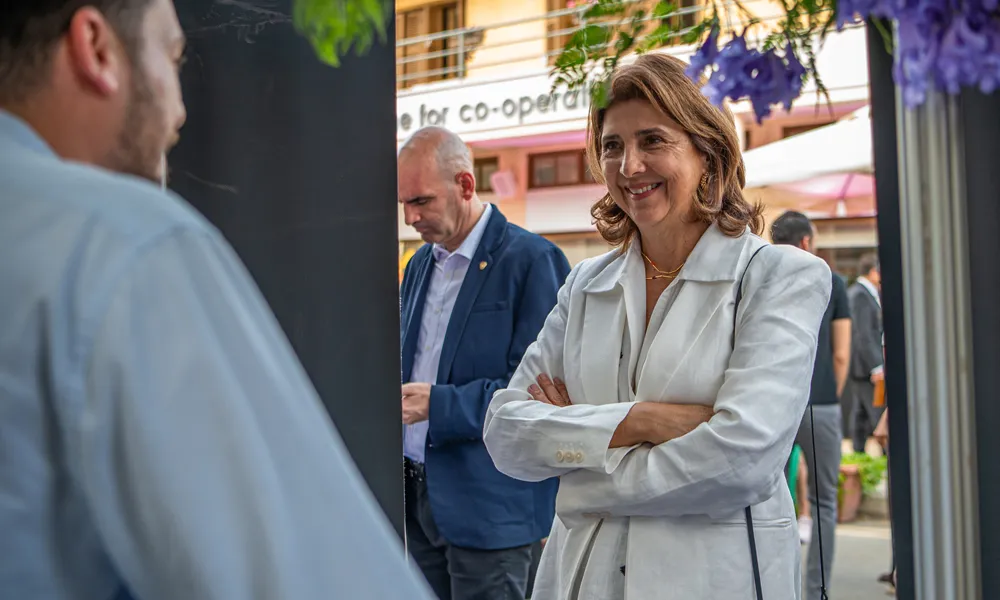

For almost a decade after the failed talks at Crans-Montana, the Greek Cypriot leadership operated under the illusion of a risk-free status quo. However, the UN envoy, María Ángela Holguín Cuéllar, has shattered this dangerous complacency, warning that treating the current deadlock as a safe haven is now a fatal mistake. Encircled by escalating conflicts in the Middle East, Cyprus cannot pretend to exist inside an isolated bubble. Moreover, Nicosia's diplomacy of impressions conceals deep contradictions in its foreign policy.
The government's parallel pursuit of Western military roadmaps and Schengen accession collides violently with the island's hyper-mobile technology services economy, Turkey's regional dominance and the irreversible physical changes being consolidated in the occupied north. Ultimately, this unstable realpolitik is pushing UN Secretary-General António Guterres to impose a final informal five-party "5+1" conference, a high-risk window for confronting a status quo that has now been completely overtaken.
The axis of accountability
The open letter of the UN's personal envoy, María Ángela Holguín, can be read as a raw, uncompromising realpolitik critique, designed to demolish what she regards as a country "frozen in time".
Her central argument rests on the premise that the luxury of comfortable stagnation has definitively expired. From this perspective, the primary target of her message is the island's entrenched political architecture. By deliberately withholding official written texts during her tenure, her evident intention was to bypass the propaganda of the local media and impose a direct confrontation with physical realities, instead of the diplomacy of impressions. She targets the underlying motives of the political elite, arguing that "there will be sectors that prefer the status quo to compromising their positions".
Furthermore, her letter presents a stern psychological diagnosis of the deadlock, arguing that institutionalised historical narratives trap the population in a zero-sum mentality. She observes that "when a painful past is taught repeatedly, it becomes impossible for people to be open to change", which explains why "certain sectors perceive even small changes as a threat or betrayal". Rejecting the dangerous idea that a frozen conflict constitutes a safe haven, she stresses that "positive changes happen when leaders recognise what is at stake and focus on the long-term prosperity of their communities".
Ultimately, Holguín shifts the burden of responsibility from the United Nations directly onto the public, issuing a stark ultimatum to "all Cypriots to encourage and press their leaders to work for a better and secure future". She concludes that avoiding permanent partition depends entirely on ordinary citizens demanding that their "leaders demonstrate will and determination".
Irreversible changes on the ground
In the decade since the collapse of the Crans-Montana talks, time has actively eroded the prospects for peace in Cyprus. Ankara and the administration in the north have aggressively and irreversibly transformed the island's political, demographic and physical landscape. Most notably, Varosha, once the untouchable focal point of peace negotiations, has been converted into a tourist hub, in direct violation of UN Security Council resolutions. At the same time, the possibility of resolving the property claims of the displaced is being systematically destroyed by a construction boom in specific areas, such as Trikomo.
Compounding this legal and demographic erasure, the occupied north is becoming inescapably interconnected with mainland Turkey, through massive infrastructure integration, including undersea water pipelines and planned undersea electricity grids. This aggressive, multi-front physical and economic assimilation demonstrates a fatal reality: the ground required for building a balanced, bizonal federation in Cyprus is rapidly vanishing.
Delaying tactics
The forthcoming five-party ("5+1") conference under UN auspices is essentially doomed to fail unless the underlying motives of both sides are exposed. Instead of confronting the island's existential threats, both the Greek Cypriot President, Nikos Christodoulides, and the Turkish Cypriot leadership remain deeply entrenched in zero-sum positions, prioritising domestic political survival over genuine compromise.
Nicosia's current manoeuvres, for example, underline the depth of this strategic impasse. President Christodoulides's five-point proposal functions as an institutional smokescreen, designed to obstruct substantive progress. By demanding a review of previous agreements and convergences by the UN before talks even begin, Nicosia is orchestrating a bureaucratic paralysis, possibly to delay politically painful decisions. This diplomacy of impressions is further exposed by unrealistic confidence-building measures, such as the demand for the opening of the Kokkina crossing, a fortified Turkish military enclave and a deliberately dead-end issue whose failure is guaranteed.
Nicosia's declared support for a bizonal, bicommunal federation requires explicit and substantive confirmation. Demanding a return to the agreed framework while simultaneously pursuing military alignments with the US and France constitutes a profoundly flawed strategy of external balancing. Instead of deterring Turkey, this approach provokes a serious security dilemma, pushing Ankara to accelerate its military build-up in the occupied north.
The sense of urgency
As the Eastern Mediterranean rapidly evolves into a geopolitical powder keg, the primary goal of UN Secretary-General António Guterres for the forthcoming "5+1" conference is to prevent a catastrophic escalation. The driving force behind this urgent mobilisation is a highly confidential Western plan aimed at replacing the 1960 guarantees for Cyprus. This plan envisions a radically new security framework based on NATO, proposing a decentralised federation secured by a joint Western military command.
However, this Western security proposal assumes that Ankara will voluntarily renounce its unilateral right of intervention and its physical military presence. Second, the plan ignores the reality of a political retrenchment by the United States, which is actively reducing its Euro-Mediterranean presence to focus on high-intensity theatres in the Indo-Pacific. Finally, the plan wrongly relies on an over-indebted, politically fragmented European Union, which fundamentally lacks the strategic autonomy and military power required to enforce security guarantees in the volatile Levantine region.
Nicosia's strategic priority
Faced with the Guterres mobilisation for a new "5+1" conference, Nicosia can no longer afford the luxury of feigned procrastination or maximalist positions. To neutralise Turkey's asymmetric physical advantage, the Greek Cypriot leadership must shift from a stance of rigid, zero-sum resistance to one of assertive, transactional pragmatism, actively championing a functional bizonal federation that relieves the central state of points of domestic friction, while clearly preserving its single international legal personality.
This constitutional compromise would presuppose a multi-layered transatlantic security shield, effectively replacing the 1960 guarantees with a local, multinational supervisory framework. Instead of depending on a declining American footprint or a potentially economically fragmented European Union for external balancing, Nicosia must actively leverage its offshore energy reserves, transforming an unstable military frontier into a highly profitable Euro-Mediterranean partnership.
The Republic of Cyprus can bind the entire island to the West and successfully secure its prosperous economy in the currently controlled areas, not through the empty promise of a fortress state, but through the binding realities of regional economic interdependence.
The Schengen contradiction
President Christodoulides's foreign policy suffers from a fatal paradox: it operates as if Cyprus were already unified. While Nicosia has developed a flourishing technology economy in the south, this hyper-mobile digital capital is extremely vulnerable and will flee to safer havens if Turkey proceeds with provocations along the buffer zone, for example.
Moreover, the policy of Schengen accession directly undermines any hope of reunification. The imposition of strict European border controls, such as biometric checks and physical barriers along the Green Line, would inadvertently transform a temporary ceasefire line into a permanent EU border, effectively handing Turkey the two-state partition it desires on a plate.
Conclusion
The attempt to develop a thriving digital haven while allowing the peace process to remain stagnant does not preserve the status quo; it actively accelerates the hardening of an unmanaged division into an irreversible reality. The attempt to bypass the fundamental legal framework of 1960, through the creation of hollow alliances with the United States and a fragmented European Union, will fail to deter Turkish ambitions. If the forthcoming UN summit collapses, the Republic's contradictory policy goals, such as the push for Schengen accession, will finalise the permanent surrender of the occupied northern part to Ankara. Thus, Nicosia accepts existing as an extremely vulnerable, permanently exposed front-line entity in a hostile geopolitical reality.
Ioannis Tirkides is an economist and president of the Cyprus Economic Society. This article is also available on the author's personal Substack, https://ioannistirkides.substack.com/publish/posts/published