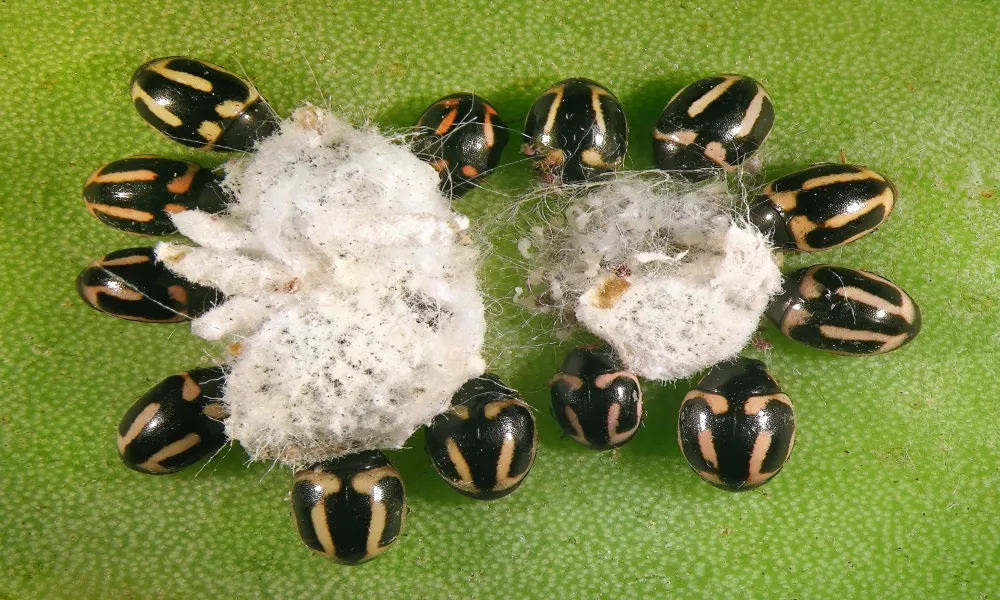

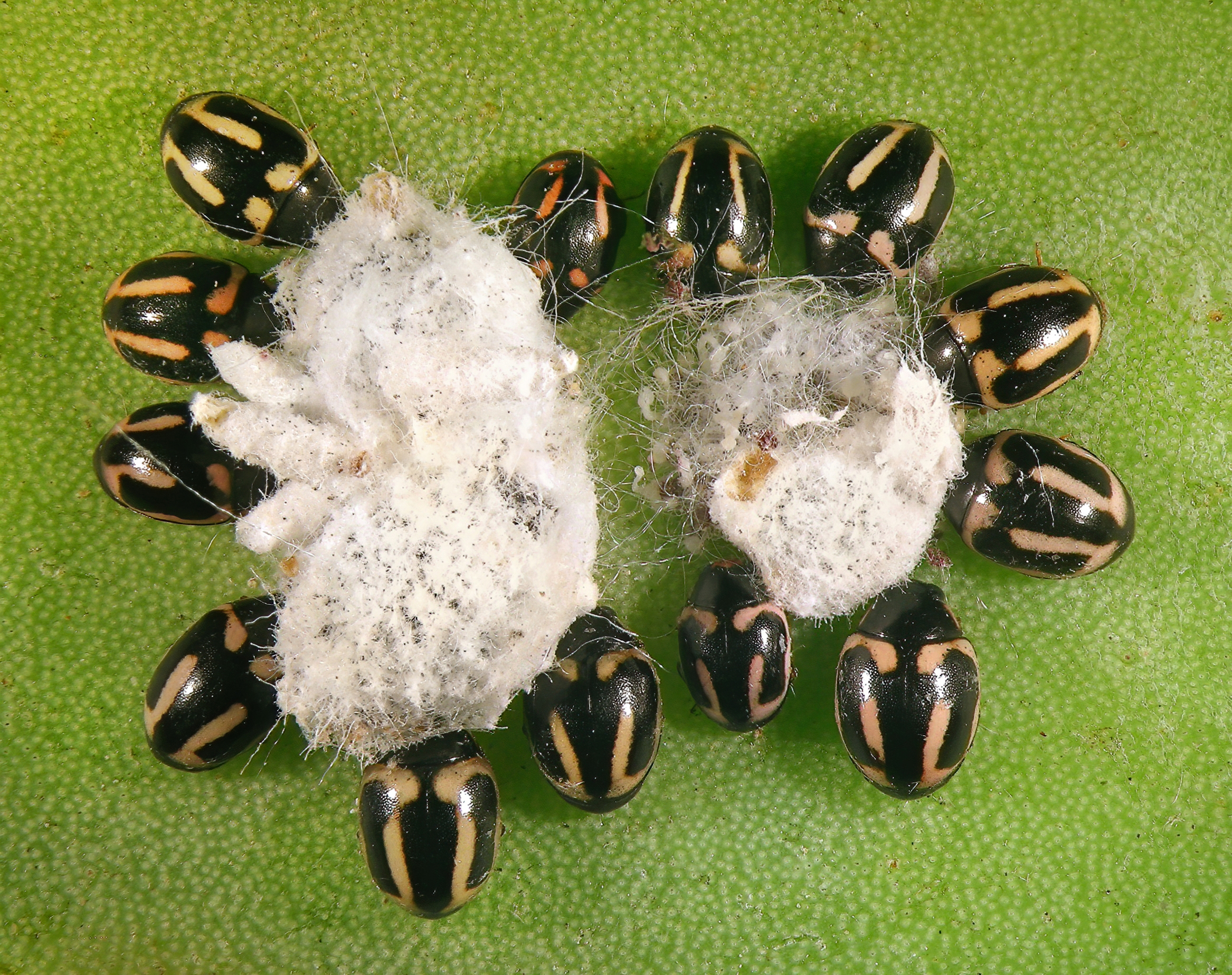
Last June, the Department of Agriculture, in cooperation with Israel's Agricultural Research Organization "Volcani Center", carried out the first introduction and release of the beneficial insect Hyperaspis trifurcata, a natural enemy of the prickly pear cochineal scale, Dactylopius opuntiae. The cochineal is an insect covered in a characteristic cotton-like wax which, over the past 10 years, has decimated thousands of prickly pears across most of Cyprus, specifically in areas of the Famagusta, Larnaca, Nicosia and Limassol districts. The goal now is for the new tool against the cochineal to spread across the whole island. Following the first indications that the beneficial insect has established itself in July 2026, the Department of Agriculture hopes in the coming months to achieve full establishment and the development of sufficient populations for its dispersal across the entire territory.
Up to 5,000 nymphs
Competent officers from the Department of Agriculture told "P" that Hyperaspis trifurcata is a small predatory insect resembling the familiar ladybird, which feeds exclusively on the cochineal. During its lifetime, they stressed, it can consume up to 5,000 individuals (nymphs). It should be noted that it was neighbouring Israel that introduced Hyperaspis trifurcata from Mexico, the cochineal's country of origin. "After a period of adaptation of the insect to the climatic conditions of the Mediterranean basin, Israel proceeded with its multiplication and mass release into plantations," the Department of Agriculture said.
Awaiting results
"Now it remains to be seen how effective Hyperaspis trifurcata will be, because we cannot judge this in advance. We have some indications that this species will be quite effective, which is why it was introduced to Cyprus, but we must wait to see how the populations of Dactylopius opuntiae will be affected," Menelaos Stavrinides, associate professor at the Department of Agricultural Sciences, Biotechnology and Food Science at the Cyprus University of Technology (TEPAK), told "P".
Referring to the insect's use in Israel, he said a degree of success was recorded, but publications by the researcher who implemented the programme in the neighbouring country note that the beneficial insect may not be particularly fast in dispersing from area to area.
"In Israel, the beneficial insect initially needed some help to disperse. It is also possible that in some areas and at some times of the year its population may not grow sufficiently to deliver results. These are matters we will wait to see. The Department of Agriculture usually takes them into account when it proceeds with the introduction of a beneficial insect and has a plan for the development of the biological control of a plant pest," Dr Stavrinides added.
Why it spread
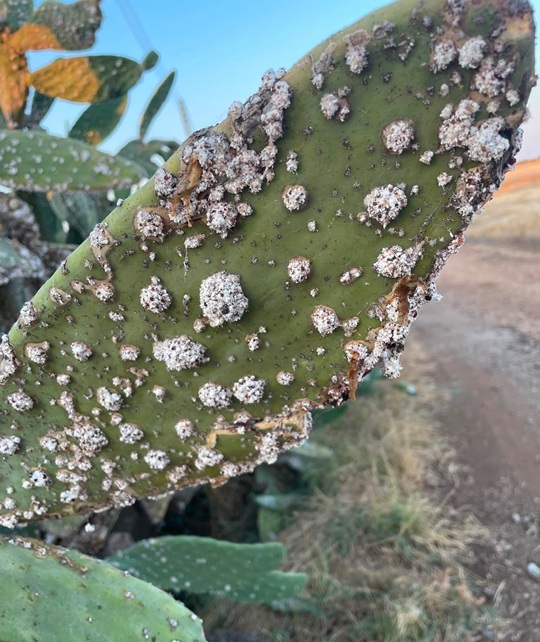
The prickly pear cochineal was first detected in 2016, in the Famagusta district, on prickly pear plants, which are its exclusive host. The Department of Agriculture's initial goal of eradicating its populations was unsuccessful. "Due to the speed of its spread, mainly by wind and birds, but also the protection from plant protection products that the waxy covering on its body provides the insect," the department explains.
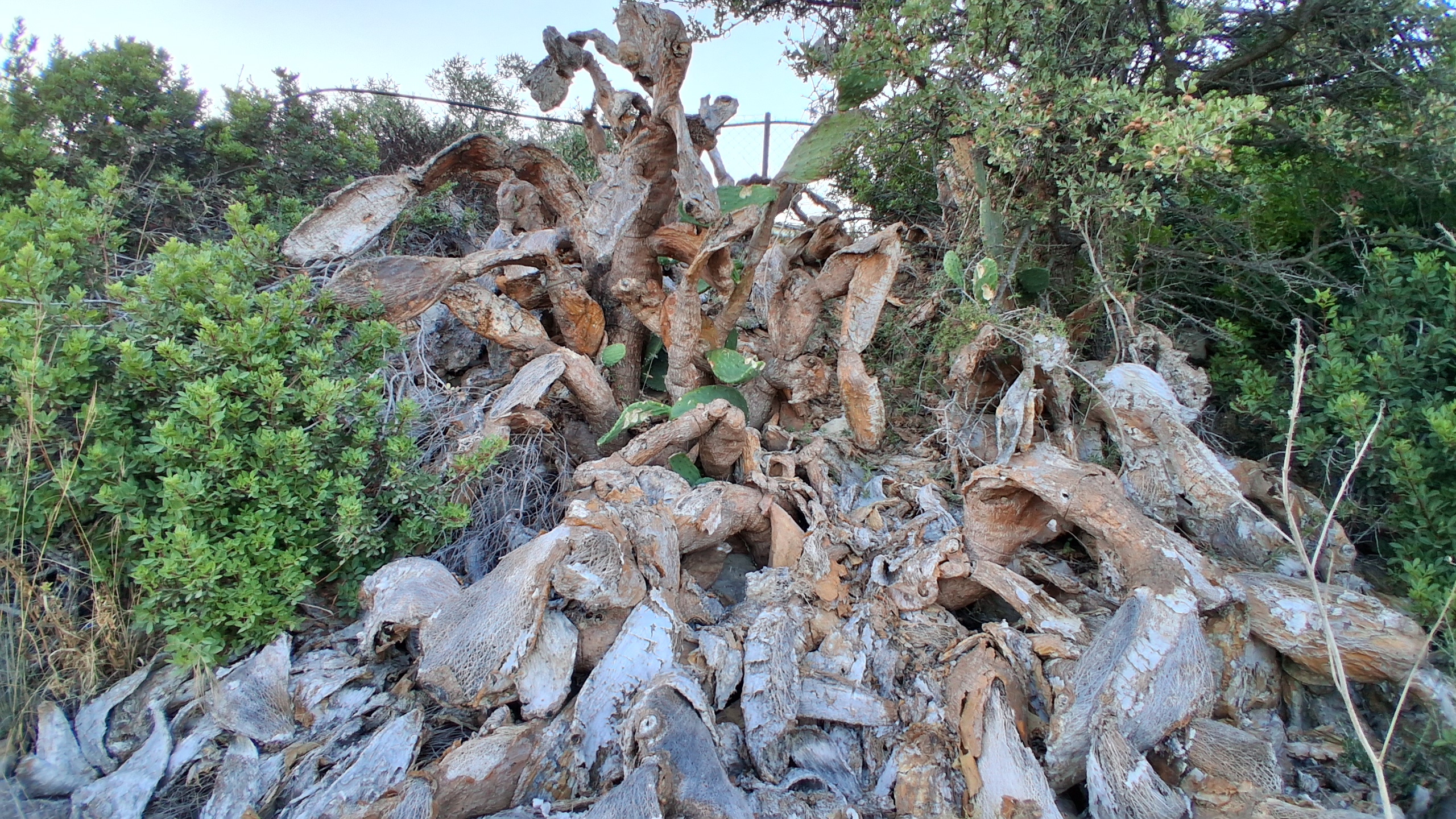
Since then, the department's efforts have focused on limiting the speed of the insect's spread, to allow time for any natural predators to adapt and for a natural balance to be achieved, and/or for more effective control measures to be identified. The climatic conditions in Cyprus, favourable to the insect, the widespread presence of isolated prickly pear plants across the countryside acting as sources of infestation, and the insect's production of a toxin that protects it from natural predators, make these efforts particularly difficult.
Slowing the spread
To date, as part of the department's effort to limit the speed of the insect's spread, and given that chemical control is not effective, farmers and the general public were given instructions to take the following measures:
- Strict pruning to reduce humidity and ensure adequate light.
- Removal of infested parts of the plant and burial in the ground.
- Rinsing infested plants with pressurised water so the insects fall to the ground and are killed by the weather conditions. Spraying the plants with soap (5% washing-up liquid) with the addition of vinegar (5%) or alcohol (5%) appears to deliver good results.
- Avoiding the transfer of infested plants and fruit to uncontaminated areas.
Improvised practices
According to Dr Stavrinides, managing the prickly pear cochineal is not easy, because there are no registered active substances (pesticides) for its control. "So the control measures are practically biological control. At the same time, crops and wild plants that receive no cultivation care eventually dry out. Some farmers to this day take certain measures, perhaps to some degree improvised, that is, they remove the insect, something which is not practically easy. They then manage to keep the cochineal population at low levels," he noted.
"But unlike a crop that receives care, in other cases, such as a large-scale commercial crop, it is not easy to manage this pest. Consequently, only the solution of biological control remains. But in previous years we did not have effective natural enemies in Cyprus. Today the beneficial insect has been introduced from Israel," he stressed.
Assessing the efforts
Taking stock, the Department of Agriculture judges that its efforts to limit the speed of the destructive insect's spread until a natural balance is achieved and/or more effective control measures are identified have succeeded, considering the following:
- Although 10 years have passed since its establishment in Cyprus, and despite its capacity for rapid spread via birds and the wind, it has not spread across the entire territory. The insect has been detected in areas of the Famagusta, Larnaca, Nicosia and Limassol districts, where a large number of prickly pears have suffered serious damage or been completely destroyed.
- The greatest damage is found in plants that are isolated in the countryside and receive no care. In areas where the first infestations appeared, there are certain indications of recovery of the affected plants, which may point to some degree of adaptation to the insect.
- Plantations located in infested areas where producers follow the measures recommended by the Department of Agriculture remain in very good condition, with no effect on the quantity and quality of production.
- The opportunity arose to identify a new control method that can be added to the available tools against the cochineal: the beneficial insect Hyperaspis trifurcata, introduced and released in Cyprus last June.