
The picture available to the competent officers of the Greek Central Intelligence Service (KYP) in the critical hours before the coup against Archbishop Makarios III is captured in the declassified "Daily Information Bulletin on Cyprus – Turkey", dated 15 July 1974. The document bears a declassification stamp dated 6 November 2024 and covers the period "from 130800 to 150800/7/1974", that is, up to 8 o'clock on the very morning the tanks rolled towards the Presidential Palace.
In November 2024, Greece's National Intelligence Service released 58 bulletins compiled by the officers of the then KYP covering the two months of the coup against Archbishop Makarios and the Turkish invasion, marking the 50th anniversary of the Cyprus tragedy. This particular bulletin records political developments in Cyprus, its authors' comments on Makarios's moves, as well as military and air movements attributed to Turkey.
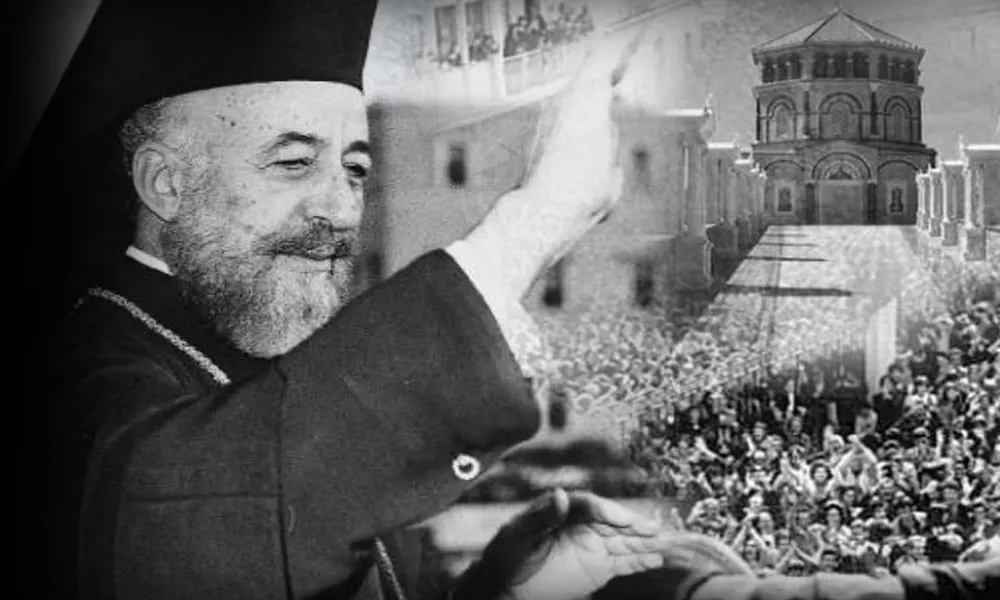
Makarios's warning to Athens
In the section on the political situation in Cyprus, the bulletin begins with the interview Archbishop Makarios gave on 13 July 1974 to the "Independent News Agency of London". According to the bulletin, Makarios stated that "on 20/7/74 the numerical strength of the National Guard will be reduced and it will become an instrument of the Cypriot Government".
The same section records that Makarios "is impatient to learn whether the Greek Government will issue orders for the dissolution of EOKA B", while he reportedly warned that, "should there be a provocation", he would not hesitate to make public a document "proving the guilt of Athens in the activities of EOKA B".
Particular weight attaches to the bulletin authors' comment on Makarios's moves. As stated verbatim: "Through his above actions, Makarios is attempting to expose the Greek Government internationally and to compel it to proceed with actions towards the dissolution of EOKA B. It is assessed that the above tactic will continue."
The parliamentary debate on the National Guard
The bulletin also refers to the debate held on 11 July 1974 in the Cypriot House of Representatives on the reduction of service in the National Guard. It records that independent MP Paraskevaides had stressed that the matter of defence "has not been addressed in a prudent manner", while another MP noted that there should be consultation so that "the shielding of the Cypriot people is not diminished". The debate, according to the bulletin, was postponed to the House's next session in September, a session that history would overtake.
"The purge of the state machinery continues"
In the "Internal Security" section, the bulletin records a decision of the Cypriot Council of Ministers, chaired by Archbishop Makarios, to dismiss members of the Police Force "for reasons of public interest". According to the press reports the bulletin cites, the number of those to be dismissed came "to approximately 40". The KYP officers' comment is characteristic: "The purge of the state machinery of anti-government elements continues."
Ankara in the frame
The bulletin then turns its gaze to Turkey. In the foreign policy section, it records a statement by the then Turkish Prime Minister Bülent Ecevit that Turkish foreign policy would not be affected by a possible US decision to cut off aid to Turkey. The comment that follows assesses that Ecevit, with these statements, was attempting "to blackmail the USA into not cutting off the aid" and at the same time "to create the preconditions for a change in Turkey's policy".
Mines, bridges and blackouts
In the military section, the bulletin records movements of Turkish units and transfers of war materiel. For the 4th Infantry Division at Keşan, it states that it was due to receive mines from the 23rd Infantry Division, while "15,000 mines have already been dispatched to the area by 5 wagons". For the 39th Infantry Division at Alexandretta, it correspondingly records that it was due to receive "15,000 mines", to be transported "by 4 wagons".
In the KYP officers' comment, it is noted that this information confirmed earlier reports "concerning the supply of the Units of the 1st Army with new mines". The assessment was that old mines were being used in other areas, "as a priority in the area of the 39th Infantry Division".
The bulletin also refers to water-crossing equipment, with the 4th Infantry Division requesting the receipt of frames and the dispatch of mechanical bridges. The relevant comment assesses that these were "actions concerning the preparation for the conduct of water obstacle crossings by the 4th Division", which, according to the bulletin, would take place on 10 August 1974.
On Imbros, the bulletin's authors recorded that "a large number of gendarmes" had been observed, supplied "with an abundance of war materiel", while during the night there was "complete blackout" at the barracks. The comment that follows notes that Imbros housed a Gendarmerie Training Centre and civilian prisons, adding that it was "highly probable, owing to the crisis", that the island's Gendarmerie detachments had been reinforced.
Violations over the Aegean
The final part of the bulletin concerns violations of Greek airspace. It records that on 9 July 1974 two Turkish propeller aircraft violated Greek airspace in the area of Chios "to a depth of 6 nautical miles", while on 10 July a Turkish naval cooperation aircraft also reportedly violated Greek airspace north of Chios.
The picture at 8am
The declassified bulletin does not describe the unfolding of the coup itself. It captures, however, the picture in the hands of the competent KYP officers on the morning of 15 July 1974: Makarios's open confrontation with Athens and EOKA B, the internal purge within the Cypriot state machinery, and a series of Turkish military movements recorded with comments and operational assessments. At 8:20 that same morning, the tanks would move against the Presidential Palace, and five days later, the mines, bridges and reinforced garrisons so meticulously catalogued would acquire their true meaning.