
By Pavlos M.Pavlou
On 25 March 2006, A. Pappas published in To Vima a text entitled "Ten little myths about 1821". In the article he set out certain unfounded myths that had been constructed several decades after the revolution and sustained for a century and a half. From the legend of the secret school and the role of the Church under the Ottomans, to the role of the great powers.
In Greece, no particular discussion of the article took place. Academic historians had considered the evidence settled for years, while scholarly studies and articles of this kind had already been written in abundance.
In Greek Cypriot Cyprus, when some teachers dared to discuss the article's content with pupils, all hell broke loose. Denunciations, representations by parents' associations, demands to the Ministry of Education for disciplinary investigations, continuous criticism in the media of the time.
In Greek Cypriot Cyprus, attachment to myths is generally very strong! Whether it concerns the national mythology directly, or touches it indirectly, for example through the History of Cyprus, before, during and after 1974.
The 'before' and the 'during'
- After 1925, the goal of enosis appears to have been only theoretically feasible. The flare-up of 1964 (the Acheson plans and so on) did not in reality bring it closer, but highlighted the complexity of a possible settlement based on union: partial administrative subordination of Cyprus to Greece (with a governor), a large section to Turkey as a base, self-administered Turkish Cypriot areas scattered across the whole island, and so forth. The presence of the Greek division had as its exclusive aim the control of Makarios and had no relation to enosis or the defence of Cyprus. Which is why it took part in no battle!
- From 1968 onwards, given the threat of a Turkish invasion and with Cyprus full of dozens of Turkish Cypriot enclaves, the vision of enosis was equivalent to expecting Turkey to vanish miraculously from the world map. Those who propagandised for enosis from 1970 onwards, if we except certain pure and unknowing souls, mainly young people, were either motivated by ulterior aims (partition/double enosis, the service of personal ambitions and so on), or had suffered total "blindness" through their passion against Makarios.
- For the first time in its entire history, Cyprus had democracy with the independence of 1960. It was to be expected that democratic functions would be truncated. Makarios, chieftains and petty chieftains determined most matters of the state's operation. Certain liberals, with a European democratic education, were not wrong to be dissatisfied. It is, however, extremely paradoxical that many used the "tyranny" of Makarios as an alibi: the collaborator of the Nazis through the organisation X, the collaborators of the dictator military men of the junta, the devotees of hysterical McCarthyism, and those who shot at the women and children of "communists" the moment the coup broke out. It was as if to say "we staged a coup with the dictatorial junta in order to bring democracy to Cyprus". A garish after-the-fact invention by people who at the time did not even have the word "democracy" in their vocabulary.
- The units of the Greek intelligence service KYP were reporting from early April 1974 on Turkey's preparations for a landing in Cyprus. Hundreds of official testimonies certify knowledge of the impending invasion, as well as the feeding of information to the Turkish army from Greek military sources, even on the positions of the National Guard's machine-gun posts. Ordinary Greek Cypriots, primary school graduates, were saying on 15 July "now the Turks will come". The myth that "Makarios brought the Turks", with the letter to Gizikis or the speech at the United Nations, is a cheap after-the-fact construction. Everything had been pre-decided and organised months earlier. Hence the stance of the officers from Greece during the invasion.
- The entirety of the Greek officers of the National Guard were initiated. For years beforehand, only those loyal to the junta were sent to Cyprus. Their daily concern was the capture of the state machinery, bribery, the corrosion of every institution, and initiation into anti-Makarios organisations ("National Front", "EOKA B"). They created a suffocating cordon around Makarios (extending even to his personal security) and cut off every avenue of well-organised resistance (for example, the cases of the Czech weapons). The Reserve Force and the armed groups of citizens were the only margin left. But it was a minimal, inadequate measure, one which simply made difficult the success of Grivas' original planning for a coup by EOKA B with the National Guard in a merely auxiliary role. When the decision was taken in Athens for the National Guard to play the main role in the coup, the absence of heavy weaponry rendered resistance almost doomed.
The 'after' and the 'today'
- Those who took part in the coup and in the Sampson "government" knew very well what they were doing and which regime they were serving (the junta dictatorship). What saved them after the coup and the invasion was also the diffusion of complicity across part of the population, which had either been influenced by or served the junta to some degree. It may have been a small section of society, but there was the fear that any campaign for justice would create division. Because, in the meantime, partly through the financing they received, many protagonists had acquired great economic power and social influence. Non-punishment, however, laid the foundation for the creation of the myth of "civil war" and "fratricide", a cunning act of moral offsetting promoted to this day.
- Moreover, the impunity even for cold-blooded murders by known individuals, across the whole of Cyprus, dissolved in advance the concept of the rule of law. One of the reasons the term "rule of law" is today mainly theoretical is the complete practical absence of the concept from 1974 onwards. It is enough to consider that the unpunished subsequently became the core of the regime. As big businessmen, channel owners, shapers of the political scene and of public opinion.
- At Disy's last great pre-election rally in Nicosia, for the parliamentary elections of 1976, the slogan that literally shook the square was "Strike again, Digenis". From that moment, today was foreordained: intemperance, groundlessness, a minimised consciousness of democracy and the rule of law (as pariahs of political life) cemented their presence. They conquered the right of perpetual diffusion and mutation. To this day.
- 1974 is not history. It is the present. Not only because its side-effects are alive, but also because the rupture of disengagement from the way of thinking and perceiving that gave birth to it never happened. However hard we find it to believe, today is a mutation of 1973, with "modern" terms, terminology and varnish.
- The demand for enosis did not die. It simply underwent successive mutations. To end up in recent decades first as a demand for "the preservation of the Greekness of free Cyprus", and today as an unavowed demand for "the preservation of exclusive control of the south by the Greek Cypriots". Above all by the deep state that governs it.
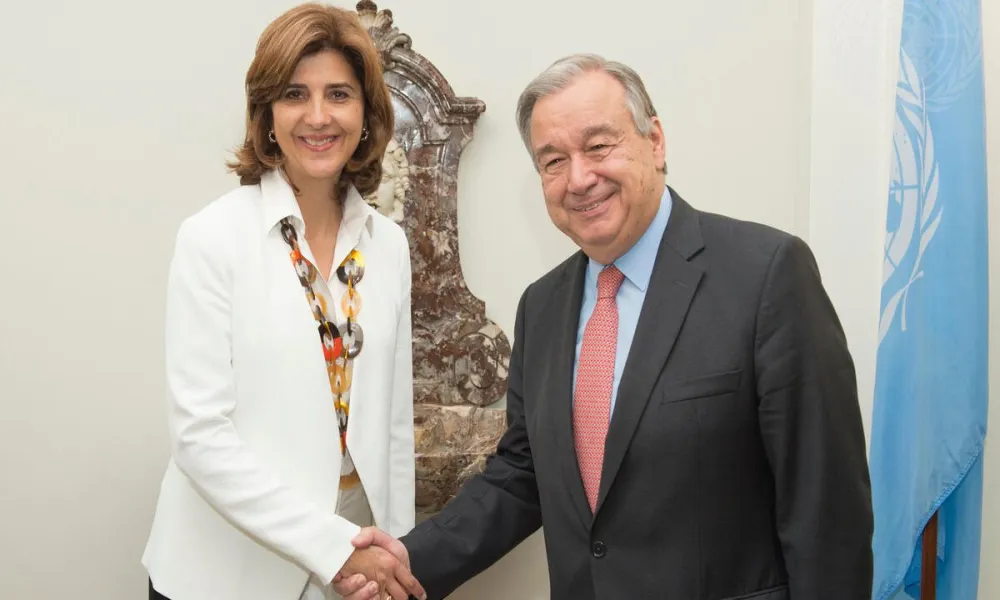
For these reasons, the announced arrival of the UN Secretary-General in Cyprus has its significance, but it will not have the weight and the result we would wish to hope for. Even if Turkey abandons the two states once again, Burgenstock, Crans-Montana and N. Christodoulides will be here. As in 1973.
...with the reproductive power of narratives (1)
Many reproduce the narrative that Cyprus was a paradise, a unified peaceful country before the invasion. It was not. It was a multiply partitioned country, with dozens of Turkish Cypriot enclaves. What hides behind this persistent narrative: (a) the disappearance from the account of everything that preceded the invasion; (b) the real priority of many, that is, not a united Cyprus but the exclusive control of the state by the Greek Cypriots. That was, and is, the "paradise".
...with the reproductive power of narratives (2)
The UN Secretary-General is coming to Cyprus. A positive development. Talk of a ready-made solution plan and the like is an exaggeration, but he will pose the dilemmas. For example, that without movement on Confidence Building Measures (such as the opening of checkpoints), anything further is difficult to materialise. How will we answer, given that we are trapped in the narrative of "reciprocity" on the CBMs? Not to reach the even harder question, whether we accept as they stand the six points of the Guterres Framework.
...with the reproductive power of narratives (3)
The mechanism of stagnation on the Cyprus problem is showing moderate mobilisation. It has set aside its waiting stance, it is activating, but it has not yet put its engines at full throttle. This shows (a) that it has confidence in N. Christodoulides to keep things at the level of "mobility without substance", and (b) that there is the fear that something might go "askew" and matters might actually move forward.