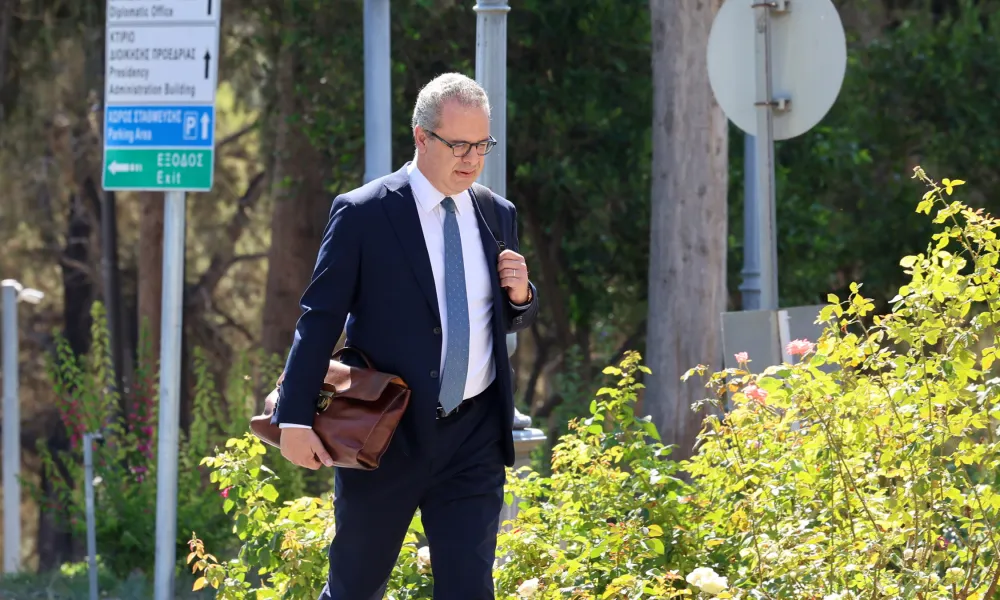

The focus of discussions in the coming period will be substantive preparations to ensure that the next expanded meeting leads to the resumption of negotiations on the Cyprus issue, according to Menelaos Menelaou, the Greek Cypriot side's negotiator.
In separate interviews published by Phileleftheros and Haravgi on Sunday, Menelaou reiterated that the basis for a settlement remains the federal framework.
Focus on restarting negotiations
Menelaou said work has begun on documenting the convergences achieved during previous negotiations.
These will then be shared with all stakeholders, including the two sides in Cyprus regarding internal aspects of the issue and the guarantor powers, which are parties to the Treaties of Guarantee and Alliance, regarding external aspects.
The next step, he said, will be the convening of an expanded meeting with the aim of deciding on the resumption of negotiations for a comprehensive settlement.
Speaking to Phileleftheros, Menelaou noted that the two sides remain in contact and that, as already announced, a new meeting between the two leaders will take place on 26 August.
He said meetings at leadership level have become more frequent since last October, but stressed that substance matters more than frequency.
“There must be political will if we are to achieve results.”
According to Menelaou, the priority now is to ensure that the next expanded meeting is properly prepared and ultimately leads to a decision to restart negotiations.
“And, if possible, we should go to the next expanded meeting having secured that outcome in advance.”
Positive impact from the UN Secretary-General's visit
Menelaou described the UN Secretary-General's recent visit as positive because it created momentum for further steps.
He said preparatory work would now focus on the convergences already achieved within what he described as the federal framework.
“It is clear. And it is very important that this reference was made at a time when Turkey continues to repeat its positions on a ‘two-state' solution.”
He said the Greek Cypriot side has repeatedly faced a familiar pattern from Turkey, namely the continued promotion of a two-state solution and ambiguity from the Turkish Cypriot side regarding its commitment to a federal framework.
Menelaou also referred to what he described as a broader Turkish approach that has delayed developments over an extended period.
He expressed hope that this pattern would not continue in the coming months.
At the same time, he said the UN Secretary-General remains committed to moving the process forward and that the Greek Cypriot side will do everything required to contribute to progress.
Criticism over confidence-building measures
Discussing confidence-building measures, Menelaou accused the other side of blocking progress and then citing that lack of progress as a reason not to move forward on the substance of negotiations.
“I am simply stating the facts. We are not interested in, nor does it serve us, to play the blame game.”
He said a renewed effort was made during the Secretary-General's visit to secure agreement on opening additional crossing points, including a compromise proposal involving the Athienou-Pyroi-Aglantzia route as part of a package that would also include the Mia Milia crossing.
According to Menelaou, the Greek Cypriot side responded positively to the proposal.
The Turkish Cypriot side, however, raised additional demands, including the inclusion of a crossing linking Lympia and Louroujina.
He said the Greek Cypriot side suggested incorporating its own proposal concerning Kokkina, but that proposal was also rejected.
Menelaou further referred to a Greek Cypriot proposal for a pedestrian crossing point within the walled city of Nicosia as a first step.
He stressed that the Greek Cypriot side wants an agreement on crossing points and will continue working constructively towards one, but added that substantive steps must also move forward.
According to Menelaou, comments from the Turkish Cypriot side suggest that confidence-building measures are increasingly being treated as a precondition for progress on the core issues.
“It is the same pattern we have seen throughout this period. Obstructing progress and then citing the lack of progress as a justification for obstructing movement on the substance.”
‘The basis for a settlement is the federal framework’
In his interview with Haravgi, Menelaou stated clearly that the basis of a Cyprus settlement remains a federal framework, one state.
He said the Greek Cypriot side remains committed to the agreed basis of a solution, the negotiating acquis, existing convergences and the six points of the Guterres Framework.
At the same time, he noted that statements from Ankara and within the Turkish Cypriot community continue to promote a two-state solution.
Menelaou pointed out that since the change in Turkish Cypriot leadership there has been no public reference by the new leadership to a federal settlement.
As a result, he said, it is impossible to assess the Turkish Cypriot position independently from Turkey's declared policy.
He noted that Turkish Cypriot leader Tufan Erhürman made an important shift last December by referring to political equality as defined in UN resolutions.
“We recognised that shift and said that political equality is inseparably linked to the federal framework, meaning one state, which is different from sovereign equality, which means ‘two states'.”
While acknowledging the constraints created by Turkey's position, Menelaou said the Greek Cypriot side had given Erhürman the necessary political space.
However, he added that the continuing absence of public references to a federal solution and what he described as a delaying approach remain matters of concern.
Convergences being documented
Menelaou confirmed that the process of documenting convergences has already begun.
Once completed, the material will be distributed to both sides in Cyprus regarding internal issues and to the guarantor powers regarding external aspects.
That process will then pave the way for an expanded meeting intended to decide on the resumption of negotiations aimed at achieving a comprehensive settlement.
He also stressed that informing the public would be an essential part of the process and would take place in parallel with developments.
Concluding, Menelaou argued that federalism is not inherently divisive.
“Not only is a federation not divisive by definition, it is the path through which we can achieve the strategic goal of the liberation and reunification of Cyprus.”
Source: CNA