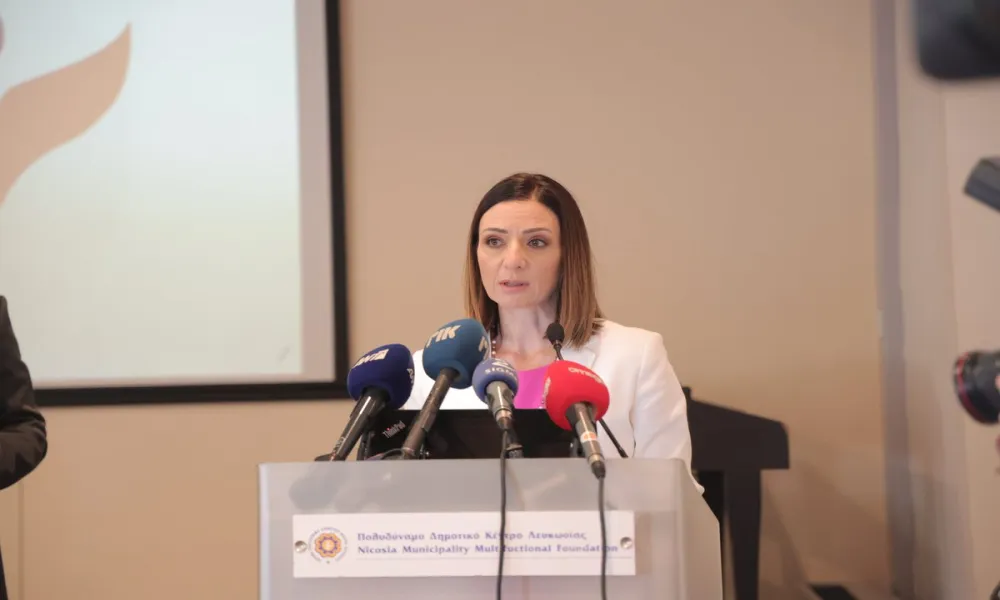

According to Alexia Kountouri, chair of the Human Rights Committee of the Cyprus Bar Association, detention facilities for minors have never become a genuine priority for the state.
“The training of all officials who come into contact with children in conflict with the law is the alpha and omega.”
In 2021, the House of Representatives passed the Children in Conflict with the Law Act, which, among many other provisions, explicitly requires the creation of dedicated detention facilities for children and adolescents outside the prison system.
Initially, implementation of this obligation was suspended, but the suspension has since been repeatedly extended.
The latest deadline is 31 December 2026. However, since no meaningful progress has been made towards establishing dedicated juvenile detention facilities, it is expected that another extension will be sought through legislative amendment.
Kountouri discussed the issue with Politis.
It should be noted that imprisonment may only be imposed on a child aged 16 or above.
Second thoughts
Why has such a facility not moved forward despite repeated decisions? Wasn't Menogeia supposed to house these children?
I think the answer is quite simple.
Judging by the outcome, the issue has not been a priority for the state.
The latest information we received was indeed that a suitable facility would be created in Menogeia.
Now it appears there are second thoughts once again.
Today, where do children who are in conflict with the law for serious offences end up?
First, it should be said that the detention of a child must be a measure of last resort.
It should be imposed for the shortest possible period and only after the court has considered alternative penalties.
Unfortunately, today these children end up in the Central Prisons.
Unsuitable conditions
Are these children actually being rehabilitated? Are there specialised programmes?
That is another serious issue.
According to the latest report by the Committee for the Prevention of Torture (CPT) of the Council of Europe, detention conditions for children and juveniles in the Central Prisons are unsuitable.
Beyond the unacceptable practice, contrary to all scientific recommendations, of holding them alongside adults, there is a complete absence of a child-centred approach.
There are no activities with purpose, no programmes aimed at progress and no meaningful efforts focused on reintegration into the community.
What does this mean for the children themselves, their families and society more broadly?
For children, it constitutes a violation of fundamental human rights.
Every child has a basic right to treatment consistent with their age and level of maturity.
Every child has the right to live in conditions of safety and to enjoy all the things that childhood brings, or should bring.
From a criminological perspective as well, penalties cannot be merely punitive or deterrent.
They should function, or ought to function, in a way that promotes reintegration into society.
If there are no specialised programmes, activities, educational opportunities, therapeutic interventions and support from experts, detention does not serve the right purpose.
The objective is not to “warehouse” children in a facility.
The objective is to heal and educate children and help them return to society.
Even one child
What do you say to those who argue there are so few children in conflict with the law that dedicated facilities are unnecessary?
Human life and dignity in general, and especially the life and dignity of a child who is under the care and custody of the state, cannot be measured numerically.
If even one child is detained under conditions that are unsuitable for their age, we have failed.
There is another aspect too.
If we do not intervene properly, if detention conditions are not appropriate, if we fail to help even that one child, then that child is highly likely to develop into an adult with serious offending behaviour.
That has consequences for their own safety, for those around them and for society as a whole.
Approach
Will creating a new detention facility solve the problem?
Of course not.
The issue is not simply about buildings.
It concerns the overall approach the state should take towards the prison system more broadly.
Announcements about new facilities are welcome, but we must consider two things.
First, what happens in the interim period before new facilities are built?
Second, we must not assume that constructing new buildings will solve every problem.
What characteristics should such a facility have so that it is not simply another prison?
Above all, it must be designed from the ground up with the child at the centre.
It should resemble a home rather than a prison.
That means providing every child with the space and time to live in a manner appropriate to their age for as long as they remain there.
It should provide safety and education.
It should allow children to create, grow and develop.
And, of course, it should offer psychological and therapeutic support to help them reintegrate into society.
Violation of obligations
Which international conventions bind the Republic of Cyprus regarding the detention of minors?
First and foremost, there is the UN Convention on the Rights of the Child, adopted by the UN General Assembly in 1989.
The Convention recognises that childhood is a particularly vulnerable stage of life and that children, because of their physical and mental immaturity, require special care and support.
The Convention was incorporated into Cypriot law in 1990.
There is also the EU Charter of Fundamental Rights, which provides that in every decision concerning children, regardless of which authority takes it, the best interests of the child must be a primary consideration.
The 2021 law is the most recent legal instrument and introduces a child-friendly criminal justice system.
Its central objective is the protection, education and reintegration of children, rather than punishment.
Clearly, holding children in the same facility as convicted adults violates Cyprus' obligations as a state.
Philosophy of the law
Is there a way for the state to protect crime victims without necessarily sending a minor to prison?
Yes, absolutely.
That is the very philosophy of the law.
Today we are discussing juvenile detention facilities, but that is only one part of the legislation.
The 2021 law establishes a range of procedures intended to protect children at every stage, from the investigation of an incident through to the execution of a sentence.
One important element is the diversion programme, which means a child may avoid being referred to court and instead participate in a specialised guidance programme or victim restoration process under the supervision of a probation officer and other professionals.
The implementation of the legislation, however, is another matter entirely.
Is there sufficient training for police officers, judges, prosecutors and prison officers in child and juvenile justice?
The training of everyone who comes into contact with children in conflict with the law is the alpha and omega of properly implementing the legislation.
It is through this that a child-centred approach and respect for both the dignity and vulnerability of children become visible in practice.
I fear that training to date has been fragmented.
There is no broader strategy ensuring, first, continuous and systematic training and, second, proper evaluation of the effectiveness of that training.
As the responsible committee of the Cyprus Bar Association, we have undertaken initiatives in recent years and have done so successfully.
But the principal responsibility rests with the state.
Fytiris: Juvenile detention facility ready in 6-8 months
Justice and Public Order Minister Costas Fytiris is racing to meet deadlines relating to the creation of dedicated detention facilities for children and adolescents outside the prison system.
With the current deadline expiring at the end of this year, the ministry is moving forward with plans to construct juvenile detention units within the geographical boundaries of the Central Prisons, but separate and distant from adult prison wings.
Asked about Menogeia, which had originally been intended for juvenile detainees, Fytiris explained that the site will still be used, but for adult detainees, such as female prisoners or offenders convicted of sexual crimes.
The Menogeia facility will have a capacity of approximately 130 places, whereas only about 15 children are currently detained, with numbers not expected to exceed 30.
According to the Public Works Department, adapting Menogeia would require more than €10 million and approximately two years to complete.
It is noted that, last spring, all foreign nationals held at the Menogeia detention centre for irregular migrants were transferred to the Limnes pre-removal detention centre, the first phase of which has already been completed.
Timeline
Speaking to Politis, Fytiris said he intends to pursue an immediate solution.
“A process is under way for the construction of modern modular facilities that will be ready within six to eight months and at a cost of under €2 million, according to an initial estimate.”
He said the aim is to launch an open tender for both the architectural and construction phases in late August or early September.
“The objective is for the facility to be ready before Easter.”
The facility will have a capacity of 60 people.
“With this solution we will save both space and time,” he added.
Specialised training
The new juvenile detention facility will include separate wings for boys and girls.
It will be staffed by personnel who will be recruited in September and will be required to complete a specialised training programme at the University of Cyprus before taking up their duties.
“In September we will recruit correctional officers for the Central Prisons as well, and all of them will go through the specialised University of Cyprus programme before assuming their responsibilities.”
Fytiris noted that six years ago Cyprus had approximately 600 prisoners, while today the prison population stands at around 1,200 on a consistent basis.
“Today we have more arrests and more convictions,” he said.