
Archbishop of Cyprus Georgios has called for the Cyprus issue to be reframed as a problem of invasion and occupation, arguing that Turkey is seeking not merely to consolidate the existing situation but ultimately to complete what he described as its takeover of Cyprus.
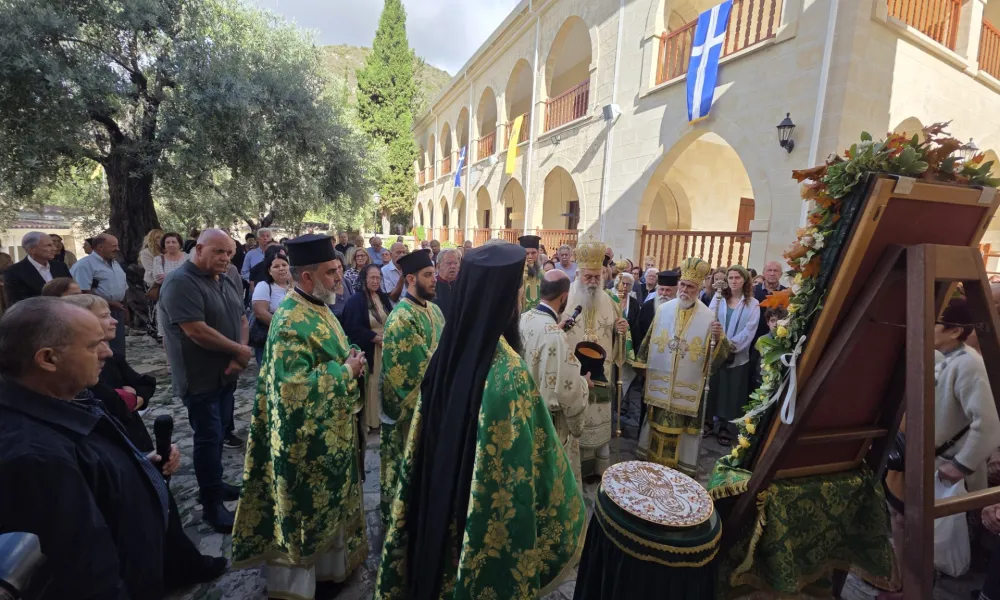
Speaking to journalists at the celebrating Holy Monastery of Agios Neophytos in Tala, Paphos, the Archbishop said Turkey’s position had, in his view, become clear and had always remained consistent.
“Their objective is not only the consolidation of the faits accomplis but the completion of the takeover of Cyprus,” he said.
Calls for Greece, Cyprus and diaspora to unite
Archbishop Georgios called for greater unity between Greece, Cyprus and the Greek diaspora, as well as greater use of international alliances, in order, as he put it, “to avert the Turkish danger”.
He argued that after so many years of occupation, compromise through continuous concessions could no longer form the basis of efforts to resolve the Cyprus issue.
“We want our problem to be reframed as a problem of invasion and occupation, and we want our rights as a country that is a member state of the EU,” he said.
“Should we not have the same rights in our own homeland?”
Focus on rights of Cypriot EU citizens
The Archbishop placed particular emphasis on the rights of Cypriots as European citizens, citing freedom of movement and establishment and the enjoyment of property rights.
“I will not stop saying that if all Europeans are entitled to free movement, free establishment and enjoyment of property everywhere, should we not have this right in our own homeland?” he asked.
He said this position should be pursued consistently in order to secure international support.
Warning against further concessions
Archbishop Georgios warned that if concessions continue, the international community could ultimately restrict itself to telling the two sides to reach an agreement between themselves, which it would subsequently support.
“We should not support any other agreement except one that safeguards our rights, our human rights,” he said.
Asked whether such an approach was realistic, the Archbishop pointed to the position of the Republic of Cyprus and Greece as EU member states.
“I believe that two EU member states, which also have the right of veto on many issues, can demand and achieve something which is self-evident,” he said.
Points to Cyprus’ EU accession
Archbishop Georgios referred to Cyprus’ accession to the European Union, noting that some countries had opposed the island joining the bloc while the Cyprus issue remained unresolved.
“Just as we were able in the past to secure our accession to the European Union, even though some countries did not want us to join while the issue remained unresolved, we can do the same now,” he said.
Concluding, he raised the question of how Nicosia and Athens could use their positions within the EU when their consent is required for European decisions concerning sanctions against other countries.
“If whenever the consent of both us and Greece is requested for sanctions against other countries, we insist on sanctions against Turkey, what excuse will they find?” he asked.