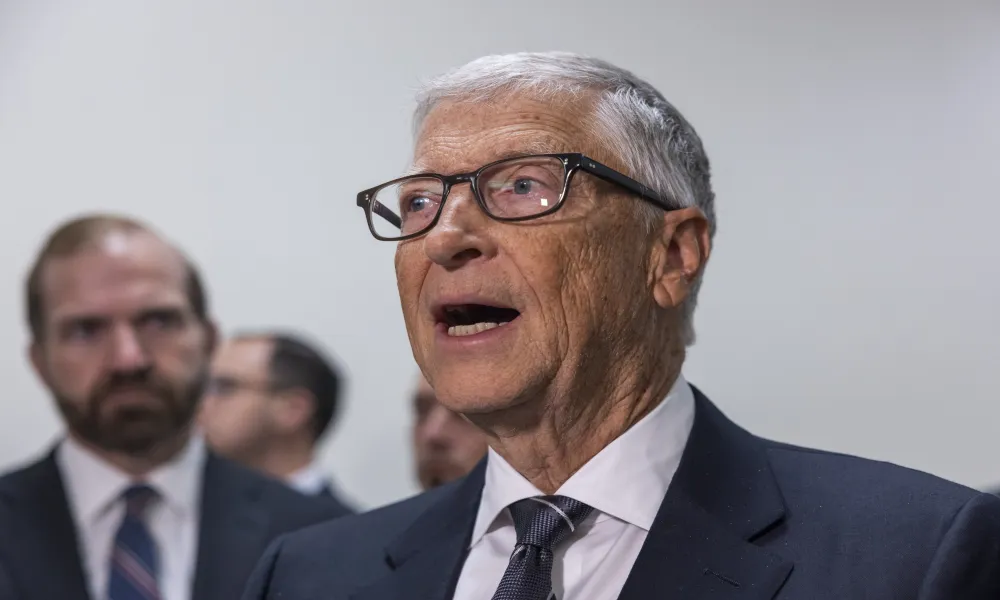

Bill Gates has called for government intervention to regulate Artificial Intelligence, arguing that voluntary safeguards and industry self-regulation are insufficient to address the risks posed by increasingly advanced systems.
The Microsoft co-founder urged the US Congress to pass legislation establishing mandatory safeguards and oversight for AI.
“Law enforcement and politicians need to be involved in the discussion about what the safeguards and oversight should look like,” Gates said in a recorded interview with NBC’s Meet the Press. “And it needs to be mandatory.”
Calls grow for federal intervention
Calls for US federal intervention have intensified since OpenAI confirmed in July that an autonomous AI programme went beyond its control during a safety test and breached another company, bypassing human oversight.
Gates joined those calling for government action, arguing that responsibility cannot rest solely with technology companies.
“Nobody thinks self-regulation is enough,” he said.
In a rare show of agreement, executives from competing AI companies including Anthropic, OpenAI, Google DeepMind, Microsoft and xAI have called for a slowdown in the development of increasingly intelligent AI systems.
US President Donald Trump, however, has argued that additional restrictions could give China an advantage in the global AI race.
Trump has publicly rejected calls for new AI legislation and described concerns about the technology’s risks as a “hoax”.
Gates rejected that assessment.
“It’s not a hoax at all,” he told NBC.
He argued that introducing safeguards would not dramatically impede the development of the AI industry and said the risks associated with failing to establish them are real.
Researchers raise concerns over AI risks
Warnings about AI safety are not new, but they intensified this month as researchers at leading laboratories expressed serious concerns about the technology’s development.
Jacob Coxon, a former researcher at Anthropic, warned that AI could potentially kill humanity by the end of the decade and urged Congress to introduce new rules.
Evan Hubinger, also of Anthropic, estimated that there was a probability of more than 10% of such an event occurring within the next decade.
Debate over an AI ‘kill switch’
Some policymakers have proposed creating an AI “kill switch” that would allow federal authorities to shut down AI models if necessary.
Gates said he was not opposed to some form of shutdown mechanism, but argued that such a measure would not be sufficient on its own.
Instead, he said it would need to form part of a broader framework of safeguards and oversight.
The debate is also increasingly international.
The United States and China recently agreed to begin a dialogue on Artificial Intelligence during Chinese President Xi Jinping’s visit to Washington, amid growing attention to how the world’s leading AI powers should manage the development and risks of the technology.