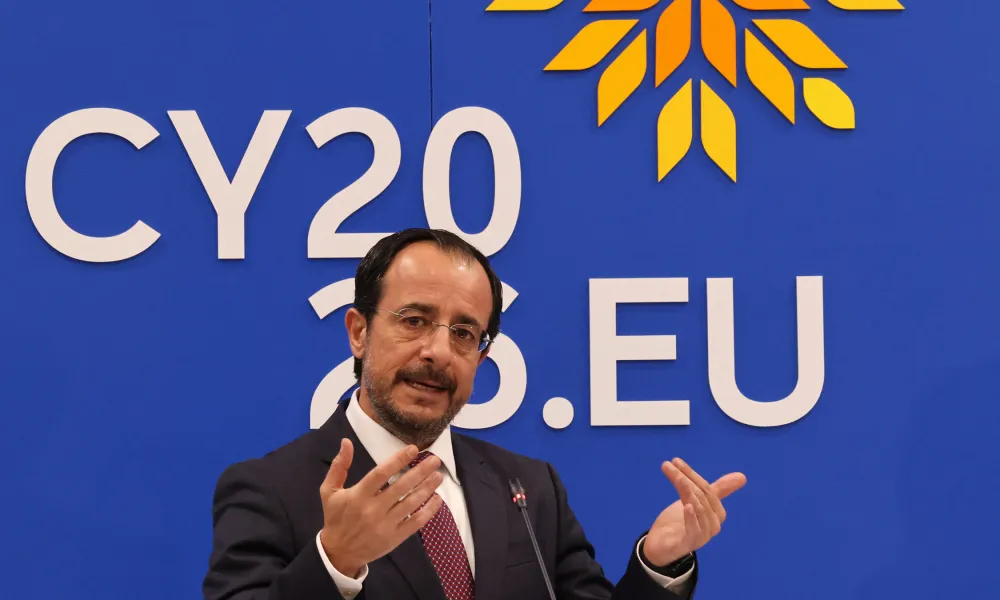

President Nikos Christodoulides on Wednesday hailed Cyprus' six-month presidency of the Council of the European Union as a success, saying the political capital gained during the period would be used to advance the country's strategic and national interests.
"The political capital we acquired over these six months is a valuable national asset, and we will use it for the benefit of our citizens, our country and our strategic and national objectives," Christodoulides told a news conference reviewing the presidency.
He said Cyprus had assumed the presidency during a period marked by the war in Ukraine, conflict in the Middle East and other geopolitical challenges, requiring the EU to demonstrate unity and effectiveness.
Christodoulides said one of the presidency's main goals had been to strengthen cooperation with EU partners and highlight the strategic importance of the wider region to the bloc.
"Thanks to the excellent relations we have with all neighbouring countries, we not only responded successfully to the crisis, but also succeeded in ensuring that Brussels recognised and accepted the strategic importance of our region for the European Union," he said.
Reflecting on the six-month term, he said Cyprus had proven it could successfully shoulder major European responsibilities and contribute to shaping EU policy.
Military Schengen
Christodoulides said the presidency had focused on building a safer and more resilient EU through a broad approach to security that included energy security, protection of critical infrastructure, hybrid threats, migration, cybersecurity and crisis response.
Among the initiatives advanced during the term were military mobility measures, the precursor to a “military Schengen”, he said, aimed at facilitating the movement of European armed forces and equipment across member states, as well as discussions on implementing the EU's mutual assistance clause under Article 42.7 of the Treaty on European Union.
He said 17 of 18 national plans under the SAFE defence financing instrument had been approved during Cyprus' presidency and that Cyprus had secured nearly €1.2 billion in funding, including an initial €177 million disbursement.
On the economy, Christodoulides said the presidency promoted measures to reduce bureaucracy, encourage investment, strengthen the single market and support small and medium-sized enterprises.
Cutting costs for businesses
He highlighted what he described as the most significant reform of the EU Customs Union since 1968 and noted that the first major legislative simplification packages were completed, with expected administrative savings of around €2.5 billion for European businesses.
"In a period of growing international uncertainty, we worked to conclude major EU agreements, including the agreement with Mercosur after 25 years of negotiations, as well as agreements with India, Mexico and Switzerland," he said.
He added that outstanding Brexit-related issues with Britain had also been resolved.
The president said Cyprus had also played a role in advancing EU enlargement, helping move forward accession talks with Moldova and Ukraine.
On transport, he noted that negotiators reached agreement on strengthening air passenger rights after 13 years of talks.
He also pointed to the adoption of a strategy for island states and coastal regions, unveiled at a conference in Paphos, aimed at ensuring their specific needs are reflected across EU policies.
In health policy, Christodoulides cited progress on critical medicines legislation designed to strengthen Europe's production capacity and supply security. He also said agreement had been reached on coordination of social security systems after a decade of negotiations and that affordable housing had been incorporated into the Cohesion Fund.
Common interests, national objectives
Turning to Cyprus' long-standing national issue, the president said the country's enhanced standing within the EU would help its efforts to secure a settlement of the Cyprus problem.
"The foremost national objective remains the resolution of the Cyprus issue, the end of the occupation and the reunification of the country," he said.
"We served the common European interest with consistency, credibility and a sense of responsibility. This has significantly strengthened our ability to pursue our objectives with greater confidence and dignity, including on the Cyprus issue."
Christodoulides also announced that the post of deputy minister for European affairs would be retained after the presidency, while the presidency secretariat would be converted into a permanent structure coordinating EU affairs. European affairs units across ministries would also be strengthened.
Rutte wrong
Asked about discussions surrounding Article 42.7 and concerns raised by NATO Secretary General Mark Rutte, Christodoulides said the clause fell exclusively within the EU's competence.
"I must once again publicly disagree with the NATO Secretary General, who has stated that the European Union cannot operate autonomously in the fields of defence and security," he said.
Foreign Minister Constantinos Kombos said the issue had been discussed by the European Council and argued that Article 42.7 created legally binding obligations for member states.
"The provision is contained in the Treaties. The Council's Legal Service considers it to be legally binding on member states, and in a very specific manner that excludes merely symbolic contributions, should its implementation become necessary," he said.
On negotiations over the EU's next long-term budget, Christodoulides said the key challenge would be increasing the bloc's own resources.
"Yes, we can increase the European Union's budget, but at the same time we must also increase its revenues," he said.
Deputy Minister for European Affairs Marilena Raouna said Cyprus had advanced negotiations on the EU's Multiannual Financial Framework to the point where concrete figures had been tabled before the end of its presidency. She said Ireland, which takes over the process, would now be tasked with advancing proposals on financing and own resources.
Source: CNA