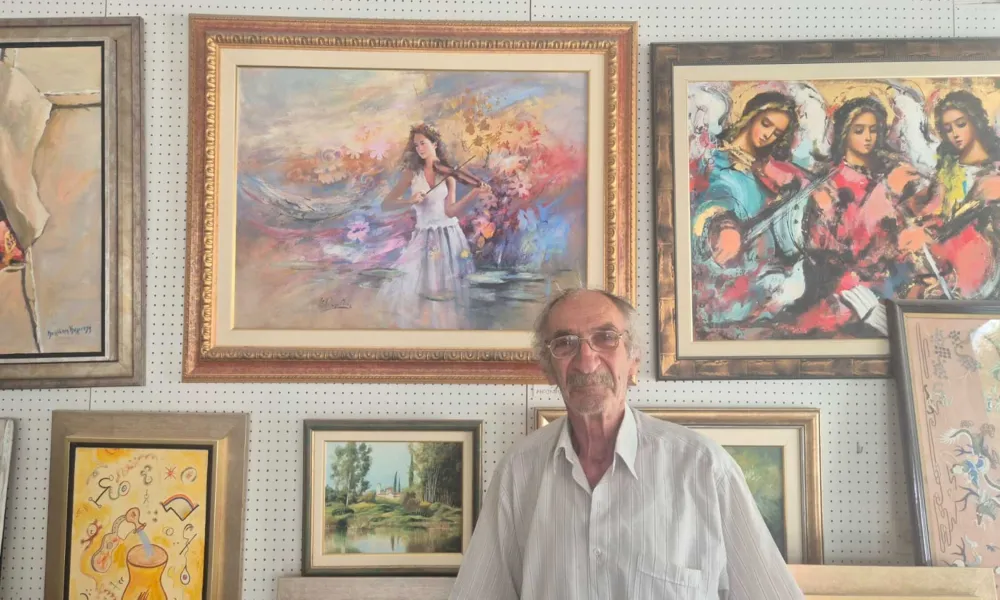
It is midday in Nicosia during the final days of July. The city swelters beneath the summer sun, but inside Leonidas Leonidou's picture-framing workshop, in the heart of the capital, the conversation is not about the day's heat.
Instead, it is about the weather of the coming months and the new hydrological year that begins in October.vThe reason is simple: tomorrow, Monday, the minallagia begin.
These traditional August observations were used by generations of rural Cypriots to forecast the weather for the entire year ahead. Leonidou has been recording them for the past 65 years.
Surrounded by framed paintings, with a fan turning beside him in a futile effort to ease the heatwave, he reflects on a lifetime spent observing details that most people overlook: the direction of the wind, the shape of a cloud, the subtle moment when humidity changes in the air.
For him, nature is not merely scenery. It is a system that sends signals.
"I'll tell you two or three things so you can understand what nature means," he says at the beginning of our conversation.
The wind
Leonidou does not begin his explanation with August dates. He begins with the geography of Cyprus. For him, understanding the weather first requires understanding how air moves across the island.
In Nicosia, he explains, there are streets that receive breezes from the Pentadaktylos mountain range during the afternoon, while others remain almost completely still.
"All the roads in Nicosia that run perpendicular to Pentadaktylos get wind in the afternoon. Those that run perpendicular to Ledras Street get no wind at all," he says.
According to him, the explanation lies in the terrain itself. "A ravine forms along the mountain range and 'pulls' the air from Kyrenia and brings it to Nicosia."
He says the same phenomenon can be observed elsewhere across the island, from the Kornos area to Anglisides and Larnaca, as well as Stavrovouni, Platania, Madari and Stavros tis Psokas.
"That's how nature works," he says.
This close observation of the natural world forms the foundation on which the minallagia are based.
Twelve days, twelve months
The minallagia are an old Cypriot method of weather forecasting.
Observations are made over 12 days in August, with each day corresponding to one month of the following year, as reflected in the traditional saying: "August comes and goes, and then August begins again."
Every sign in the sky is believed to carry meaning.
Cloud cover, wind, humidity and temperature are all thought, according to tradition, to indicate whether a month will be wet, dry or cold.
Leonidou, however, did not limit himself to the knowledge handed down by older generations. Over the years he developed his own system.
"I begin on August 3 and continue until August 15. Each day represents one month. Then I do a second study from August 16 until August 28 using the old calendar. Afterwards, I combine the two results," he says.
He does not simply note whether clouds or wind appear.
He records the time, duration and intensity of conditions in notebooks and notes, while also taking photographs and videos.
"If a south-westerly wind is blowing, I'll take a photo with my mobile phone. Then, when I study it later, I'll also have the time recorded," he explains.
August as a way of life
For most people, August is a month of holidays. For Leonidou, it is a month of observation. In Agros, where he spends part of the summer, he often avoids sleeping indoors. Instead, he sleeps outside on the veranda so he can remain in direct contact with the sky.
"I don't sleep in a bed at night. I put on my shorts and a light vest. Beside me I have a sheet and a woven rug (pefdzin)," he says, painting a picture from another era.
It is the image of a man lying beneath the stars, not for romance, but in order to document the next change in the weather.
He watches clouds moving between the mountains.
"If I have a south-westerly wind together with humidity, that means rain and I need to record the time," he says.
When clouds follow a certain path, he notes the exact moment. Even in the city he follows the same routine. He sets an alarm every two hours. He wakes up, drinks a little water, steps outside to study the sky and then returns to sleep.
"I am constantly on alert. During August it becomes a way of life."
Lessons from his grandmother
Behind all of this lies a family story. Leonidou learned the minallagia from his grandmother.
"My grandmother used to observe them and taught me certain things. Afterwards, because I enjoyed research, I refined them over time," he says.
Their bond was particularly close.
As he explains, she had a special affection for him because he had inherited his grandfather's name.
Every day after school he would visit her, and through those daily encounters she passed on her knowledge.
Today, he is the only member of his family who can still read the minallagia.
Nevertheless, he has tried to pass the tradition on to his grandchildren, and it appears there may already be a successor.
Leonidou shows a photograph of one of his grandsons sleeping outside on a balcony. He is the only one, he says, who has shown an interest in learning the minallagia. It is an image that seems to complete a circle: from grandmother to grandson, and perhaps from him to the next generation.
‘God's devastation’ at the coffee shop
Mr Leonidas believes his observations have been confirmed many times. According to him, his forecasts are usually accurate 90%-95% of the time, while for the current year he believes they reached 99%.
He recalls one occasion when he wrote the words "God's devastation" beside a specific date.
"It was beautiful weather until noon. At 4pm, Nicosia General Hospital and Parliament were flooded," he says.
On another occasion, he pinned a note in the village coffee shop that read: "Hail, destruction."
One of his cousins, a farmer, became angry when he saw it. Fearing for his crops and fruit trees, he tore the note up. The coffee shop owner then asked Leonidas to write it again and kept it.
Months later, when the date finally arrived, the note was put back on display.
The same man saw it once more and again became angry.
The following day, Mr Leonidas recalls, the weather changed by midday and the harvests were, unfortunately, destroyed.
Reaching upwards
The minallagia belong to an era when people were much more closely connected to nature. Farmers waited for rain, feared frost and watched the sky because their harvest and survival depended on it.
Today, in a world where weather forecasts appear instantly on a mobile phone screen, Mr Leonidas still looks upward.
Not because he ignores the modern era, but because he carries knowledge passed down by word of mouth.
"Clouds, wind and rain. Those are the three foundations," he says.
And every August, while most people check weather apps to organise their schedules, he continues to study the sky. For 65 years he has practised something that is difficult to learn from books alone: He ‘listens’ to nature.