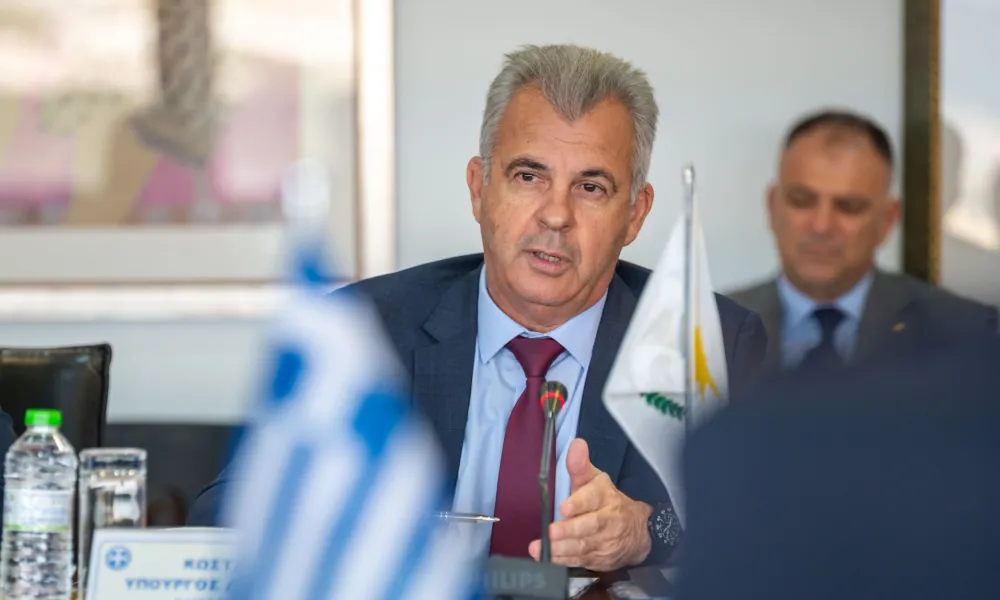

Justice and Public Order Minister Costas Fytiris set out the open fronts of his ministry, from organised crime and the Central Prisons to police staffing and the guarding of political figures, speaking on Politis radio 107.6 & 97.6 on the morning show with Katerina Iliadi.
A supporting role in the 'mafia state' investigation
On the widening investigation into the so-called "mafia state" case, Mr Fytiris said the role of the Police will be supportive and that all evidence requested will be handed over to the independent investigative team. The team is expected to be formed in the coming days with the participation of investigators from Greece, while a liaison officer will maintain communication with the Police.
Santys case with the Legal Service
On the Santys case, the minister said the police investigation has been completed and the file has been forwarded to the Legal Service. He declined to comment on whether the findings could lead to prosecutions, noting that the political head of the ministry must not intervene in the substance of a criminal investigation.
New prison before the end of 2027
Mr Fytiris said the existing Central Prisons facilities no longer meet modern needs in either capacity or quality of infrastructure. The planned extension of the current prison has been suspended in favour of building a new correctional facility. "The only solution, even though it is long-term, was to go for a new correctional institution that meets modern requirements," he said, adding that the aim is for works to begin before the end of 2027, with improvements to the existing facilities in the meantime.
He also described the security systems being installed at the prisons: a mobile phone detection system already in place, an anti-drone system in operation, and a third system under installation to cut mobile signal exclusively within the prison grounds. He acknowledged that overcrowding remains a significant problem despite earlier releases and deportations of prisoners.
Reorganising the Police
On organised crime, the minister stressed the need for constant reorganisation of the Police, as criminal organisations adapt quickly and acquire modern technology, including sophisticated communication systems, satellite phones, cryptocurrencies, seemingly legitimate businesses and weapons. "In a way, organised crime reorganises itself. The Police must reorganise before it does, and acquire more means and better training," he said, noting that criminal groups can buy modern systems within two hours while state services must follow lengthy procedures.
Staffing needs and prison recruitment
Mr Fytiris said that before taking office he considered the number of police officers in Cyprus high compared with other European countries, but changed his view once he saw the range of duties the force carries out, including guarding hospitals and buildings, prisoner transfers and tackling human trafficking, organised crime and terrorism. "Now I am minister and I see the spectrum of duties and activities the Police has, I consider the number small," he said.
The new director of the Central Prisons is expected to be appointed in September, with delays attributed to public service procedures and bureaucracy. Of 90 advertised prison warder positions, not all were filled, and a new procedure will follow, with recruits attending a two-month training programme in cooperation with the University of Cyprus.
Risk assessment for political guards
On the guarding of political figures, Mr Fytiris said decisions should be based on the risk assessment carried out by the competent police committee. He concluded that his role is political and supervisory, not operational, aimed at supporting the services and monitoring their smooth functioning.