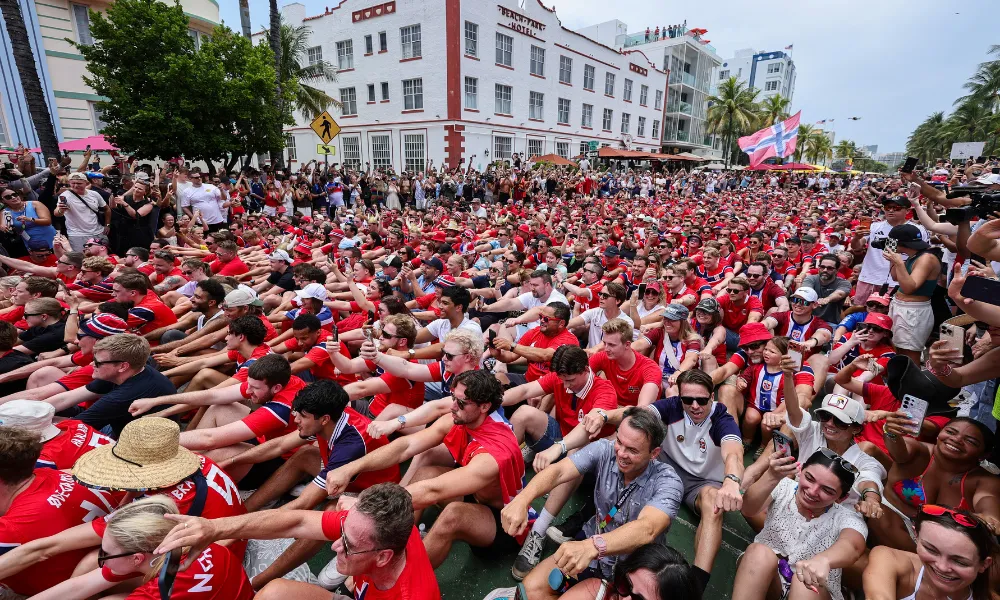

Football fever has swept Norway ahead of the World Cup quarter-final against England, with ticket resale prices reaching as high as $1 million. The national team has already made history with its run in the tournament, replica shirts have sold out, beer sales are surging and thousands of fans are scrambling for spots in bars and organised viewing venues.
The run nobody predicted
Few believed Norway would get this far. The team returned to a World Cup finals after a 28-year absence and produced one of the tournament's biggest shocks, eliminating five-time world champions Brazil with a 2-1 win in the round of 16. The victory has united Norwegians behind the national team in an atmosphere resembling a national holiday.
Flags, songs and improvised street parties dominate Oslo, where many fans are sewing and decorating their own shirts in the national colours. The team's success, supporters say, has reignited national pride and turned the celebrations into a collective experience.
Leading the charge is 25-year-old striker Erling Braut Haaland, whose performances have drawn comparisons with global stars such as Lionel Messi and Kylian Mbappé. Equally decisive has been goalkeeper Ørjan Nyland, whose saves have proved crucial to the team's progress and turned him into a new national hero.
Tickets at $1 million on FIFA's own platform
Resale prices for the quarter-final have soared to staggering levels, with some listings exceeding $1 million. According to FIFA's official resale website, a pair of tickets for the match in Miami, originally sold by FIFA for $1,285, is now offered for $1.005 million.
FIFA has imposed no cap on the prices ticket holders can demand through its resale platform, a policy that has led to extreme price surges. While these figures represent the top of the market, lower options exist: one ticket with an original price of $1,285 is listed at $5,000, still many times its face value.
Bars, beer and a change in the law
The tournament's impact has reached into daily life. Due to the time difference with the United States, where the World Cup is being staged, the Norwegian government granted an exception allowing bars to serve alcohol beyond the usual 3am limit so fans can watch the matches, a decision that has opened a public debate on making the extension permanent.
Businesses are already recording significant gains. The Mack Bryggeri brewery in Tromsø announced sales up by roughly a third compared with last year, attributing the demand to football fever. Bar owners in Oslo report takings rose by around 50% during the Brazil match and estimate revenue could double for the England quarter-final, with fans arriving from midday to secure a seat for a match that kicks off late at night.
A prince in the crowd and a Viking row
The win over Brazil sparked one of Norway's biggest spontaneous celebrations in years, with around 100,000 people flooding the streets of Oslo. Even Crown Prince Haakon joined in, appearing outside the Royal Palace to celebrate with the crowd.
The signature celebration has become a gesture mimicking Viking rowing. The ritual, inspired by Iceland's famous "Viking clap" at Euro 2016 and established by Norway's official supporters' association, has gone viral, with politicians, athletes and fans in many countries posting videos on social media.
An unexpected ambassador
The team's success has boosted Norway's international image. According to Norway's Ambassador to the United States, Anniken Huitfeldt, the country is enjoying unprecedented positive publicity at a time when relations with Washington had been tested by political tensions. When she now meets American senators and members of Congress, she notes, they greet her with the rowing gesture instead of a handshake, proof that football has become an unexpectedly effective ambassador for Norway abroad.