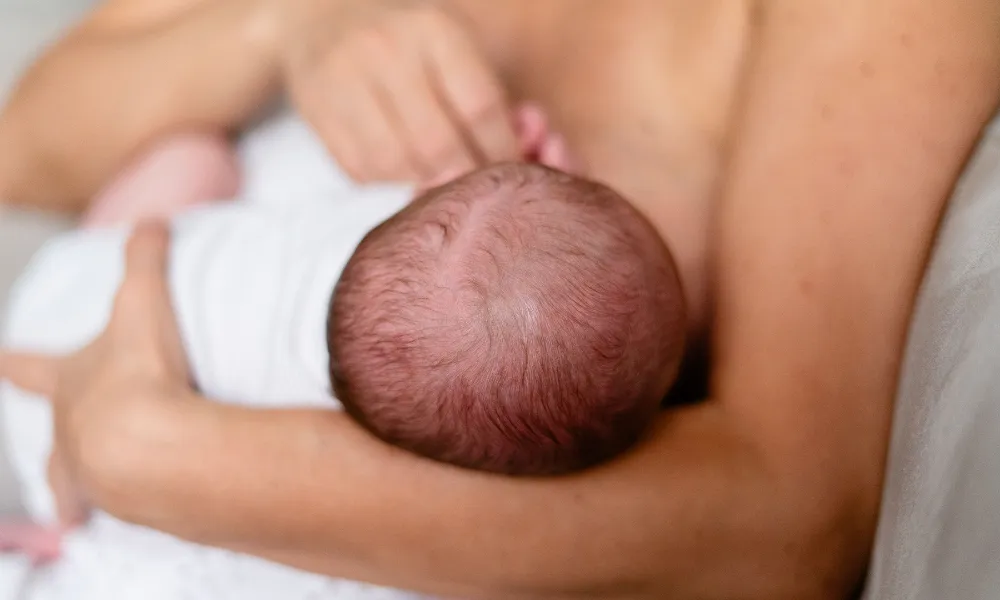

During a visit to Nicosia Central Prisons last month, a mother tried to breastfeed her crying eight-month-old daughter by covering her with a sheet in the visitors' area, because no private space had been made available. It was, she told CNA, one of several occasions in recent months when facilities she says she needed to feed her baby during visits to the child's father were not provided. Her case, and the institutional back-and-forth it has triggered, tests where exactly the law stands, and where it simply doesn't reach.
The visits
The complainant told CNA she has repeatedly raised the issue with prison authorities, explaining that she needs "a more private and appropriate space during the visit" in order to breastfeed her infant, now eight months old, without disruption. "In some cases a space could be found and the visit was completed, while in others I wasn't given the opportunity to use a suitable private space. This made it difficult for me to breastfeed my child and, in some cases, forced me to cut the visit short or fail to complete it at all," she said.
On 20 May 2026, when her baby was just four months old, she filed a formal complaint with the Commissioner for Administration and Human Rights (the Ombudsman) and the Commissioner for the Protection of Children's Rights. "There was no suitable private space available and, even though I explained I needed to breastfeed my child, no practical solution could be found. As a result, I was forced to leave without being able to complete the visit," she said.
The problem, she says, continued. During a visit on 1 September, she said, "my baby was crying loudly and I tried to cover her with a sheet so I could breastfeed her in the visiting area, which was extremely difficult and uncomfortable." She noted that her lawyer offered his office so she could breastfeed there. "I stayed for about 20 minutes and then left, because I didn't want to take advantage of his personal kindness," she said, adding that the episode showed a simple, practical solution exists, provided the prison is told in advance that she will be accompanied by her infant and a suitable private space is arranged.
On 4 September, she says she was asked to go to the guard post to breastfeed. "I explained that breastfeeding can take 20 to 30 minutes or more, and that if I leave the visiting area, I effectively lose a large part, or even all, of my visit," she said. She said the situation then "escalated," with a prison officer telling her, as she recalls it, that she kept "creating problems" and that she would go wherever there was space, per her orders.
As a mother of five, she told CNA, these visits "have particular significance for me and my family. They're one of the few moments when the children can have real contact with their father and maintain a family bond during an extremely difficult period." She stressed she isn't asking for special treatment, only "a simple, humane, dignified and consistent solution, so that a mother can breastfeed her infant and complete her family visit."
No legal duty, but...
Asked to comment, Nikoletta Tyrimou, Press Spokesperson for the Ministry of Justice, pointed to the "special circumstances" at the prison caused by overcrowding and heightened demand for available space. "Permanently and exclusively dedicating a specific room is not always feasible," she said. "Where possible, the prison provides the necessary facilities, respecting mothers' needs alongside security requirements and the orderly operation of the institution."
The Prisons Department also responded to a related letter from the Commissioner for Administration, who investigated the case after the mother's complaint. Excerpts of the Commissioner's response, obtained by CNA, conclude that the Prisons Department's handling of the matter does not fall outside its lawful mandate, since the prison is not considered "a public space serving the general public."
Even so, the Commissioner urges the Prisons Department to continue providing the mother with a specific room for breastfeeding purposes, provided the necessary conditions are met.
The Commissioner's reasoning draws on several sources. The European Prison Rules recognise the importance of maintaining and developing prisoners' family relationships through visits, though visits may be subject to restrictions and supervision for reasons of security, order and crime prevention, and visiting arrangements should allow prisoners to maintain family ties in as normal a way as possible. The European Committee for the Prevention of Torture (CPT)standards, meanwhile, contain no specific provision requiring a dedicated breastfeeding room for mothers visiting prisoners with their infants.
Under national law, Cyprus's legislation on the promotion and protection of breastfeeding requires breastfeeding or milk-pumping rooms in specific public buildings listed in the law's schedule, covering public and broader public sector buildings that serve the general public. Central Prisons, the Commissioner notes, is neither explicitly listed among those buildings nor a facility serving the general public, but a correctional institution with controlled, conditional access under heightened security.
Despite this, the Commissioner has called on the Prisons Department "to continue providing the existing specific room for breastfeeding purposes, as has been the practice to date, provided the necessary safety conditions are met and a specific day and time are set for this purpose," in order to support the mother's communication and family bond with her children.
The Health Ministry's response
CNA also contacted Chryso Grigoriadou, a Ministry of Health officer and Chair of the National Committee for the Protection, Promotion and Support of Breastfeeding, who confirmed the Committee has received a written complaint from the mother, which will be investigated under the relevant legislation.
She said the Ministry of Health "attaches particular importance to the protection, promotion and support of breastfeeding," describing it as a matter of major public health significance.