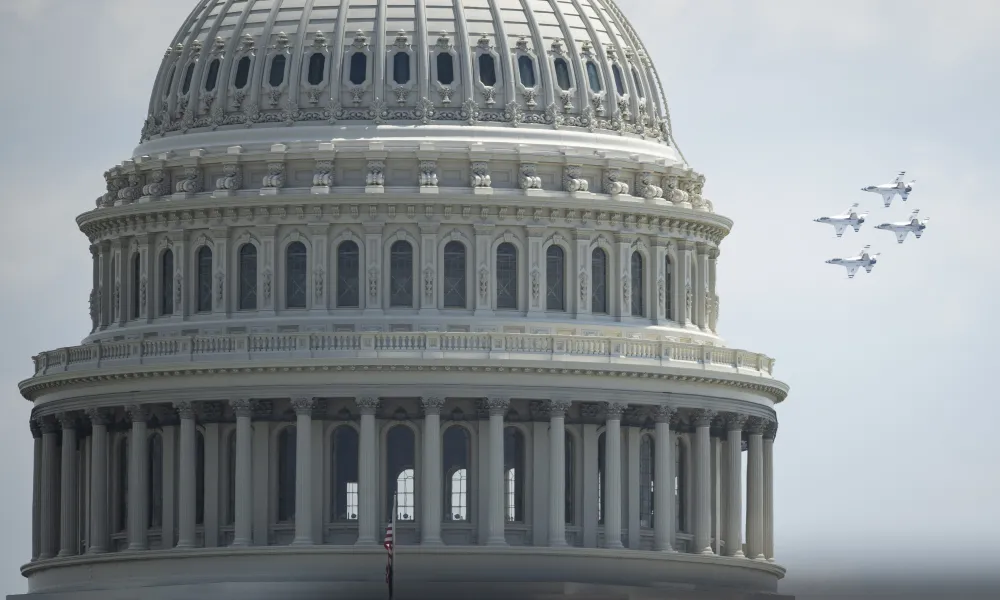

Key indicators of democracy in the United States have fallen to their lowest levels in 50 years, according to a report by a leading think tank. Globally, the report finds that the rule of law appears to have been significantly undermined by the "threats and actions" of the Trump administration.
Worldwide, judicial independence, credible elections, freedom of expression, freedom of the press and access to justice are all at their lowest levels in at least 30 years, according to the International Institute for Democracy and Electoral Assistance (International IDEA), headquartered in Stockholm.
About the report
The intergovernmental organisation's annual report, titled Global State of Democracy, is described as the most comprehensive of its kind, covering 174 countries and measuring democratic performance dating back to 1975.
Findings on the US and globally
International IDEA said the decline in the United States was particularly sharp but forms part of a wider global trend, with 2025 marking the 11th consecutive year in which more countries experienced democratic backsliding than improvement, the longest continuous decline since the think tank's records began.
"In 2025, global challenges to democracy, and the difficulty of halting its erosion, were both confirmed and worsened by political developments in the United States," the report's authors wrote.
The report stated: "President Donald Trump rapidly consolidated power in the executive branch and used it to advance a narrow set of personal goals and pursue retaliation against those he considered enemies... The effects were extensive, undermining the rule of law both domestically and internationally and straining long-standing alliances and multilateral cooperation."
Kevin Casas-Zamora, Secretary-General of International IDEA, warned that the risk of conflict is rising as democracy deteriorates. "The core message of our research is that investment in democracy must be at the centre of every country's security strategy," he said. "The link between the decline in the quality of democracy and the rise in conflict is not being recognised, either in policymaking or in public debate."
The separate Uppsala Conflict Data Program, based at Uppsala University in Sweden, shows that 2025 recorded the most violent conflicts, including the most interstate conflicts, of any year in its dataset, which dates back to 1946.
Some positive developments noted
The International IDEA report also highlighted some positive developments, including in Australia, where civil society groups were consulted on a strategy against racism and on protecting children's privacy online, among other issues, and in Syria, where the "repressive dictatorship" of Bashar al-Assad was overthrown.
In Bangladesh, Nepal and Sri Lanka, youth-led popular protests toppled leaders who had held power for many years, though the report noted that "achieving substantive reforms with a long-term impact in a short period of time proved difficult."
Rule of law identified as weakest area
Casas-Zamora said it was clear that events in the United States had affected other countries. International IDEA first added the US to its list of "backsliding" democracies in 2021, pointing to a "visible deterioration" that it said began in 2019.
The think tank bases its assessments on 50 years of democratic indicators, classifying countries into one of three categories: democracies, "hybrid" regimes, and authoritarian regimes.
Globally, the report found that the rule of law was the weakest area of democracy in 2025, with 71 countries, 41 percent of those assessed, ranked as low performers. It also found the situation deteriorating rapidly, with 29 countries recording a decline.
"What happens in the United States has global resonance. There is now an epidemic of election-result denial, whose 'patient zero' is the current occupant of the White House," Casas-Zamora said.
"I am not prepared to say that the decline in the quality of democracy is inevitable or permanent. It can be reversed," he added. "We live in an unstable world, and that means things can happen that create very positive political prospects."
However, despite the positive signs in Nepal, Bangladesh and elsewhere, the report paints an overall bleak picture. "While people continue to push back against democratic decline, civil society space is narrowing," its authors wrote. "Civil society and citizen participation have been damaged, in part due to the widespread use of strategic lawsuits against public participation, foreign agent laws, and the criminalisation of peaceful protest."
Source: The Guardian