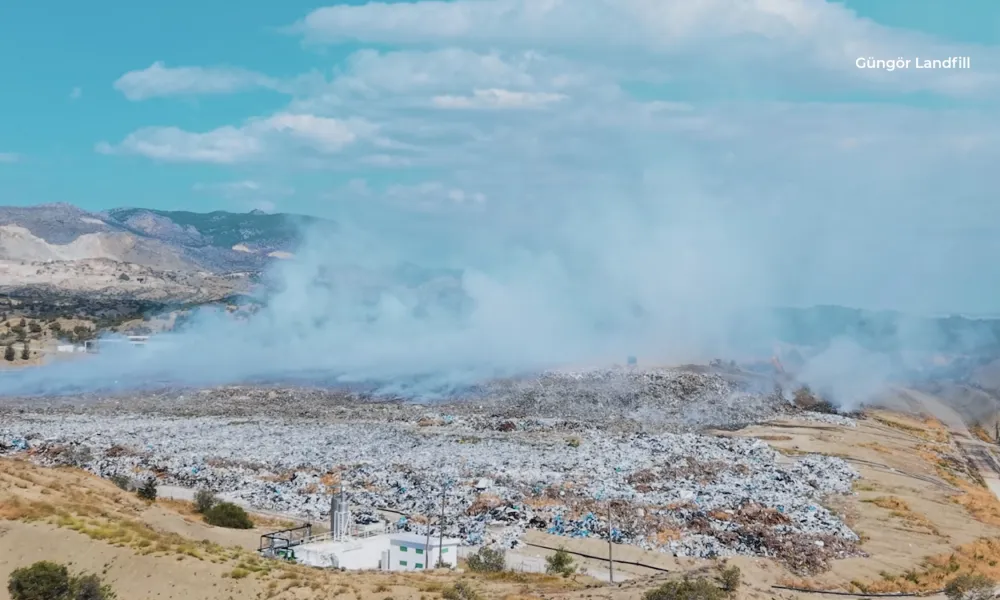

The alarm triggered by the fire at a waste disposal site in Koutsoventis in the north has subsided, but calls remain for measures to ensure the early detection of toxic clouds and the timely warning of residents, both Greek Cypriot and Turkish Cypriot.
Environmental engineer and Greek Cypriot co-chair of the Bi-communal Technical Committee on the Environment, Michalis Loizides, said the fire was a surface fire and did not spread underground, citing the fact that it was extinguished within a short period and the manner in which it developed.
"It was the best scenario we could have had," he told Politis.
For his part, Chrysanthos Savvides, head of the Air Quality Sector at the Republic of Cyprus Department of Labour Inspection, sought to reassure the public in the government-controlled areas, noting that the incident no longer poses any particular danger to human health.
He said that, up to now, the department's monitoring stations in Nicosia had not recorded pollutant levels exceeding the permitted limits.
Gaps in monitoring
However, the incident once again highlighted gaps in the monitoring of hazardous pollutants during the first critical hours of such events, monitoring that concerns both communities and is necessary to ensure residents in affected areas receive timely information.
The issue was discussed on Monday by the Environment Technical Committee, which is promoting the creation of one or more mobile units for measuring hazardous airborne pollutants, as well as the development on both sides of an early warning system for residents.
The aim is that, in such cases, concentrations of specific toxic and hazardous gases could be monitored by two or three instruments and, when levels exceed thresholds capable of affecting the general population, warnings could be issued advising people to remain indoors, as is already done during dust episodes.
If the phenomenon is severe, Loizides said, evacuations of affected areas should also be considered. He added that, in the case of this fire, such a measure might have been necessary on the first day of the blaze, Sunday, September 6, for areas located very close to the dumpsite, within a radius of 2-3 kilometres.
Proposal under discussion
At Monday's meeting, Committee members began examining issues related to implementing the proposal. Discussions included whether it should be pursued through universities or private initiatives, and whether two separate monitoring units should be acquired or a single unit that could operate on both sides.
Loizides noted that short-term exposure does not raise the same level of concern as prolonged exposure, stressing that the key objective is to avoid continuous and long-term exposure of the population to such pollutants.
Smoke in one place, measuring instruments in another
From the first day of the fire until now, the two air-quality monitoring stations operated by the Labour Inspection Department in Nicosia have not recorded pollutant concentrations exceeding permitted limits, Savvides told Politis.
The reason, he explained, was that the smoke cloud did not move towards those areas.
He said he understood the argument raised by residents that monitoring was conducted in different locations, such as Strovolos, while residents in areas such as Aglandjia could smell the smoke.
As he explained, "The smell is an indication that something different from normal conditions is occurring; however, it does not mean that it is linked to a negative impact on human health to such an extent that someone is at risk. Quality of life is affected during the first two or three days because people can smell something, until the quantity of air in the atmosphere has been filtered," he said.