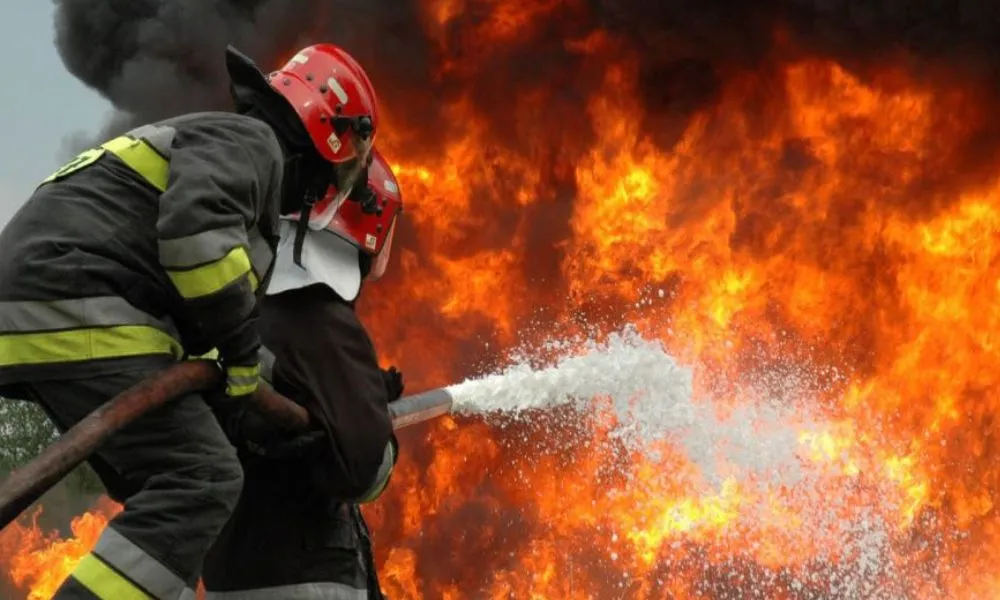

Following the announcement of the provision of two additional aerial firefighting assets through the EU Civil Protection Mechanism (rescEU), the European Commission announced that this year Cyprus will, for the first time, participate in the firefighter pre deployment programme. Specifically, 21 firefighters from Greece will arrive for the period 1–15 September.
With the support of the EU Civil Protection Mechanism (rescEU), Cyprus is being integrated into the European planning for the 2026 summer firefighting fleet, with the deployment of two light aircraft for a fourth consecutive year, in addition to four other light aircraft funded through other EU programmes. The two additional aircraft will be activated for the period 15 June to 31 October, said on Wednesday to a group of Cypriot journalists the head of communications of the European Civil Protection and Humanitarian Aid Operations (ECHO), Zacharias Giakoumis. He clarified that the European Commission covers personnel costs, full transport costs to the country requesting assistance and return, as well as 75% of operational costs.
Referring to the European Regional Station in Paphos, he said that the inauguration will take place later this year, expressing confidence that the Office of the President of the Republic of Cyprus is in communication with the European Commission regarding the date. At the same time, he stressed that an important role of the station relates to its regional function, through cooperation with countries beyond the EU and the development of capabilities via joint exercises. It is an important component about which more will be heard when the inauguration takes place, Mr Giakoumis said.
Pre deployment also in Cyprus
A second point he highlighted regarding Cyprus concerns the firefighter pre deployment programme, which, he said, began in 2022 on the initiative of the then Greek Minister for Civil Protection and former Commissioner for Humanitarian Aid and Crisis Management (2014–2019), Christos Stylianides, and continues with an increasing number of participants. In 2022, the programme started with 236 firefighters, who were pre deployed only in Greece. This year, in the fifth year of the programme, 777 firefighters from 14 countries are participating, to be pre deployed across six Mediterranean countries. Mr Giakoumis noted that this year, for the first time, a number of firefighters will also be pre deployed in Cyprus, specifically 21 firefighters from Greece, during the period 1–15 September.
The largest number of firefighters, a total of 245, will be pre deployed in Greece (their presence will begin from 16 July), specifically in the Peloponnese, Attica and Macedonia, while large numbers will be deployed in Spain and France.
Support for Civil Defence restructuring
Around €4.5 billion has been allocated by the European Commission for the period 2021–2027 for prevention and preparedness in relation to forest fires, through a series of projects and measures, with Mr Giakoumis noting that Cyprus has also benefited.
“This March, the European Commission presented a major strategy for the prevention of forest fires, including strengthening the firefighter pre deployment programme in member states and enhancing forest firefighting resources, something we are already seeing, as well as new policies such as common guidelines for fire risk assessment in all member states and provisions for strengthening other measures,” he said.
At this point, he referred to Cyprus, describing the processes for restructuring Civil Defence as an indicative example of strengthening a member state in matters of prevention and preparedness. As he explained, assistance can also be provided through studies and experts who visit Cyprus at regular intervals in order to share their expertise at a technical level with their counterparts in Cyprus.
The worst year in 2025
Referring to the history of fires in Cyprus over the past 20 years, Mr Giakoumis said that 2025 was the worst year in terms of burned areas, speaking of 14,000 hectares of land burned, as also shown in a relevant chart, where the percentage of burned areas is above the average of the past 20 years. Regarding 2026 (data up to 30 April), the situation appears close to the average of the past 20 years, he added.
Temperatures above average
At the same time, he presented the estimate of the European Forest Fire Information System (EFFIS) for the upcoming climatic conditions in Europe, specifically for the period June–September 2026. “As regards the region of Southern Europe (Mediterranean countries), temperatures will be above average, therefore the risk of forest fires will be increased, as unfortunately happens every year,” he said.
However, rainfall in September is expected to be higher than average. “Nevertheless, what I should note is that these estimates are very dynamic and change continuously,” he added.