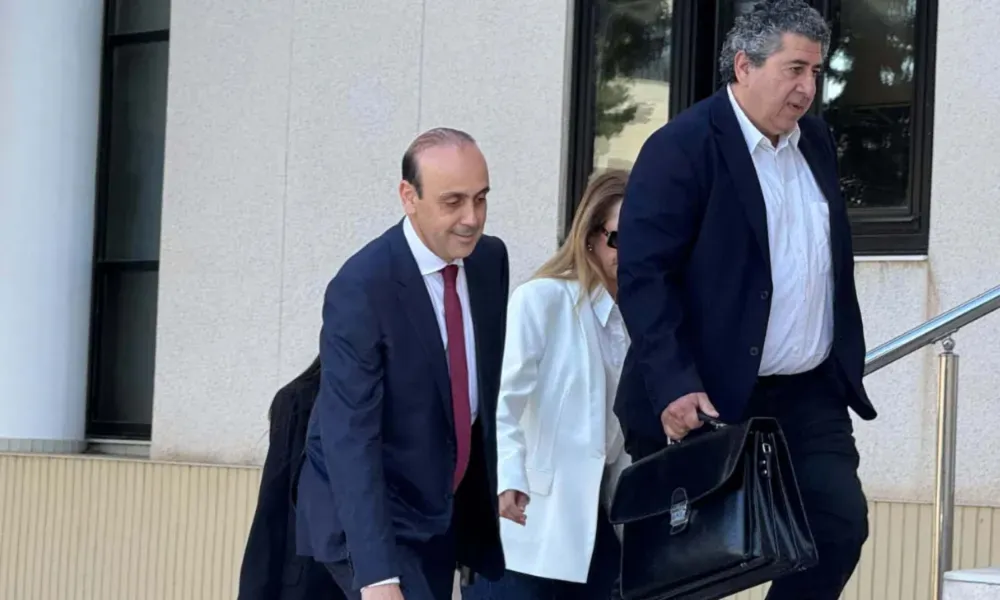

The trial of suspended Paphos mayor Phedonas Phedonos will be held behind closed doors, following a decision announced on Thursday by the Permanent Criminal Court of Paphos.
In delivering the ruling, the court president also prohibited the publication of any records from the proceedings.
Phedonos, who has pleaded not guilty to all charges against him, is scheduled to stand trial from 27 to 31 July 2026.
Risk to complainant's privacy and testimony
Explaining the court's reasoning, the judge noted that although the complainant's name was not made public during the previous hearing on 24 June, her identity appears in the details of the alleged offences.
Given the nature of the allegations and the concerns raised by the prosecution on behalf of the complainant, the court found there was a clear risk not only of violating her privacy but also of affecting the quality of her testimony through fear, anxiety and possible social stigma.
The judge stressed that these concerns exist regardless of whether the allegations are ultimately proven, a matter that will be determined at the conclusion of the trial.
European court precedent
The court referred to a rape case heard by the European Court of Human Rights, in which proceedings were conducted behind closed doors to protect the complainant's private life.
The judge noted that in that case, authorities had publicly disclosed the complainant's identity shortly after the complaint was filed and that the complainant had also given media interviews.
Nonetheless, the European court concluded that privacy considerations justified closed proceedings.
Applying the same principle, the Paphos court held that the complainant in the current case should be able to testify without fear or pressure.
Defence objections rejected
The defence argued that considerable time had passed since the alleged offences and that the complainant was an adult rather than a child.
The court rejected those arguments, stating that adult women who allege rape or sexual abuse remain particularly vulnerable and may still face stigma through public exposure.
The judge further noted that adulthood alone does not automatically require a public hearing when compelling reasons exist for private proceedings.
Defendant's rights remain protected
The court emphasised that the defendant's right to a fair trial would not be undermined by the decision.
According to the ruling, conducting the proceedings behind closed doors will not prevent or adversely affect the defence's ability to present its case.
The court also considered holding only part of the proceedings in private, such as during the complainant's testimony, but concluded that sensitive personal information could arise throughout the trial and not only during her evidence.
Arguments from both sides
The prosecution, represented by Eirini Savva, argued that the nature of the alleged offences makes the case exceptional and that the evidence is expected to include sensitive personal information and details of the complainant's private life.
It also warned of the potential for re-traumatisation if the proceedings were held in public.
The defence team, consisting of Christos Pourgourides and Epameinondas Korakides, argued that the complainant was already known to third parties in Paphos and had allegedly spoken about the accusations to numerous witnesses.
The defence further maintained that details of the investigation had previously appeared in the media, strengthening the case for a public hearing and public scrutiny, particularly in a case involving a public figure.
Five charges
Phedonos faces five charges:
- Rape
- Indecent assault against a woman
- Indecent assault against a woman by another act
- Assault causing actual bodily harm
- Administering a drug or other substance capable of stupefying or overcoming a person's resistance
He has denied all charges.
The court has scheduled the hearing over five consecutive days, from 27 to 31 July, with proceedings beginning at 9am each day.
Following Thursday's ruling, the entire trial will be conducted behind closed doors.