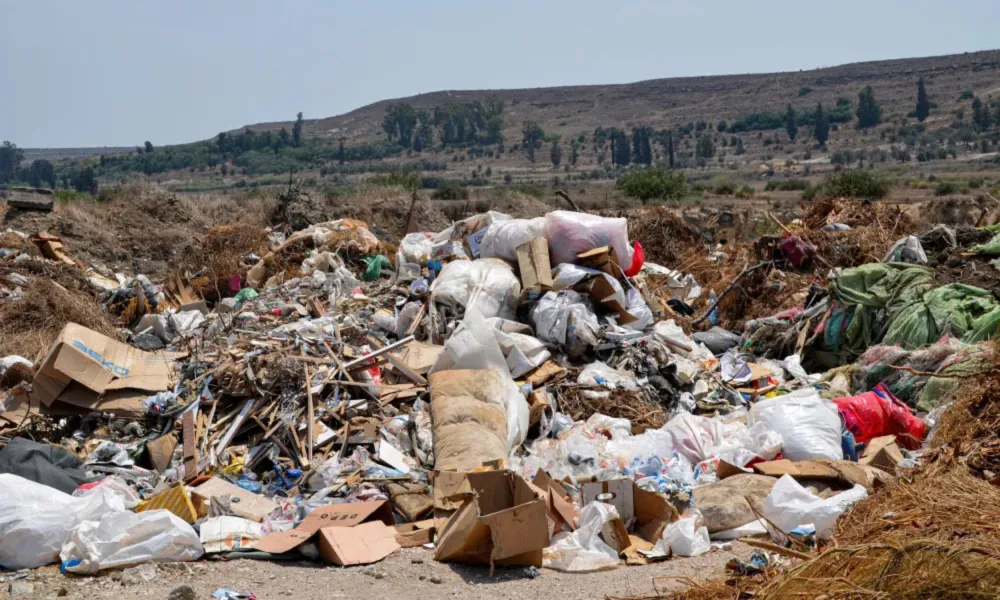

The first communities, from a total of around 100 across Cyprus, have begun removing illegal dumping sites within their boundaries as part of a new nationwide cleanup campaign.
The initiative is the third of its kind and follows the approval by the Council of Ministers on 16 July of €1 million in emergency funding, with priority given to areas facing an increased risk of wildfires.
The proposal was jointly submitted by the ministers of Agriculture, Rural Development and Environment, Interior, and Transport, Communications and Works.
Following the submission of information by communities to the Union of Cyprus Communities by 24 July, detailing the number of illegal dumps within their jurisdictions and the estimated cost of removing them, the campaign's working group met on 26 July.
The group, consisting of representatives of the Union of Communities, the Department of Environment and district administrations, evaluated the data and compiled a list of approximately 100 communities and more than 200 illegal dumping sites, according to Union of Cyprus Communities president Andreas Kitromilides.
"Some communities have already started cleanup operations because they have their own crews or managed, before the holiday period, to secure contractors and access to licensed waste-receiving facilities," Kitromilides told Politis.
"Those that did not manage to do so will begin taking action towards the end of August," he added.
Grants of up to €15,000
From the €1 million allocated by the state, each participating community will receive funding ranging from €4,000 to €15,000, depending on its needs.
The emergency grant is financed through equal savings achieved by the Ministries of Agriculture and Transport.
The funds were transferred to the budget of the Ministry of the Interior, which distributes them through district administrations to community service clusters or community councils in line with Cabinet Decision No. 344/2026 of 26 March 2026.
Funded works include:
- Collection and removal of solid waste.
- Mixed construction and demolition waste.
- Bulky discarded items.
- Other illegally dumped materials.
- Restoration works where considered necessary.
An Achilles' heel for fire prevention
According to the Fire Service, Cyprus has approximately 850 illegal dumping sites nationwide.
Authorities regard them as a major weakness in wildfire prevention efforts.
Although progress has been made in addressing other fire-related risks in recent months, illegal dumps remain what officials describe as a "time bomb".
Before the current fire season began, the Fire Service provided every community council with a list identifying illegal dumping sites that needed to be removed, together with areas requiring vegetation clearance.
Under existing legislation, local authorities are responsible for identifying and clearing illegal waste-disposal areas.
However, after many local authorities cited financial constraints, the government decided for a third consecutive year to provide financial assistance, recognising that the rapid removal of illegal waste is essential for environmental protection, public health and wildfire prevention.
Two previous campaigns
The government allocated:
- €1 million in 2024
- €1.2 million in 2025
under the #WasteFreeCyprus campaign to clean illegal dumping sites.
The newly approved €1 million raises total state support since 2024 to €3.2 million.
This latest funding is in addition to the €4.16 million already approved for 2026 as part of broader wildfire-prevention measures in communities.
Cameras to prevent new dumping
Meanwhile, procedures have begun to allow communities and municipalities to install surveillance cameras at cleaned sites to prevent the re-emergence of illegal dumps in previously unattended areas.
As Politis reported last week, following conditional approval by the Commissioner for Personal Data Protection on 20 July, a meeting was held at the Ministry of the Interior to determine the next steps.
According to the ministry, the commissioner required that warning signs be displayed informing the public that an area is under camera surveillance.
Issues still to be resolved include:
- Setting technical specifications for the cameras.
- Launching a procurement tender.
- Selecting monitoring locations.
- Determining which body will manage the video footage.
According to the Interior Ministry, the most likely operators are the Unions of Communities and Municipalities.
Commissioner: Legitimate under certain conditions
Personal Data Protection Commissioner Maria Christofidou said the installation of video-surveillance systems at illegal dumping sites for the prevention or early detection of fires could constitute a legitimate measure serving the public interest, provided it is necessary and proportionate and includes appropriate safeguards for personal data.
She said any such system must comply with both the EU General Data Protection Regulation (GDPR) and national legislation.
Among other requirements, there must be:
- An appropriate legal basis.
- Compliance with proportionality and data-minimisation principles.
- Suitable technical safeguards.
- A data protection impact assessment where required under Article 35 of the GDPR.
Christofidou stressed that the legality of each surveillance system must be assessed on a case-by-case basis, taking into account its specific characteristics and mode of operation.