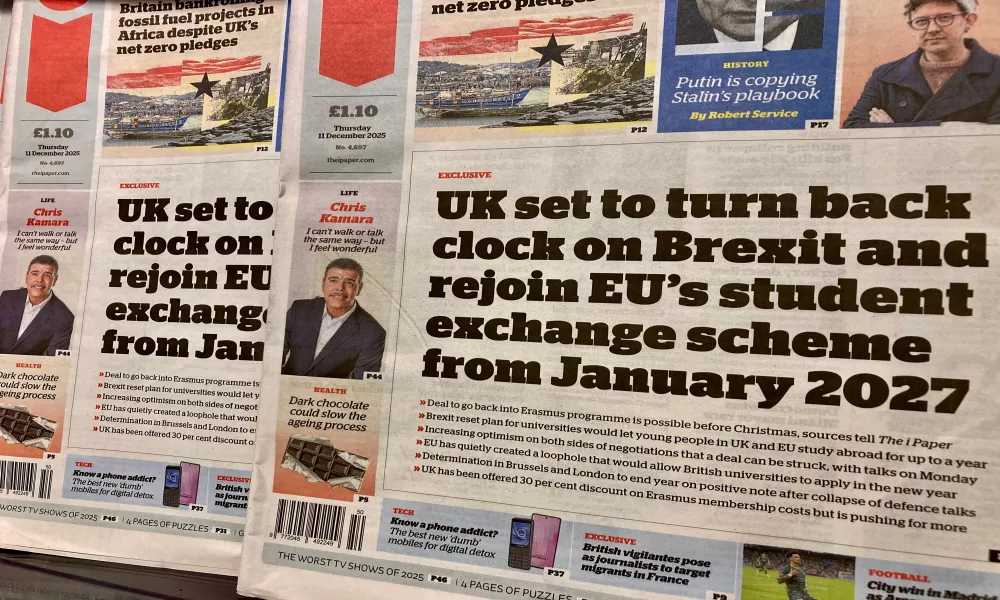

The European Union and the United Kingdom are still negotiating two key issues ahead of their summit: tuition fees for EU students studying in the UK and participation in a proposed youth mobility programme.
Speaking after a meeting of EU education and youth ministers, European Commission Executive Vice-President Roxana Minzatu said she hoped the summit would produce a positive outcome.
According to Minzatu, discussions remain ongoing over both the tuition fee regime for European students and the proposed youth experience programme, although the UK's return to Erasmus has created positive momentum.
"It would be a very good complement if we could also move forward on the youth experience programme and the discussion on tuition fees," she said, adding that negotiations remain dynamic but expressing optimism about reaching an agreement.
Tuition fees remain a sticking point
According to reports, the EU is seeking an arrangement under which European students would pay the same tuition fees as British students.
Those fees are estimated to be around four to five times lower than the international tuition rates currently charged to many EU students following Brexit.
Another area of disagreement concerns participation in the proposed youth mobility scheme.
The EU is reportedly seeking 100,000 visas annually, while the UK has proposed a range of 50,000 to 80,000, citing concerns about migration levels.
To strengthen its negotiating position, the EU has linked the tuition fee issue, the youth mobility programme and Erasmus participation as a single package, arguing that all three agreements should enter into force simultaneously.
Strong support for closer cooperation
Irish Education and Youth Minister Hildegarde Naughton, whose country currently holds the presidency of the Council, described the summit as important for maintaining positive EU-UK relations.
She said there was widespread hope for a positive outcome across several policy areas.
Focus on skills, AI and youth policy
Meanwhile, the Youth Council approved conclusions on empowering young people in a changing information environment and promoting youth spaces across Europe.
Ministers also adopted conclusions relating to:
- Skills and competencies linked to artificial intelligence.
- Science education and STEM subjects.
- Critical thinking and human agency in the digital world.
The council reviewed progress on the next Erasmus+ programme and received updates on the proposed Skills Portability Act.
New initiatives on education and artificial intelligence
Minzatu presented the Commission's education and skills package, which focuses on improving literacy, mathematics and science performance, while also strengthening support for teachers.
The package includes guidance for new teachers, plans for European School Alliances involving partnerships between two or three member states, and a network of advisory support services already backed by Erasmus+ funding in 30 regions.
She also announced that a pilot artificial intelligence literacy certification programme will begin during the 2027-2028 academic year.
In addition, Minzatu welcomed the creation of a European Digital Infrastructure Consortium involving eight member states aimed at developing European classroom technology and reducing dependence on external suppliers.
Regarding Erasmus+, she noted that the 2027 call for proposals, worth €5.3 billion, was published on Wednesday and includes participation by both the United Kingdom and Switzerland.
The EU, she added, wants Erasmus to remain strong and accessible during negotiations on the bloc's next multiannual budget.
"Erasmus should remain a right for everyone, not a limited opportunity only for those who can afford it," she said.
Source: CNA