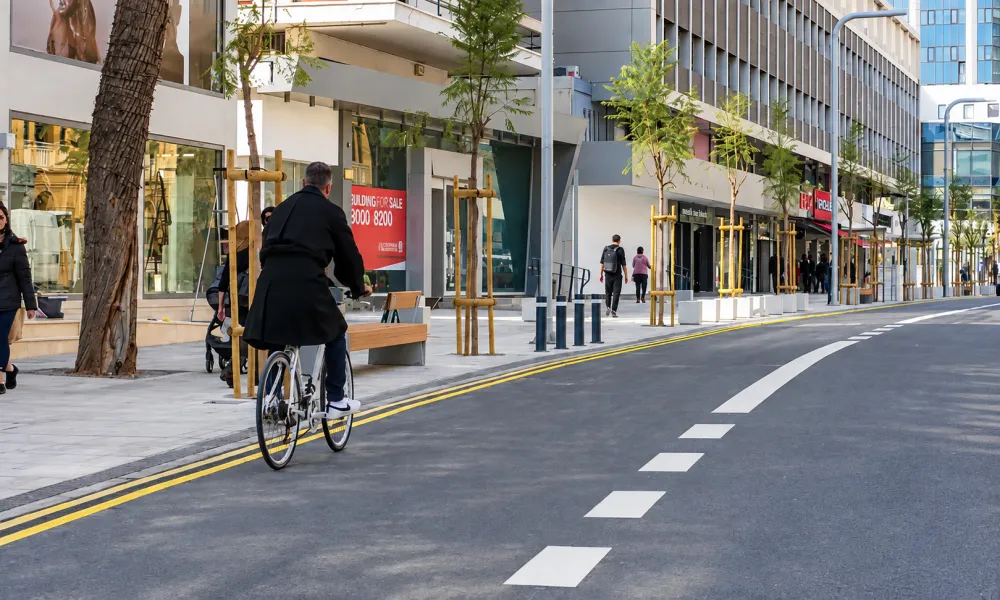

Makariou Avenue returns to Parliament on Thursday as debate over the future of central Nicosia intensifies, with the European Commission warning that any change to the EU-funded redevelopment must be assessed against the conditions under which the project received almost €21 million in European funds.
The House Transport Committee will reopen discussion on Makariou Avenue, including the one-way system on its southern section, the current traffic arrangements and calls for the closed section to be reopened to general traffic.
Meanwhile, according to information obtained by Politis, Transport Minister Evi Tsolaki is due to meet Nicosia Mayor Charalambos Prountzos on Friday to discuss outstanding issues affecting the capital.
The meeting comes as controversy over Makariou Avenue expands to Ledras and Onasagorou streets, where a preliminary redevelopment proposal has also triggered opposition.
Disputes over changes to central Nicosia are not new. Objections have previously been raised over traffic arrangements on Costakis Pantelides Street, followed by concerns surrounding works in the Commercial Triangle and Stasikratous Street, and subsequently Makariou Avenue.
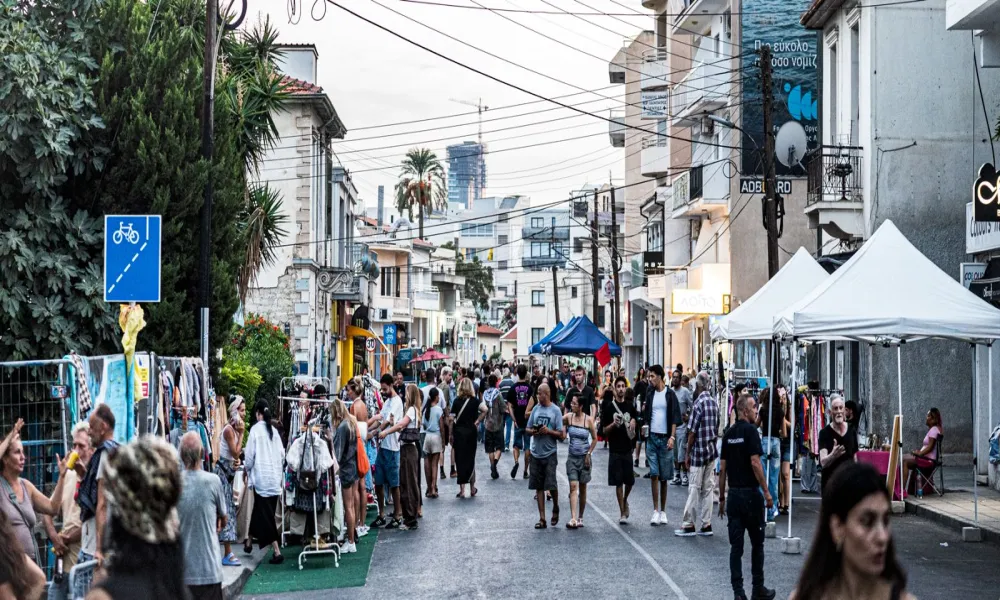
Now organised shopkeepers, residents and property owners are also objecting to plans concerning Ledras and Onasagorou, with some going as far as calling for the mayor's resignation.
Almost €21m in EU funding at stake
The debate over reopening Makariou Avenue now takes place against the backdrop of the European Commission's formal position.
Responding to questions from Politis, the Commission made clear that any changes to the project would need to be assessed against the conditions under which it was approved and funded.
The redevelopment of the Commercial Triangle, Makariou Avenue and Stasikratous Street was 85% funded by European resources. The EU contribution amounted to €20.995 million, while the overall cost reached €24.7 million.
The funding was allocated to a project with specific objectives, including sustainable mobility, reducing private-car use, strengthening public transport and improving infrastructure for pedestrians and cyclists.
The Commission does not say Makariou Avenue is prohibited from reopening to general traffic. Nor does it say such a decision would automatically require repayment of the almost €21 million.
However, it makes clear that any change would need to be assessed to determine whether the project continued to serve the objectives for which the funding was approved.
If a change were considered a substantial modification affecting the nature or objectives of the project, questions could arise over the European funding.
Transport Ministry wants guarantees first
As Politis has previously reported, the Transport Ministry does not intend to agree to changes to Makariou Avenue unless it is first established that they would not result in the recovery of EU funding and pass the cost on to taxpayers.
A competent source told Politis that any change to the project's underlying philosophy would first have to safeguard public finances.
There are still four years remaining in the five-year assessment period, calculated from the final disbursement of European funding.
That timeframe has become a central consideration in the debate.
Before the current arrangements are altered, authorities will have to establish whether, and to what extent, reopening the avenue would affect the funding conditions.
So far, there is no assurance that a substantial change would carry no financial consequences.
Is Makariou really a ‘dead avenue’?
Data obtained by Politis presents a different picture from the description of Makariou Avenue as a "dead avenue" used by some shopkeepers.
Along the section stretching from the former Woolworth traffic lights to the junction with Omirou Avenue, there are 93 premises and plots fronting Makariou Avenue.
Including those extending into the adjoining squares, the total reaches 106.
Of these, 92, or 87%, are recorded as active or incorporated into investment and development plans.
If properties not currently available on the market because of foreclosure or development plans are excluded, the potential commercial occupancy rate is estimated at 87% for Makariou Avenue and the squares, rising to 91% for premises fronting the avenue itself.
Makariou clearly does not have the commercial activity it enjoyed in previous decades. The figures, however, do not indicate an avenue without economic activity, as some of its critics have suggested.
Disputes move from street to street
Calls for changes to Makariou form part of a much longer debate over the future of Nicosia's commercial centre.
There were objections to traffic arrangements on Costakis Pantelides Street, followed by opposition to interventions in the Commercial Triangle and Stasikratous Street.
On Makariou Avenue, some shopkeepers argue that restrictions on general traffic have made access more difficult and harmed commercial activity. They want more private vehicles to be allowed through the avenue.
However, the commercial landscape of central Nicosia has been changing for years.
Businesses have moved to other parts of the capital, major shopping centres have absorbed a significant share of consumer spending and shopping habits have changed.
At the same time, significant public and private investment has taken place in the centre and new businesses have opened.
The debate over whether Makariou Avenue has succeeded or failed therefore cannot be reduced solely to the number of cars travelling along it each day.
Ledras and Onasagorou dispute escalates
Before agreement has been reached over Makariou, controversy has also erupted over Ledras and Onasagorou streets.
A preliminary proposal for the redevelopment of the two historic commercial streets has prompted objections from affected groups, who are questioning both the scale of the plans and the process being followed.
The Committee of Shopkeepers, Residents, Small Business Owners and Property Owners in the Pedestrianised Historic Commercial Centre went as far as calling for the resignation of Nicosia Mayor Charalambos Prountzos on Wednesday.
The committee accuses the mayor of mishandling the public consultation process and has also made serious allegations regarding the selection of PwC.
These are allegations made by the committee itself, which has announced that it no longer believes there is scope for cooperation with the mayor.
Shopkeepers and residents raise specific objections
Beyond the increasingly heated dispute, affected groups have submitted specific objections to the preliminary redevelopment proposal.
They believe the available funding is insufficient for a meaningful redevelopment of the entire area.
They have also expressed concern that important streets and side roads east of Onasagorou and west of Ledras could be left outside the project.
Among the streets mentioned is Ippokratous Street, where the Leventis Municipal Museum is located.
The groups are also demanding:
- Financial guarantees and support for businesses while construction is under way.
- More greenery within the redevelopment.
- Specific project timetables.
- The involvement of specialised consultants.
Municipality aims to revive historic centre
The Nicosia Municipality, for its part, is pursuing the redevelopment with the stated aim of strengthening the area's historic, commercial and cultural character.
The municipality also wants to bring activity back to a section of the old city that has faced longstanding problems.
The wider debate now leaves central Nicosia facing several interconnected questions at once: how to support commercial activity, how much space should be allocated to private vehicles, how sustainable mobility commitments should be protected and how redevelopment projects should be shaped through consultation with those who live and work in the area.
In the case of Makariou Avenue, however, there is an additional consideration with potentially significant financial consequences.
The European Commission is not prohibiting change, but it has made clear that any substantial alteration must first be assessed against the objectives and conditions attached to the almost €21 million in EU funding.