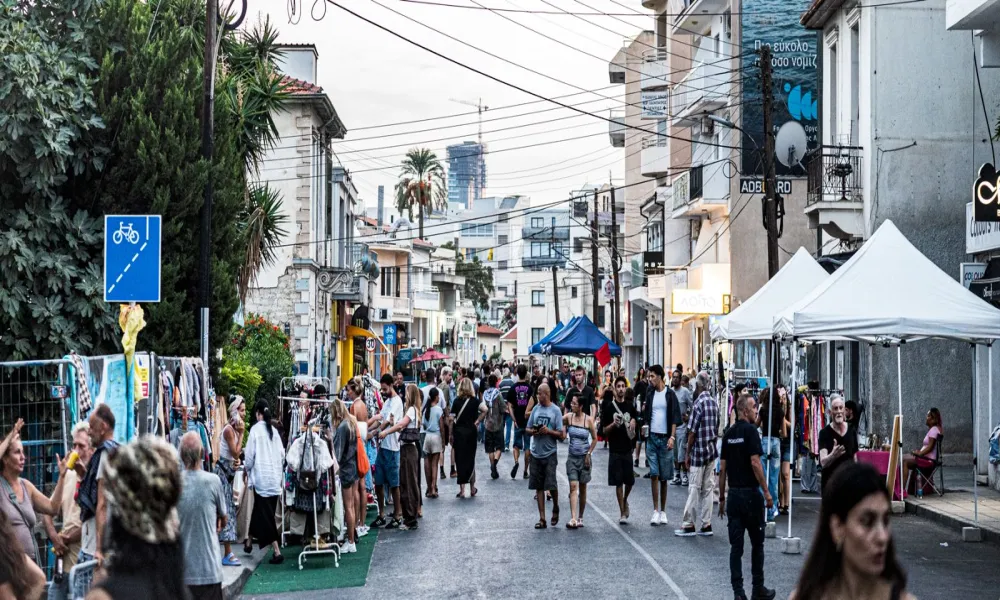

Gladstonos Street in Limassol and the Agioi Omologites neighbourhood in Nicosia were transformed on Sunday into streets for laou laou, or slow, easy-going movement, as part of European Mobility Week.
The experiment demonstrated something we often pretend not to see. Give people safe space to walk, cycle or use a scooter without competing with cars, and they will use it.
The large turnout in both cities says something. So do the calls for such initiatives to happen more frequently. There is demand for alternative ways of getting around. What is usually missing is the infrastructure to make them possible.
Build it and people will use it
We have seen it repeatedly in Limassol and Nicosia.
When proper infrastructure is created, even temporarily for a Sunday, people use it. The case becomes even stronger when permanent, legal and, above all, safe infrastructure is provided.
Pedestrian streets, linear parks and properly designed cycle lanes attract people.
Perhaps it is time to stop saying “these things don’t work in Cyprus” and start asking how many genuine opportunities we have actually provided for them to work.
There are contradictions in our attitude towards transport.
Many Cypriots who studied abroad learned to walk, take buses, use metros or trams where available, or cycle. Yet on returning to Cyprus, we often take it for granted that we cannot go anywhere without a car.
At Cyprus University of Technology and the University of Cyprus, discussions frequently revolve around the need for more parking spaces.
We have reached a point where students buy a car before they buy a laptop.
It is not the students’ fault
The problem is not the students.
It is a mentality built over decades, reinforced by cities designed around it.
We have accepted the idea that walking is impractical, cycling is unsafe and sometimes even that travelling without a car reflects poorly on someone’s status.
But when the city itself forces people to travel by car, changing attitudes becomes considerably harder.
Public transport must become a real alternative
Public transport is another part of the problem.
Buses in Cyprus have never achieved the central role they play in many other European cities. Routes, frequencies and waiting times do not always correspond to the realities of people’s daily lives.
At the same time, we often fail to provide buses with the infrastructure needed to perform better, even as fares increase.
Whenever a bus lane is proposed or road space is taken away from cars, opposition begins.
We want better buses, apparently, as long as we do not have to give them a single metre of road.
Do car-free streets really hurt businesses?
The argument that reducing car traffic inevitably kills commercial areas is also difficult to reconcile with what happens in practice.
Businesses in Limassol and Nicosia were busy on Sunday.
The explanation is hardly complicated. A pedestrian stops for coffee, eats and shops.
A driver frequently just passes through, bringing noise and pollution without necessarily spending anything.
A cycle lane to nowhere is not enough
This is where both central government and municipalities bear significant responsibility.
The state in particular has far greater financial and institutional resources and cannot reduce sustainable mobility policy to a few fragmented projects and one European Mobility Week each year.
Cyprus needs sustained investment, funding, incentives for local authorities and, crucially, networks that actually connect.
A cycle lane that begins nowhere and ends nowhere is more of an excuse than infrastructure.
The aim is choice, not abolishing cars
Nobody is suggesting that everyone should throw away their car keys and buy a bicycle or scooter.
For many people, a car is essential and will remain so.
The point is to provide a genuine choice for those who can and want to travel differently.
There is also a social dimension. Walking, cycling and public transport cost very little compared with purchasing a car and paying for fuel, insurance and maintenance.
Every person able to leave their car at home for some everyday journeys also means one fewer vehicle on the road.
Ultimately, that benefits the people who genuinely need to drive too.
None of this is revolutionary elsewhere in Europe. In Cyprus, however, sustainable mobility is still sometimes discussed as though someone were proposing the abolition of the car.
Nobody is asking everyone to become a cyclist.
But we should at least make it possible for those who want to.
Because, as Sunday demonstrated once again, there are plenty who do.
All that is missing is the space.