
The increasingly public dispute over the Great Sea Interconnector (GSI) has developed into a broader political and institutional problem for the Christodoulides government, exposing differences within the administration and between the government and its main supporting party, DIKO.
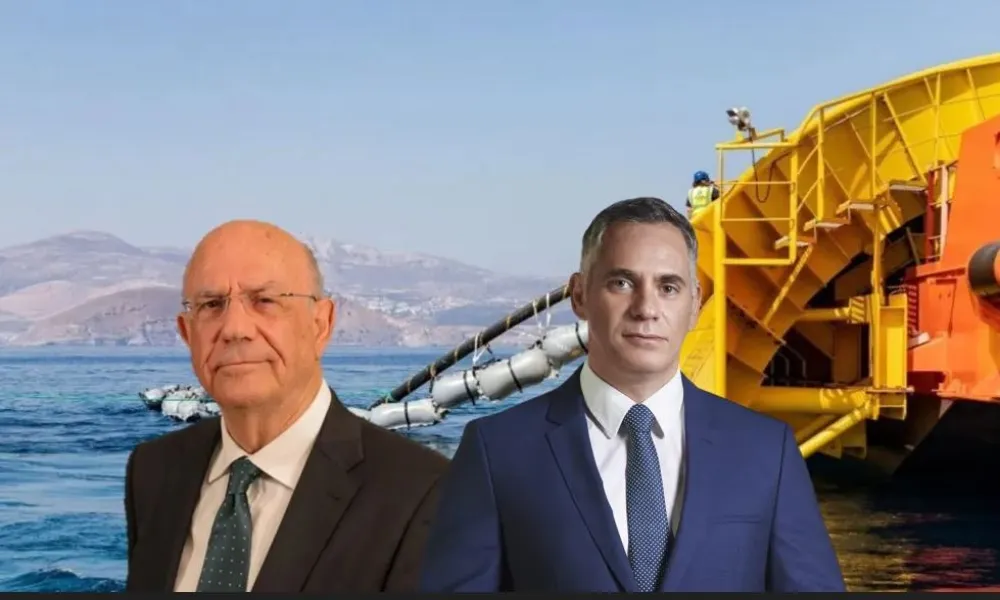
At the centre of the confrontation are DIKO leader Nicolas Papadopoulos and Finance Minister Makis Keravnos, whose disagreement over the Cyprus-Greece electricity interconnection has moved beyond questions about the project’s financial viability and into the political relationship underpinning the government.
The involvement of other DIKO figures, including Energy Minister and party vice-president Michalis Damianos, has further complicated the picture and raised questions over whether the government can maintain a coherent position on a project with major implications for Cyprus’ energy future.
Divisions within the government camp
The dispute has created an unusual political situation.
The leader of the principal party supporting the government, together with other DIKO officials, is publicly criticising a senior government minister. At the same time, other Cabinet members originating from DIKO have sought to defend or moderate the government’s position.
President Nikos Christodoulides, meanwhile, has so far avoided directly intervening in the public confrontation.
The situation creates a significant political challenge for the President as attention gradually turns towards the 2028 presidential election, raising questions over whether electoral considerations and the preservation of political alliances are affecting the government’s handling of the dispute.
It also raises a broader question: how effectively can a government manage major strategic decisions when its own ministers and political supporters appear unable to maintain a unified position?
The substance of the GSI dispute
The disagreement has been developing for months.
Christodoulides has repeatedly stated that the electricity interconnection should proceed, while Keravnos has continued to express serious reservations concerning its financial viability, overall cost and potential impact on consumers and public finances.
The disagreement became a direct political confrontation when Papadopoulos publicly questioned why Keravnos remained Finance Minister if he considered the project harmful while the government itself remained committed to implementing it.
Papadopoulos also accused Keravnos of “demonising” the GSI.
Keravnos responded sharply, referring to “the ridiculousness of politics” and accusing the DIKO president of having “obsessions” over certain issues.
DIKO immediately responded, arguing that Papadopoulos had not formally demanded the minister’s resignation but had raised a legitimate political question about whether Keravnos’ position was compatible with government policy.
From that point, the debate expanded beyond the GSI itself and into the relationship between DIKO and the government.
Calls for Christodoulides to intervene
Four interventions on Wednesday demonstrated how the dispute has acquired wider political significance.
DIKO parliamentary spokesman Panikos Leonidou called for de-escalation, describing the confrontation as regrettable.
He urged Christodoulides, upon returning to Cyprus, to take the initiative and bring Papadopoulos and Keravnos together for discussions.
“They are not enemies, they are partners,” Leonidou said, arguing that a solution based on dialogue and de-escalation is necessary.
Pantelides criticises Keravnos
DIKO's Chrysis Pantelides adopted a significantly tougher position, describing Keravnos’ comments as “unacceptable, to put it mildly” and insulting towards the party president.
He insisted that Papadopoulos had not demanded Keravnos’ resignation but had raised a political question.
Pantelides also called on Christodoulides to clarify whether he agreed with the comments made by his Finance Minister.
At the same time, he expressed support for the electricity interconnection itself, while acknowledging that the financial concerns surrounding the project must be answered with concrete evidence.
Kenevezos brings 2028 into debate
Former DIKO figure and former Cyprus ambassador to Athens Kyriakos Kenevezos gave the dispute a broader institutional and electoral dimension.
Kenevezos argued that the problem was not personal but governmental and said the President should not allow such confrontations to continue indefinitely.
He called for the relevant studies to be presented and the project’s economic risks to be clearly explained.
Kenevezos also directly raised the question of 2028, arguing that the political centre should consider developing its own political expression and leaving open the possibility of his own presidential candidacy.
Damianos seeks to lower tensions
Energy Minister and DIKO vice-president Michalis Damianos took a different approach, seeking to reduce the intensity of the dispute.
Damianos argued that, fundamentally, the various sides are “more or less saying the same thing”.
The government wants the GSI to proceed and regards the electricity interconnection as strategically necessary and, in the longer term, effectively unavoidable. At the same time, he said, the project’s financial aspects must be fully clarified.
Damianos has described the connection to another electricity grid as necessary for Cyprus’ long-term energy adequacy, while stressing the importance of completing the relevant financial assessment.
‘DIKO has a candidate for 2028’
Politically, Damianos’ most significant intervention concerned the next presidential election.
He said that, in his view, “DIKO has a candidate for 2028”, referring to Christodoulides.
Damianos also argued that it would be a mistake for DIKO to contest the next presidential election independently.
His position contrasts with Kenevezos’ assessment that the political centre should explore its own path, exposing different views over DIKO’s future relationship with Christodoulides.
GSI becoming a wider political test
The Great Sea Interconnector has therefore become a catalyst for issues extending well beyond the technical and financial merits of the electricity cable.
The dispute has exposed difficulties in presenting a fully unified government position, intensified tensions between DIKO and Keravnos and revealed different approaches within the political centre towards Christodoulides and the 2028 presidential election.
The viability and cost of the interconnector remain the immediate substantive questions.
But the political debate it has triggered is now considerably larger, touching directly on the cohesion of the government, its relationship with DIKO and the alliances likely to shape the next presidential contest.