
More than €760 million has been provided by the European Union to support the economic and social development of the Turkish Cypriot community between 2006 and the end of 2025, according to the European Commission's latest annual report.
Around €33.7 million was committed under the 2025 action programme, while the 2021-2027 Multiannual Financial Framework provides for total funding of €240 million. The Commission reiterates that this assistance does not imply recognition of any authority in areas of the Republic of Cyprus where the government does not exercise effective control.
A total of 102 contracts were being implemented under the programme at the end of 2025.
Major infrastructure projects
Several significant infrastructure projects advanced during 2025 with EU funding.
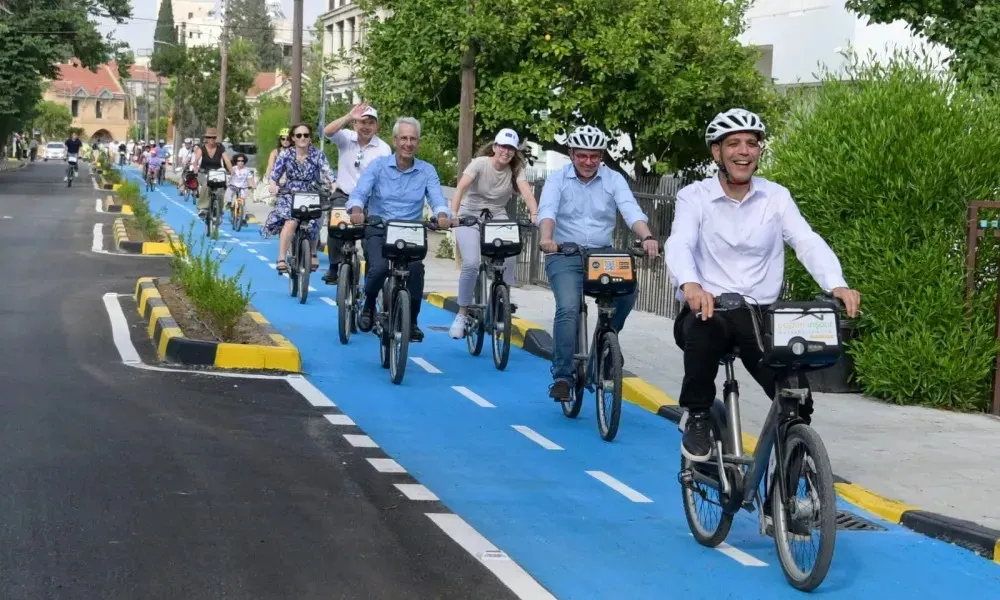
These included the extension of the Pedieos linear park into the northern part of the island, the widening of the Agios Dometios crossing point, the installation of photovoltaic systems at the Mia Milia wastewater treatment plant, the replacement of major sewage pipelines and the construction of a treated-water return pipeline.
An additional 153 kilometres of sewerage pipelines were installed during 2025 alone, aimed at replacing problematic septic systems that pose a risk to groundwater.
Through the United Nations Development Programme, projects worth more than €37 million also continued. These include sewerage upgrades in Mandres, water infrastructure and solar installations in Lefka, sports facilities in schools and a sludge-receiving facility in Mia Milia.
The Commission nevertheless expressed serious concern over waste management, warning that the landfill serving the Turkish Cypriot community is nearing capacity and threatening the sustainability of the entire waste-disposal system.
Support for businesses
The EU continued to support small and medium-sized enterprises, which it describes as the backbone of economic activity in the Turkish Cypriot community.
Since the programme began, more than 2,554 grants worth over €27 million have been awarded to support private-sector development.
Under the "eunite" programme, nearly €2 million was provided to 45 businesses engaged in, or seeking to engage in, trade across the Green Line, helping them meet EU product and food-safety standards.
Ten startups participated in the Startups4Peace competition, receiving mentoring, training and seed funding.
Green Line trade declines
Despite EU efforts, Green Line trade fell by around 5% in 2025 to €14.4 million.
The decline was attributed primarily to rising prices in the Turkish Cypriot community. No new categories of processed non-animal-origin food products were approved for trade during the year.
The Commission stressed that alignment with EU standards remains crucial both for growing trade and for preparing businesses for a potential comprehensive settlement.
Delays in halloumi implementation
Implementation of the Protected Designation of Origin (PDO) system for halloumi continued during 2025.
By the end of the year, four Turkish Cypriot producers and 24 livestock farms had been certified.
However, the Commission highlighted significant delays in animal-health and food-safety inspections. The transfer of authority to the independent certification body Bureau Veritas was delayed by more than a year, limiting Turkish Cypriot participation in the PDO scheme.
A livestock genetic-improvement programme was launched during 2025, while EU support also helped address an outbreak of foot-and-mouth disease recorded in December.
Funding for missing persons
The EU contributed a further €2.6 million to the Committee on Missing Persons in 2025, bringing total funding since 2006 to €41.1 million.
The EU now finances approximately 80% of the committee's operational budget, covering excavations, exhumations and laboratory work.
By the end of 2025, the remains of 1,714 individuals had been exhumed, while 1,063 of the 2,002 persons listed as missing had been identified.
Cultural heritage projects
Since 2011, about €32.5 million has been allocated to the Technical Committee on Cultural Heritage.
The funding has supported the conservation, protection and restoration of more than 200 monuments, religious sites and cemeteries across Cyprus.
A digital heritage platform and youth ambassador programme were also established.
Scholarships and youth programmes
During the 2024-2025 academic year, 142 scholarships were awarded to Turkish Cypriot students for studies in EU member states.
Since 2007, a total of 2,418 scholarships have been granted, covering studies at more than 100 universities in 23 European countries.
The scholarships support undergraduate, postgraduate and doctoral studies, as well as research and professional training programmes.
Civil society support
Under the ninth phase of the "Cypriot Civil Society in Action" scheme, 16 grants worth €2.22 million were approved.
The projects focus on environmental protection, reconciliation, confidence-building, women's empowerment, youth rights, health, animal welfare and support for victims of gender-based violence.
A new €2.3 million programme launched in December 2025 aims to strengthen civil-society organisations and promote joint initiatives between Greek Cypriots and Turkish Cypriots.
Bringing the community closer to the EU
More than 350 outreach and information events promoting the EU and its aid programme were organised during 2025.
The first bicommunal Europe Day event attracted around 5,000 participants.
Through the TAIEX technical-assistance mechanism, 81 expert missions and a workshop were carried out in 13 areas of the EU acquis, including product safety, anti-money laundering, education, environmental policy, statistics and food safety.
€38.5m in payments during 2025
The European Commission signed new legal commitments worth €29.2 million in 2025, while payments reached €38.5 million.
Audits by the European Court of Auditors found no negative issues in programme projects.
The Commission concludes that the programme continues to have a positive impact on the social and economic development of the Turkish Cypriot community and helps preserve the prospect of reunification.
It stresses, however, that EU assistance alone cannot resolve the Cyprus problem, as responsibility for reunification ultimately remains with the island's two communities.