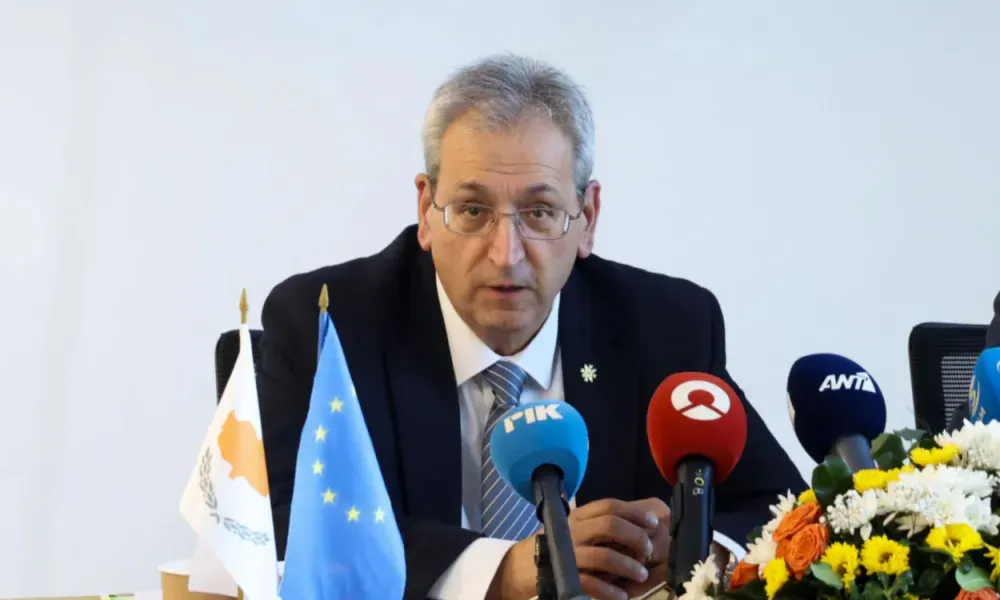

Labour and Social Insurance Minister Marinos Mousiouttas says the government is "not dogmatic" about pension reform and remains open to suggestions, provided they do not alter its core philosophy or endanger the sustainability of the Social Insurance Fund (SIF).
Speaking on Politis podcast "Matia stin Oikonomia" (A Look at the Economy), Mousiouttas outlined the changes expected to affect pensions if the government's plans proceed according to schedule and receive parliamentary approval.
He described the initiative as the first major reform of the pension system in 46 years.
The minister said he is expected to hold meetings with political parties and reiterated that the government is willing to listen to proposals, provided they do not undermine the reform's objectives or the viability of the fund.
At the same time, regarding provident funds, he expressed the belief that a solution can be found if all stakeholders are prepared to make concessions.
"The government has its position," he said, "but is trying to maintain balances between the social partners in an effort to reach a solution."
A necessary reform
Mousiouttas explained that the reform is a necessary measure and was included in President Nikos Christodoulides' election programme.
He recalled that the consultation process began around two years ago under his predecessor, Yiannis Panayiotou, when instructions were given to the actuary to begin the review.
"The first result of the reform will be an increase in pensions," he said.
According to Mousiouttas, increases will vary. For some pensioners the rise could be around 5%, while for others it could reach 55%, depending on factors such as:
- The level of contributions paid.
- The frequency of contributions.
- The length of an individual's working life.
Asked about the overall increase in pension spending, he replied: "No, we don't know," noting that many different variables are involved.
He added that the reform will affect not only pensions but also a range of related benefits.
According to the minister, changes will apply to all categories of pensions, including:
- Old-age pensions.
- Disability pensions.
- Widow's pensions.
Changes will also be made to related allowances, with more favourable arrangements for beneficiaries.
He further noted that the reform incorporates additional measures intended to strengthen pension levels over time.
For example, beyond the existing insurance credits granted for:
- Higher education studies (up to four years).
- Military service.
the reform provides for additional insurance credits for:
- Mothers who are not working or are working part-time, for up to three years per child.
- Persons with disabilities.
- Informal carers.
- Graduates seeking employment for up to one year.
The 12% actuarial reduction
Regarding the 12% actuarial reduction applied to early retirement, the minister said it will be reduced to a rate below 10%, applied horizontally across the board.
However, he stressed that it cannot be abolished.
Doing so, he said, would effectively amount to lowering the retirement age from 65 to 63.
"It is in no way our intention to reduce the retirement age, and no country is moving towards lowering retirement limits," he said.
Asked whether additional factors could be taken into account when determining the level of the actuarial reduction, Mousiouttas said:
"We did not choose that proposal."
He noted that some trade unions had suggested differentiating the reduction according to profession or length of working life.
"That proposal has been removed from the table," he said, while leaving open the possibility that it could return during future discussions.
Draft bill before 15 August
On the draft legislation concerning the first pillar of the pension system, the minister said it will be presented to the social partners before 15 August.
Prior to that, a meeting is scheduled for 5 August with Finance Minister Makis Keravnos.
Asked whether the Finance Ministry supports the reform, Mousiouttas answered in the affirmative, while noting that there remains "one point we wanted to review again".
Poverty threshold
The minister acknowledged that even after the reform there will still be pensioners living below the poverty threshold.
He said the intention is for provident funds to operate as a complementary mechanism, increasing retirees' overall income.
"If someone is below the poverty line, which some people will be, the additional amount received from a provident fund, if it becomes compulsory, may increase their income," he said.
According to Mousiouttas, the poverty threshold currently stands at €1,103, while the minimum wage is €1,088.
He recalled that during the election campaign there had been calls to raise the minimum pension to €1,088.
According to the minister, it is impossible for the minimum pension to reach such levels.
"I wish I could say the pension would reach not €1,088 but €1,588," he said.
He explained that there is a ceiling on the money available to the fund and on the contributions expected to enter it over the next 40 years, which is the time horizon used in the actuarial study.
The minister stressed that it must be understood that, since agreement has already been reached that neither contributions nor the retirement age will increase, the resources available to the fund are fixed.
As a result, any additional benefit proposed in one area would need to be offset by reductions elsewhere.
Sustainability
Responding to questions about the sustainability of the Social Insurance Fund, Mousiouttas said:
"The fund is sustainable, including with the changes being introduced."
He added that a new actuarial study covering a period of 40 to 50 years had been deemed necessary.
Regarding the management of the fund's reserves, he said safeguards would be introduced, including investment diversification, to ensure that workers' and employers' contributions are not put at risk.
The independent authority that will manage the funds, he said, should include people with expertise in the field, integrity and clear guidelines favouring low-risk investments.
"And when we say individuals, these could be firms or whatever else, but there will be a board which, based on practices we see in other countries, will be able to assign portions of the portfolio to specialised organisations for management," he said.
Trade unions, he added, will have an advisory role within the committee.
'I want to and I can'
Asked whether he wants to remain at the helm of the ministry ahead of an anticipated cabinet reshuffle, Mousiouttas replied:
"I want to and I can complete this reform, always in cooperation with the Finance Minister, the President of the Republic, the social partners and the political parties, so that we can provide citizens with what they deserve: a better quality of life, at least as far as the pension system is concerned."