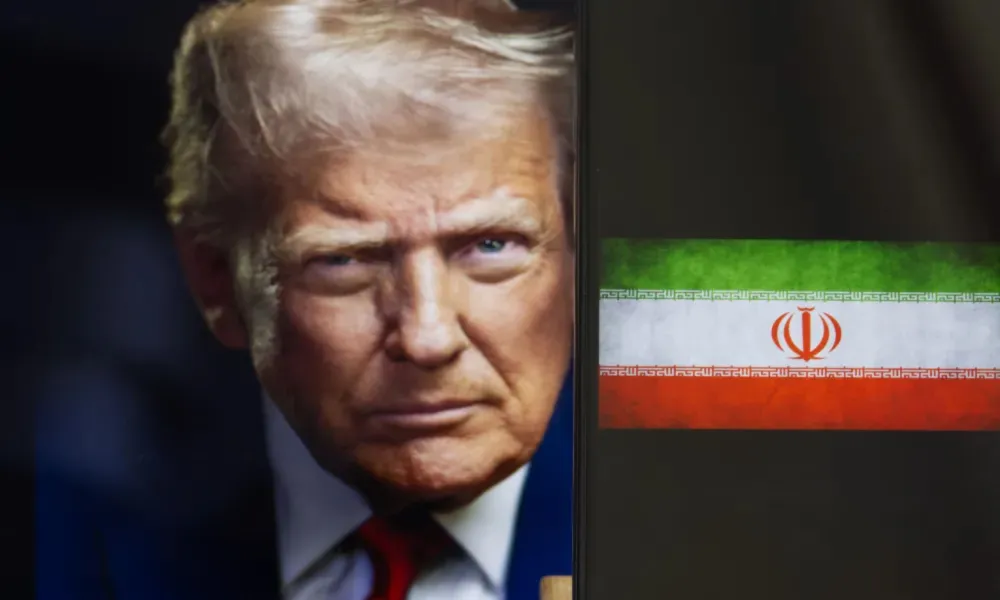

President Donald Trump wants to leave "room" for talks with Iran, his ambassador to the United Nations said on Sunday, against the backdrop of a suspension of US air strikes that has helped push oil prices lower.
"What President Trump is doing right now is leaving room for negotiations. Negotiations are continuing," Mike Waltz told Fox News.
However, he stressed that the US president has not definitively ruled out further escalation against Tehran, despite recent signals of restraint.
"He is keeping all options on the table," Waltz said.
US bombing operations against Iran have been suspended since Friday night, following two weeks of unprecedented strikes after the collapse of the ceasefire that had been in place since April.
Iran, for its part, has not reported any attacks against US military bases in Gulf monarchies allied with Washington. No overnight military alerts were declared in those countries.
"As our strategy is fundamentally based on reciprocity, we have also suspended our operations," said Iranian military spokesperson Mohammad Akraminia.
Financial markets appeared to react positively to the pause in hostilities. In early trading, Brent crude fell nearly 5% to about $92 a barrel, briefly dropping below $90, while West Texas Intermediate (WTI) declined to around $84 a barrel.
As the conflict approaches its fifth month on Tuesday, US media reports have highlighted concerns over ammunition supplies.
According to the New York Times, citing two informed sources, the Trump administration is concerned about declining stockpiles of munitions for Patriot air-defence systems and other missile-defence systems protecting regional allies.
Waltz rejected the concerns.
"The US military has everything it needs to conduct this campaign with maximum effectiveness," he said, adding that additional resources are being deployed to the Middle East.
Support from Netanyahu
From Tehran's perspective, the United States is in a "difficult and unstable" position and may be searching for a "new strategy", according to Akraminia.
Two days before Israeli Prime Minister Benjamin Netanyahu is due to visit Washington, the Iranian military spokesman warned that if Americans "allow themselves to be deceived again" by the Israeli leader and insist on continuing the war, particularly through air strikes, the conflict would "expand geographically".
Netanyahu, meanwhile, said he fully supports Trump's efforts to end what Israel and the United States describe as Tehran's ambitions to acquire nuclear weapons, an accusation Iran has denied for decades.
"If we could achieve that without high-intensity fighting, that would be good," Netanyahu told Fox News.
In Tehran, which has largely avoided bombardment since hostilities resumed in early July, daily life appeared to be returning to normal, with traffic congestion and high temperatures once again dominating daily routines, according to reporters from Agence France-Presse on the ground.
Strait of Hormuz tensions persist
The conflict, which began on 28 February with US and Israeli strikes against Iran, has claimed thousands of lives, primarily in Iran and Lebanon.
It has also disrupted the global economy through the interruption of shipping traffic in the Strait of Hormuz, through which around one-fifth of the world's hydrocarbon consumption normally passes.
Iran has closed the strategic waterway and intends to impose transit fees despite US opposition.
Tehran announced that it held further discussions on Friday and Saturday with Oman, which lies on the opposite side of the strait, regarding its future management.
The preliminary agreement known as the "Islamabad Memorandum of Understanding," signed by Washington and Tehran on 17 June and providing for a 60-day peace negotiation process, collapsed less than a month after taking effect.
Iran subsequently declared the Strait of Hormuz closed once again.
According to Iranian state television, six vessels attempting to transit the waterway without Tehran's permission were stopped during the previous 24 hours.
In response, the United States reimposed a blockade on Iranian ports in the Gulf.
On Sunday, Iranian military-focused news agency Defa Press reported that an oil tanker struck a naval mine after deviating from the route permitted by Tehran along the Iranian coastline.
The report was picked up by other media outlets, although it had not been independently confirmed.
New front in Yemen
Although relative calm has returned to the Gulf over the past two days, hostilities have intensified on another front involving Saudi Arabia and the Iran-backed Houthi rebels in Yemen.
The latest escalation was triggered on 13 July, when Tehran sent an aircraft carrying a Houthi delegation to Sanaa without obtaining Saudi approval, as had become customary over the past decade.
The move was followed by air strikes blamed on Saudi Arabia against Sanaa airport.
In retaliation, the Houthis declared a naval blockade of Saudi Arabia, targeted Saudi oil tankers and, for the first time since 2022, launched attacks inside Saudi territory.
On Saturday, they targeted oil facilities in the kingdom.